The world of cryptocurrency often moves to its own beat, yet it remains profoundly influenced by traditional financial currents. Recently, a significant signal emerged from the U.S. Federal Reserve, suggesting a potentially stable, or even restrictive, monetary policy ahead. This development holds considerable weight for investors across all asset classes, including digital assets. A majority of Federal Reserve officials now anticipate no rate cuts next year, according to a key Wall Street Journal report. This outlook could reshape market dynamics and influence the economic outlook for many months to come. For crypto enthusiasts, understanding these shifts in Fed interest rates becomes crucial for navigating future market volatility.
The Fed’s Unofficial Voice: Decoding Nick Timiraos’s Report
Nick Timiraos, a respected Wall Street Journal reporter, often earns the moniker “the Fed’s unofficial spokesperson.” His insights frequently provide early glimpses into the central bank’s internal discussions and future intentions. His recent report, therefore, carries substantial weight within financial circles. Timiraos explained that a clear majority of U.S. Federal Reserve officials project no rate cuts throughout the upcoming year. This assessment comes directly from their internal discussions and projections. Specifically, his analysis indicated that out of 19 surveyed officials, seven expect no further interest rate reductions this year. Furthermore, two officials anticipate only a single rate cut. This data strongly implies a consensus.
This collective view suggests that, given the current robust economic outlook, most officials do not foresee additional rate cuts next year. Such a stance reflects the Fed’s commitment to its dual mandate. This includes achieving maximum employment and maintaining price stability. Therefore, a prolonged period of higher Fed interest rates appears increasingly likely. Investors must consider these signals carefully. They will undoubtedly influence strategic decisions in the coming months. Understanding the nuances of this reporting is key.
Understanding the Federal Reserve’s Stance on Fed Interest Rates
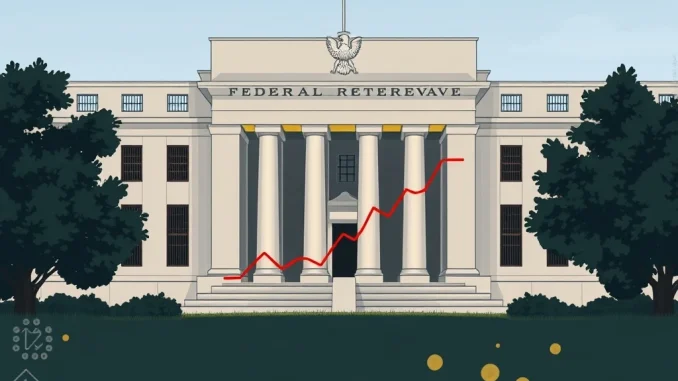
The Federal Reserve employs monetary policy tools to manage economic conditions. Adjusting the federal funds rate stands as its primary mechanism. When the Fed raises interest rates, borrowing becomes more expensive. This action typically slows economic activity and helps combat inflation. Conversely, lowering rates encourages borrowing and spending, stimulating growth. The recent indication of no rate cuts next year suggests the Fed believes current rates are appropriate. They likely see them as effective in cooling inflation without significantly harming employment. This strategy aims for a “soft landing” for the economy. It avoids a severe recession while bringing inflation down to target levels.
Historically, periods of higher interest rates tend to make riskier assets less attractive. This includes many cryptocurrencies. Investors often seek safer, yield-bearing assets like bonds during such times. Consequently, this shift in sentiment can impact crypto valuations. The Fed’s commitment to holding rates steady, therefore, signals a continued environment of higher borrowing costs. Businesses and consumers will feel this impact. Furthermore, this steadfast approach highlights the Fed’s confidence in the economy’s resilience. They believe it can withstand elevated rates. Thus, the path for Fed interest rates seems clear for the near term.
The Broader Economic Outlook Driving Monetary Policy Decisions
The Federal Reserve’s decisions are deeply rooted in its assessment of the overall economic outlook. Several key indicators shape this perspective. A strong labor market, for instance, provides a foundation for sustained consumer spending. If unemployment remains low and wage growth continues, the economy shows resilience. Similarly, inflation data plays a critical role. The Fed aims for a 2% inflation target. If inflation remains stubbornly above this goal, the central bank feels compelled to maintain restrictive monetary policy. Recent economic reports have often exceeded expectations. This includes stronger-than-anticipated GDP growth and persistent consumer demand. These factors collectively reduce the urgency for rate cuts.
This sustained economic strength gives the Fed leeway. It allows them to keep Fed interest rates elevated for longer. They can ensure inflation is fully under control. Officials might fear that cutting rates too soon could reignite price pressures. This cautious approach prioritizes long-term price stability over short-term economic boosts. Therefore, the current robust economic outlook is not just a backdrop. It is the primary driver behind the Fed’s projected path of no rate cuts. This careful balancing act is essential for maintaining trust in the central bank’s ability to manage the economy effectively.
Cryptocurrency Impact: How Higher Rates Influence Digital Assets
The implications of the Fed’s monetary policy extend significantly into the cryptocurrency impact landscape. When Fed interest rates remain high, the cost of capital increases across the board. This directly affects venture capital funding for crypto projects. Startups find it harder and more expensive to raise money. Consequently, innovation and growth within the crypto ecosystem can slow down. Moreover, higher rates make traditional savings accounts and government bonds more attractive. These assets offer guaranteed returns with minimal risk. This contrasts sharply with the inherent volatility of digital currencies. As a result, some investors may reallocate funds from speculative crypto holdings to more stable, interest-bearing investments.
Furthermore, the “risk-on, risk-off” sentiment in markets is heavily influenced by interest rate policy. A “risk-on” environment, often associated with lower rates and abundant liquidity, typically favors cryptocurrencies. Conversely, a “risk-off” environment, characterized by higher rates and tighter liquidity, prompts investors to shed riskier assets. The signal of no rate cuts firmly positions the market in a “risk-off” or at least a “risk-neutral” stance. This environment challenges the narrative of quick gains in crypto. It instead emphasizes long-term value and utility. Therefore, the cryptocurrency impact of sustained higher rates requires careful consideration by all market participants.
Navigating the Path Forward: What No Rate Cuts Means for Investors
The Federal Reserve’s projected path of no rate cuts for the coming year provides a clear signal for investors. It suggests a period of sustained vigilance against inflation. This means that borrowing costs will likely remain elevated. For traditional markets, this could imply continued pressure on corporate earnings and potentially a slower pace of economic growth. Growth stocks, which rely heavily on future earnings, might face particular headwinds. In contrast, value stocks or those with strong cash flows could prove more resilient. Investors should re-evaluate their portfolios in light of this persistent monetary policy.
For the cryptocurrency impact, this outlook reinforces the need for strategic thinking. Projects with strong fundamentals, clear utility, and robust development teams may be better positioned to weather a period of tighter liquidity. Speculative assets, however, might struggle to find upward momentum. Traders and investors should adjust their expectations for rapid price appreciation. Instead, they might focus on accumulation strategies or projects demonstrating real-world adoption. Ultimately, the Fed’s firm stance on Fed interest rates shapes the broader financial landscape. Understanding this landscape is paramount for informed decision-making in both traditional and digital asset markets. This clear signal helps define the investment climate.
Potential Shifts in the Economic Outlook: What Could Change the Fed’s Mind?
While the current consensus points to no rate cuts, economic conditions are dynamic. Several factors could potentially alter the Federal Reserve’s monetary policy stance. A significant and unexpected downturn in the labor market, for instance, could prompt a re-evaluation. If unemployment rates rise sharply, or wage growth stalls, the Fed might consider easing policy. Similarly, a faster-than-anticipated decline in inflation, consistently moving towards the 2% target, could also open the door for rate reductions. Unexpected geopolitical events or severe financial market instability could also force the Fed’s hand. These external shocks often require a swift policy response.
Conversely, a re-acceleration of inflation, perhaps due to supply chain disruptions or robust demand, could lead to even higher Fed interest rates. This would further solidify the “higher for longer” narrative. The Fed continuously monitors a wide array of economic data. Their decisions are data-dependent. Therefore, while the current economic outlook suggests stability, flexibility remains a core tenet of their approach. Investors must stay attuned to incoming economic reports and Fed communications. These will provide crucial clues about any potential shifts. The future of no rate cuts is contingent on these evolving economic realities.
Conclusion: Navigating a Stable Rate Environment
The message from the Federal Reserve, as relayed by Nick Timiraos, is clear: a majority of officials anticipate no rate cuts next year. This firm stance on Fed interest rates reflects confidence in a strong economic outlook and a commitment to combating inflation. For the cryptocurrency impact, this translates into a continued environment of higher borrowing costs and potentially reduced liquidity. Investors in digital assets must therefore adapt their strategies. Focus on fundamental strength and long-term utility. Understanding this prevailing monetary policy is essential for making informed decisions. The financial landscape is shaped by these crucial signals. Staying informed helps investors navigate potential challenges and opportunities.
Frequently Asked Questions (FAQs)
Q1: Who is Nick Timiraos and why is his report significant?
A1: Nick Timiraos is a Wall Street Journal reporter often called the “Fed’s unofficial spokesperson.” His reports are significant because they frequently offer early insights into the Federal Reserve’s internal discussions and future policy intentions, making them closely watched by financial markets.
Q2: What does “no rate cuts” next year mean for the economy?
A2: “No rate cuts” next year means the Federal Reserve expects to maintain current Fed interest rates at their elevated levels. This suggests the Fed believes the economy is strong enough to handle these rates without significant slowdowns, and it remains committed to bringing inflation down to its target.
Q3: How do higher interest rates impact the cryptocurrency market?
A3: Higher interest rates generally lead to a negative cryptocurrency impact. They increase the cost of borrowing, reduce liquidity in financial markets, and make traditional, less risky investments (like bonds) more attractive. This can divert capital away from speculative assets like cryptocurrencies, potentially leading to price stagnation or declines.
Q4: What is the Federal Reserve’s primary goal with its monetary policy?
A4: The Federal Reserve’s primary goal with its monetary policy is to achieve maximum employment and maintain price stability (i.e., control inflation). By adjusting interest rates and other tools, the Fed aims to foster sustainable economic growth without excessive price increases.
Q5: What factors could lead the Fed to change its stance on rate cuts?
A5: The Fed’s stance could change if there are significant shifts in the economic outlook. Key factors include a substantial weakening of the labor market, a faster-than-expected decline in inflation, or unforeseen economic shocks like a severe recession or financial instability. The Fed’s decisions are always data-dependent.
Q6: Should crypto investors be concerned about this outlook?
A6: Crypto investors should certainly be aware of this economic outlook. While not a direct cause for panic, it signals a period where market liquidity might be tighter and risk appetite lower. This environment often favors projects with strong fundamentals and real-world utility over purely speculative ventures. Adjusting investment strategies to account for sustained higher Fed interest rates is a prudent approach.