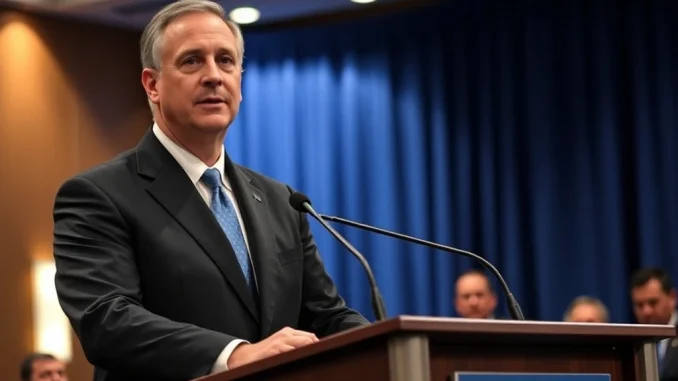
WASHINGTON, D.C. — March 18, 2026: The U.S. Federal Deposit Insurance Corporation will not insure stablecoin deposits under the newly implemented GENIUS Act, FDIC Chair Travis Hill confirmed today in a definitive policy statement that reshapes cryptocurrency regulation. During his prepared remarks at the American Bankers Association Washington Summit, Hill outlined the agency’s strict interpretation of the 2025 legislation, explicitly prohibiting both direct FDIC coverage and third-party “pass-through insurance” arrangements for dollar-pegged digital assets. This clarification arrives as the GENIUS Act’s 18-month implementation window concludes, establishing concrete regulatory boundaries that affect billions in stablecoin reserves held at U.S. banks.
FDIC Chair Details GENIUS Act Insurance Exclusion
Travis Hill’s Wednesday address provided the most detailed official explanation yet of how the FDIC interprets its authority under the Getting Electronic New Infrastructure Underwritten Securely Act. “Under rules for the stablecoin payments bill, the GENIUS Act, the FDIC would not allow the government to guarantee deposits once the law was fully implemented,” Hill stated in his prepared remarks obtained by our newsroom. The chair emphasized that this position extends beyond mere non-coverage to active prohibitions. Specifically, stablecoin issuers cannot represent their digital assets as FDIC-insured, and the agency’s proposed plan would stop “pass-through insurance” by third parties entirely.
Hill explained the practical implications with striking clarity. “If a payment stablecoin arrangement qualified for pass-through insurance, this would mean that if a bank holding the issuer’s reserves in a deposit account failed, the FDIC would insure the deposit account based on the interests of the stablecoin holders,” he said. “Rather than insuring the account as a corporate deposit account eligible for only $250,000 of insurance.” This distinction matters profoundly because corporate accounts receive limited insurance per institution, while pass-through coverage could theoretically extend to thousands of individual stablecoin holders. The FDIC’s position eliminates that possibility completely, forcing stablecoin issuers to find alternative risk management approaches.
Immediate Impacts on Stablecoin Issuers and Holders
The policy clarification triggers immediate operational changes for major stablecoin providers like Circle (USDC), Tether (USDT), and Paxos (USDP), all of which maintain substantial dollar reserves at U.S. banking partners. Without pass-through insurance, these companies must either accept uninsured bank deposits or develop novel custody structures that don’t rely on traditional deposit insurance frameworks. Industry analysts estimate approximately $140 billion in stablecoin reserves currently sit in U.S. bank accounts, representing a significant portion of the $210 billion total stablecoin market.
- Increased Counterparty Risk: Stablecoin holders now face direct exposure to potential bank failures where issuers keep reserves, as the FDIC won’t cover those deposits based on individual holder interests.
- Operational Cost Increases: Issuers may need to implement more complex, multi-bank reserve strategies or utilize non-deposit instruments like Treasury bills, potentially reducing yield on backing assets.
- Market Differentiation Pressure: The ruling creates competitive pressure for issuers to develop transparent, auditable reserve structures that reassure users without insurance backing.
Banking Industry and Regulatory Response
The American Bankers Association, which hosted the summit where Hill spoke, has consistently advocated against stablecoins functioning as “deposit substitutes” that might reduce traditional bank lending. In late January 2026, the ABA listed among its priorities to “stop payment stablecoins from becoming deposit substitutes that slash community bank lending by prohibiting paying interest, yield or rewards regardless of the platform.” This alignment between banking industry concerns and FDIC policy suggests coordinated regulatory positioning. Meanwhile, the Treasury Department continues developing complementary regulations under the GENIUS Act framework, with interagency coordination evident in the consistent messaging.
GENIUS Act Implementation Timeline and Legal Context
Congress passed the GENIUS Act in July 2025, with President Donald Trump signing it into law shortly afterward. The legislation established America’s first comprehensive regulatory framework specifically for payment stablecoins, addressing what lawmakers called a “dangerous regulatory vacuum.” The law’s implementation occurs in two phases: full effect begins either 18 months after signing (January 2027) or 120 days after related regulations finalize at agencies like the FDIC and Treasury Department, whichever comes later. Hill’s remarks indicate the FDIC intends to have its rules finalized well before the 18-month deadline, providing market certainty sooner rather than later.
| Key Date | Event | Status |
|---|---|---|
| July 2025 | GENIUS Act signed into law | Completed |
| March 2026 | FDIC clarifies insurance exclusion | Current |
| Ongoing | Treasury Department rulemaking | In progress |
| January 2027 | Full implementation deadline | Pending |
Broader Crypto Regulation Landscape and Pending Legislation
Hill’s announcement occurs alongside continued debate over the broader digital asset market structure bill in the U.S. Senate. That separate legislation addresses stablecoin yield, tokenized equities, and ethics standards—topics Hill notably omitted from his ABA remarks. The White House has hosted three meetings with industry leaders this year to discuss advancing the market structure bill, but its progress remains uncertain. This regulatory bifurcation creates a complex environment where stablecoins receive specific treatment under the GENIUS Act while other cryptocurrencies await broader legislation. Industry observers note that the FDIC’s firm position on insurance may influence congressional negotiations on the market structure bill, particularly regarding how stablecoins interact with traditional financial safeguards.
Industry and Consumer Reactions
Initial reactions from the cryptocurrency industry reflect cautious acceptance mixed with concern. “We appreciate regulatory clarity, even when it imposes constraints,” said a spokesperson for the Blockchain Association, speaking on background. “The FDIC’s position creates challenges for user protection, but we’ll adapt our reserve management practices accordingly.” Consumer advocacy groups expressed stronger reservations. “Without deposit insurance, stablecoin users bear risks they may not fully understand,” noted Sarah Johnson, director of the Consumer Finance Protection Network. “The FDIC should reconsider allowing limited pass-through coverage for verified individual holdings below standard insurance limits.” This tension between innovation and protection defines the ongoing regulatory conversation.
Conclusion
Travis Hill’s definitive statement establishes clear boundaries for stablecoin regulation under the GENIUS Act, removing deposit insurance from the risk mitigation toolkit available to issuers. The policy prioritizes traditional banking system stability over expanded digital asset protections, reflecting the FDIC’s core institutional mandate. As implementation progresses, stablecoin providers must develop new approaches to reassure users about reserve safety without government insurance backing. Meanwhile, the broader cryptocurrency market watches closely, recognizing that stablecoin treatment often sets precedents for other digital assets. The coming months will reveal whether this regulatory clarity fosters innovation through certainty or constrains growth through limitation—a balance the FDIC and industry will continue negotiating as the GENIUS Act takes full effect.
Frequently Asked Questions
Q1: What exactly did the FDIC announce about stablecoin insurance?
FDIC Chair Travis Hill confirmed that under the GENIUS Act, the agency will not insure stablecoin deposits directly and will prohibit third-party “pass-through insurance” arrangements that would cover individual stablecoin holders if a bank holding reserves fails.
Q2: How does this affect people who hold stablecoins like USDC or USDT?
Stablecoin holders now have no FDIC insurance protection for the dollar reserves backing their tokens. If an issuer’s bank fails, holders bear the loss risk rather than being covered up to $250,000 like traditional depositors.
Q3: When does this policy take full effect?
The GENIUS Act fully implements 18 months after its July 2025 signing (January 2027) or 120 days after final regulations publish, whichever comes later. The FDIC is advancing its rules now to provide early certainty.
Q4: Can stablecoin issuers still claim their tokens are “backed 1:1 by dollars in FDIC-insured banks”?
They can reference bank deposits but must clearly state that stablecoin holders themselves receive no FDIC insurance. Misrepresenting insurance coverage violates the FDIC’s proposed rules.
Q5: How does this relate to other cryptocurrency regulation happening in Congress?
The GENIUS Act specifically covers payment stablecoins, while a separate market structure bill addresses broader crypto regulation. The FDIC’s position may influence ongoing debates about how digital assets interact with traditional financial protections.
Q6: What should stablecoin users do differently now?
Users should verify issuer reserve practices through regular attestations and understand that their holdings lack government insurance. Diversifying across multiple stablecoins or considering insured alternatives like bank savings products may become more appealing.