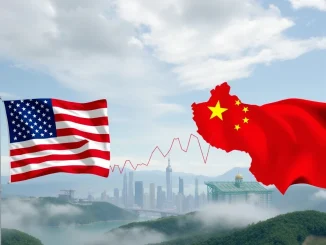
The global economic landscape is always shifting, and recent pronouncements from the European Union have sent a clear signal of impending turbulence. While the cryptocurrency market often dances to its own beat, it’s crucial to understand how broader macroeconomic shifts can create ripples across all asset classes. The latest news from Brussels regarding potential EU tariffs on U.S. imports is a prime example of such a shift, carrying the potential for significant disruption and uncertainty.
The Looming Threat of EU Tariffs: A €72 Billion Warning Shot
Maroš Šefčovič, the European Commissioner for Trade and Economic Security, recently delivered a stark warning: the European Union stands ready to unleash a staggering €72 billion ($84 billion) in additional retaliatory tariffs on U.S. imports. This isn’t a mere hypothetical; it’s a contingency plan, meticulously prepared, should crucial trade talks with the United States collapse. This aggressive stance underscores the EU’s determination to protect its economic interests in the face of what it perceives as unfair trade practices.
The context for this impending showdown is rooted in previous actions taken by the U.S. government. Former U.S. President Donald Trump had previously announced his intention to impose a 30% tariff on certain EU imports, set to begin on August 1. This move, part of a broader ‘America First’ trade policy, ignited a series of tit-for-tat exchanges that have characterized the transatlantic trade relationship in recent years. The EU’s latest threat is a direct response, aiming to apply pressure and achieve a more equitable resolution.
Understanding the US Trade War Context: How Did We Get Here?
The concept of a US trade war with key allies, particularly the EU, isn’t new. It has roots in long-standing disputes and more recent protectionist policies. To fully grasp the current situation, it’s helpful to look at the historical backdrop:
- Steel and Aluminum Tariffs: In 2018, the U.S. imposed tariffs on steel and aluminum imports from various countries, including EU members, citing national security concerns. The EU responded with its own retaliatory duties on U.S. products like Harley-Davidson motorcycles, bourbon, and Levi’s jeans.
- Aircraft Subsidies Dispute: For decades, the U.S. and EU have been locked in a dispute over government subsidies to aircraft manufacturers Boeing and Airbus. Both sides have imposed tariffs on billions of dollars worth of goods as a result of World Trade Organization (WTO) rulings.
- Digital Services Taxes: More recently, several EU countries have moved to implement digital services taxes on large tech companies, many of which are U.S.-based. The U.S. views these taxes as discriminatory and has threatened retaliatory tariffs in response.
These ongoing points of contention have created an environment of distrust and economic brinkmanship. The current threat of €72 billion in retaliatory tariffs is a culmination of these unresolved issues, signaling that the EU is prepared to escalate if its concerns are not addressed through negotiation.
Maroš Šefčovič’s Stance: A Firm Negotiation Tactic?
As the European Commissioner for Trade and Economic Security, Maroš Šefčovič is at the forefront of the EU’s trade strategy. His recent statement is more than just a warning; it’s a carefully calculated move designed to strengthen the EU’s hand at the negotiating table. By clearly outlining the potential consequences of failed talks, the EU aims to:
- Signal Resolve: Demonstrate that the EU is united and determined to defend its economic interests, rather than passively accepting unilateral U.S. tariffs.
- Create Leverage: Provide a strong incentive for the U.S. to engage constructively in trade discussions and seek a mutually agreeable solution.
- Protect Domestic Industries: Shield European businesses and workers from the adverse effects of U.S. tariffs by imposing equivalent costs on U.S. imports.
Šefčovič’s role highlights the EU’s shift towards a more assertive trade policy, emphasizing strategic autonomy and the protection of its internal market. This proactive approach seeks to avoid a scenario where European industries are unfairly disadvantaged by protectionist measures from other major economies.
Economic Fallout: Who Pays for Retaliatory Tariffs?
When tariffs are imposed, it’s often the consumers and businesses in the imposing country that bear the ultimate cost. While tariffs are levied on imports, the increased cost is typically passed down the supply chain. Here’s a breakdown of potential impacts:
Impact on Businesses:
- Increased Input Costs: European manufacturers relying on U.S. components or raw materials would face higher import costs, potentially reducing their competitiveness.
- Reduced Export Opportunities: U.S. exporters to the EU would find their products more expensive and less attractive to European buyers, leading to decreased sales.
- Supply Chain Disruption: Businesses might scramble to find alternative suppliers or markets, leading to inefficiencies and higher operational costs.
Impact on Consumers:
- Higher Prices: Consumers would likely see increased prices for imported goods affected by the tariffs, reducing their purchasing power.
- Reduced Choice: Some products might become too expensive or even disappear from shelves if businesses cease importing them due to tariffs.
Impact on Global Economy:
A full-blown US trade war with the EU could have wider ramifications, slowing global economic growth, disrupting international trade flows, and creating significant market uncertainty. It could also encourage other countries to adopt protectionist measures, leading to a fragmented global trading system.
Consider the potential ripple effect across various sectors:
| Sector | Potential Impact (EU perspective) | Potential Impact (US perspective) |
|---|---|---|
| Agriculture | Higher costs for U.S. agricultural imports, potential boost for EU farmers but retaliatory tariffs could hit EU exports to U.S. | Reduced demand for U.S. agricultural exports to EU, hurting farmers. |
| Automotive | Increased cost for U.S.-made auto parts, potential for EU tariffs on U.S. vehicles. | EU tariffs could make U.S. cars uncompetitive in Europe. |
| Tech/Digital | Increased cost for U.S. tech hardware, potential for digital services tax disputes to escalate. | Reduced market access for U.S. tech giants in Europe. |
| Luxury Goods | Potential for EU tariffs on U.S. luxury goods, affecting high-end consumer products. | Reduced demand for U.S. luxury exports to Europe. |
Navigating Trade Tensions: What Does This Mean for Global Markets?
The prospect of escalating trade tensions between two of the world’s largest economic blocs naturally sends jitters through financial markets. Investors typically dislike uncertainty, and a trade war introduces a significant amount of it. Here’s how this situation could impact global markets, including a subtle connection to the crypto space:
Traditional Markets:
- Stock Market Volatility: Companies with significant exposure to U.S.-EU trade could see their stock prices fluctuate wildly. Export-oriented industries and those relying on international supply chains are particularly vulnerable.
- Currency Fluctuations: The Euro and U.S. Dollar could experience significant volatility as market participants react to trade news and the perceived strength or weakness of each economy.
- Safe-Haven Demand: In times of uncertainty, investors often flock to traditional safe-haven assets like gold and government bonds, potentially driving up their prices.
The Crypto Connection:
While cryptocurrencies like Bitcoin and Ethereum are often seen as uncorrelated assets, they are not entirely immune to broader macroeconomic forces. A significant escalation in the US trade war could have indirect effects:
- Risk-Off Sentiment: If traditional markets experience a downturn due to trade war fears, a ‘risk-off’ sentiment could spread, potentially leading some investors to reduce their exposure to more volatile assets, including cryptocurrencies.
- Inflationary Pressures: Tariffs can lead to higher prices for goods. If sustained inflation becomes a concern in major economies, it could influence central bank policies, which in turn could impact liquidity and investor appetite for risk assets.
- Search for Alternatives: Conversely, some might view cryptocurrencies as a hedge against traditional financial instability or as an alternative store of value if confidence in fiat currencies or traditional markets wanes due to prolonged trade conflicts.
It’s a complex interplay, but the general principle is that global economic stability provides a more favorable environment for all markets to thrive. Disruptions, like those threatened by EU tariffs, introduce friction that can impact investment decisions across the board.
What’s Next? Navigating the Diplomatic Tightrope
The immediate future hinges on the outcome of the trade talks. While the threat of retaliatory tariffs is serious, it’s also a powerful tool to bring parties to the negotiating table. Both the EU and the U.S. have a vested interest in avoiding a full-blown trade war, which would harm their respective economies and global trade.
Potential Scenarios:
- Successful Negotiation: The ideal outcome, where both sides find common ground, perhaps by rolling back existing tariffs or agreeing to new trade frameworks.
- Partial Agreement: A compromise where some issues are resolved, but others remain, leading to a de-escalation but not a complete resolution.
- Escalation: If talks fail, the EU could proceed with its €72 billion tariffs, leading to further U.S. retaliation and a deepening of the trade conflict.
Monitoring statements from key figures like Maroš Šefčovič and the U.S. Trade Representative will be crucial for understanding the direction of these critical negotiations.
Conclusion: The Imperative of Global Economic Harmony
The EU’s readiness to impose €72 billion in retaliatory tariffs on U.S. imports marks a critical juncture in transatlantic trade relations. While the immediate focus is on traditional goods and services, the ripple effects of a potential US trade war are far-reaching, impacting global economic stability and, by extension, influencing sentiment across all financial markets, including the dynamic world of cryptocurrencies. The stakes are incredibly high, not just for the economies of the EU and U.S., but for the entire international trading system.
The diplomatic dance between Brussels and Washington will determine whether this warning shot leads to a constructive resolution or spirals into a damaging trade conflict. For investors and businesses worldwide, staying informed about these trade tensions is paramount, as the decisions made in the coming weeks could shape the economic landscape for years to come. Ultimately, cooperation and open dialogue remain the most effective path to sustained global prosperity.
Frequently Asked Questions (FAQs)
Q1: What exactly are retaliatory tariffs?
Retaliatory tariffs are taxes imposed by one country on the imports of another country in response to the latter’s own tariffs or perceived unfair trade practices. They are designed to exert economic pressure and encourage the offending country to reverse its protectionist measures or come to a trade agreement.
Q2: How much are the EU’s proposed retaliatory tariffs?
The European Union is preparing to impose €72 billion (approximately $84 billion) in additional retaliatory tariffs on U.S. imports if trade talks fail.
Q3: Who is Maroš Šefčovič and what is his role?
Maroš Šefčovič is the European Commissioner for Trade and Economic Security. In this role, he is responsible for leading the EU’s trade policy, negotiating trade agreements, and ensuring the EU’s economic interests are protected on the global stage. His recent statement highlights the EU’s assertive stance on trade disputes.
Q4: How could a US-EU trade war affect the global economy?
A full-scale US-EU trade war could significantly slow global economic growth, disrupt international supply chains, increase prices for consumers, reduce corporate profits, and lead to widespread market volatility. It could also encourage other nations to adopt protectionist policies, further fragmenting global trade.
Q5: Is there a direct link between these trade tensions and cryptocurrency markets?
While there isn’t always a direct, immediate correlation, global economic instability and increased market uncertainty stemming from trade tensions can indirectly impact cryptocurrency markets. A ‘risk-off’ sentiment in traditional finance might lead investors to reduce exposure to all volatile assets, including crypto. Conversely, some might view crypto as a hedge against traditional financial system instability in extreme scenarios.
Q6: What specific U.S. products might be targeted by EU tariffs?
While the exact list of products for the proposed €72 billion tariffs hasn’t been fully disclosed, past EU retaliatory tariffs have targeted iconic U.S. goods such as Harley-Davidson motorcycles, bourbon, Levi’s jeans, and various agricultural products. The aim is often to select products that create political pressure within the U.S. and maximize economic impact.