The cryptocurrency world often buzzes with news of significant transactions. Recently, a notable event captured the attention of on-chain analysts. An anonymous Ethereum whale has made a substantial move, injecting millions into the ETH market. This strategic maneuver highlights key aspects of large-scale crypto investment behavior.
Understanding the Latest ETH Accumulation
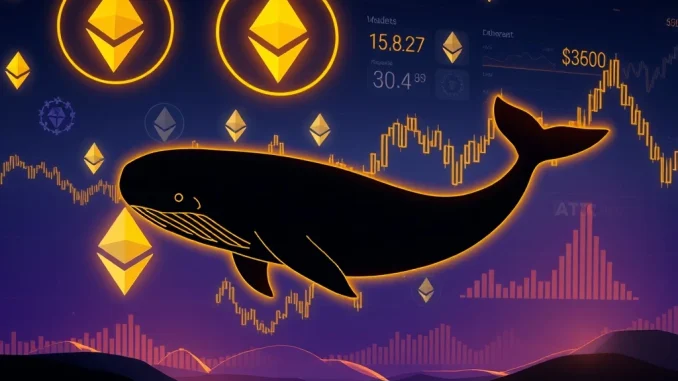
An anonymous Ethereum whale, identified by the address 0xAeA, recently made headlines. This entity accumulated a staggering 4,332.14 ETH. This amount is worth approximately $17.17 million. The accumulation occurred over a mere three-day period. On-chain analyst ai_9684xtpa first reported these significant movements. Such large transactions often signal strong conviction from major players.
The whale executed two primary withdrawals from the OKX exchange. Initially, on October 15, 1,506 ETH was moved. This first withdrawal happened at an average price of $4,096.82 per ETH. Subsequently, an additional 2,825 ETH was withdrawn. This second transaction occurred at an average price of $3,892.21. Therefore, the whale’s average purchase price across both transactions stands at $3,963.36. Withdrawals from exchanges generally suggest an intent to hold assets. This action reduces the immediate selling pressure on the market. Consequently, it often indicates a long-term bullish outlook.
The Significance of On-Chain Analysis
On-chain analysis provides crucial insights into market dynamics. It examines public blockchain data. This data includes transaction volumes, whale movements, and exchange flows. Analysts use these metrics to predict potential market shifts. For instance, large withdrawals from exchanges often precede price increases. Conversely, significant deposits to exchanges can indicate upcoming selling pressure. This makes on-chain data invaluable for informed decision-making.
Tracking whale activity is particularly important. Whales are individuals or entities holding vast amounts of cryptocurrency. Their movements can influence market sentiment and price action. Their actions are often seen as indicators of confidence or concern. Thus, observing their accumulation or distribution patterns helps investors understand potential future market trends. The recent ETH accumulation by 0xAeA serves as a prime example of such impactful activity.
What Drives an Ethereum Whale’s Strategic Moves?
Several factors might motivate an Ethereum whale to accumulate such a large amount of ETH. These sophisticated investors typically conduct extensive research. They consider both fundamental and technical indicators. Key drivers often include:
- Long-term Conviction: Whales may believe in Ethereum’s fundamental strength. They might see its potential for future growth.
- Market Timing: They could be positioning themselves for an anticipated price rally. Their timing often involves buying during dips.
- Ecosystem Development: Ongoing upgrades like Ethereum 2.0 (now the Merge and subsequent updates) can attract capital. These developments enhance the network’s scalability and efficiency.
- Institutional Interest: Increasing institutional adoption of Ethereum could signal future demand. Whales often front-run this institutional flow.
This whale’s actions suggest a strong belief in Ethereum’s long-term value. Such confidence can positively influence broader market sentiment. It also reinforces the idea that smart money is actively engaging with ETH.
Impact on Crypto Investment Strategies
The actions of a large Ethereum whale can significantly influence individual crypto investment strategies. While retail investors should not blindly follow whales, their movements offer valuable data points. Here are some considerations:
- Validation of Outlook: Whale accumulation can validate a bullish outlook on ETH. It suggests that well-resourced entities share similar sentiments.
- Supply Dynamics: Removing ETH from exchanges reduces the available supply. This can create upward price pressure if demand remains constant or increases.
- Market Psychology: News of whale activity often generates positive sentiment. This can attract more buyers to the market.
- Risk Assessment: Investors should still conduct their own due diligence. Whale movements are just one piece of the puzzle.
Diversification remains crucial. Relying solely on whale movements is not a sound investment strategy. Instead, combine this information with other forms of analysis. This includes fundamental analysis, technical analysis, and macroeconomic factors. Therefore, a holistic approach is always recommended.
Analyzing Broader Market Trends for Ethereum
The recent ETH accumulation occurs within a larger context of evolving market trends. Ethereum continues to be a dominant force in the decentralized finance (DeFi) and NFT sectors. Its robust ecosystem supports thousands of decentralized applications (dApps). This broad utility drives consistent demand for ETH. Furthermore, the transition to a Proof-of-Stake consensus mechanism (Ethereum 2.0/The Merge) has significantly altered its economic model. This change makes ETH a deflationary asset under certain conditions, further attracting investors.
Global macroeconomic conditions also play a role. Factors like inflation concerns, interest rate changes, and geopolitical events influence the broader crypto market. Ethereum, as a major asset, is not immune to these external pressures. However, its strong fundamentals and continuous innovation often help it weather market volatility. The actions of whales like 0xAeA often reflect their interpretation of these complex market forces. They position themselves accordingly to capitalize on anticipated movements.
The Role of OKX in Whale Transactions
OKX served as the origin for the whale’s significant ETH withdrawals. This highlights the role of major cryptocurrency exchanges in facilitating large-scale transactions. Exchanges provide the liquidity and infrastructure necessary for such movements. However, the decision to withdraw funds from an exchange to a private wallet is telling. It signifies a shift from a trading mindset to a holding or ‘HODLing’ strategy. This move reduces counterparty risk associated with keeping assets on an exchange. It also often implies a long-term bullish conviction, as previously noted.
Many institutional and large individual investors prefer self-custody for substantial holdings. This practice enhances security and control over their assets. The average price paid by the whale, $3,963.36, indicates a strategic entry point. This price point was observed during a period of considerable market activity for Ethereum. Therefore, the whale likely identified this as an opportune moment for a substantial investment. This reinforces the idea of calculated risk-taking by experienced market participants.
What This ETH Accumulation Means for the Future
The recent ETH accumulation by this anonymous whale could be a harbinger of future price action. While not a guarantee, such large-scale buying often precedes periods of upward momentum. It indicates confidence from deep-pocketed investors. Their actions can create a ripple effect throughout the market. This can encourage smaller investors to follow suit. Consequently, this can lead to increased demand and potentially higher prices.
However, the cryptocurrency market remains highly volatile. Prices can fluctuate rapidly based on various factors. Regulatory news, technological advancements, and broader economic conditions all play a part. Investors should approach the market with caution. Always conduct thorough research before making any investment decisions. The whale’s move provides valuable data. Yet, it does not guarantee specific future outcomes. It merely offers a glimpse into the strategies of a significant market participant.
In conclusion, the strategic Ethereum whale accumulation of over $17 million in ETH is a significant event. It provides valuable insights through on-chain analysis. This action suggests a strong bullish sentiment from a major player. It impacts potential market trends and influences crypto investment perspectives. While not a definitive signal, it certainly adds an intriguing layer to the ongoing Ethereum narrative.
Frequently Asked Questions (FAQs)
Q1: What is an Ethereum whale?
A1: An Ethereum whale is an individual or entity holding a very large amount of Ethereum (ETH). These holders possess enough capital to significantly influence market prices through their buying or selling activities. Their transactions are closely monitored by on-chain analysts.
Q2: Why are whale movements important for crypto investment?
A2: Whale movements are important because they can indicate shifts in market sentiment and potential future price direction. Large accumulations often suggest a bullish outlook, while significant selling could signal a bearish trend. Their actions can move markets due to the sheer volume of their holdings.
Q3: What does ‘on-chain analysis’ mean in cryptocurrency?
A3: On-chain analysis involves examining publicly available data directly from a blockchain. This includes transaction volumes, addresses holding large amounts of crypto, exchange inflows/outflows, and network activity. It helps analysts understand fundamental market dynamics and predict future price movements.
Q4: What does it mean when a whale withdraws ETH from an exchange?
A4: When a whale withdraws ETH from an exchange to a private wallet, it typically indicates an intent to hold the asset for the long term. This reduces the immediate selling pressure on the exchange. It often signals a bullish conviction, as the whale is taking custody rather than leaving it available for quick trading.
Q5: Should I follow an Ethereum whale’s investment strategy?
A5: While whale movements provide valuable insights, it is generally not advisable to blindly follow their investment strategies. Whales have different risk tolerances, financial goals, and information access. Individual investors should conduct their own thorough research and analysis, diversifying their portfolios based on their personal financial situation and risk appetite.