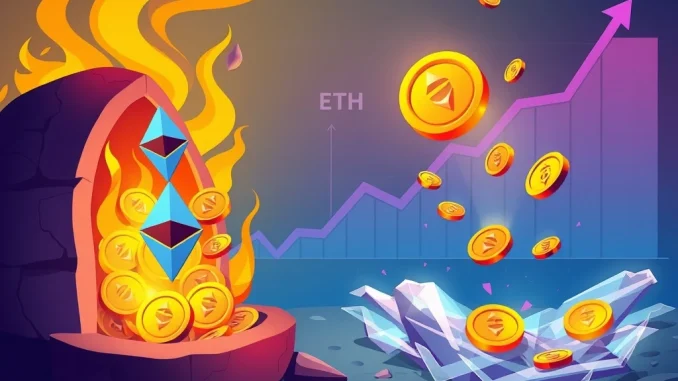
Imagine a digital asset becoming scarcer by the day, not just through mining, but through deliberate destruction and unforeseen circumstances. This isn’t a fantasy; it’s the current reality for Ethereum (ETH), the world’s second-largest cryptocurrency. Recent Ethereum news reveals a significant shift in its economic model: over 6 million ETH, representing more than 5% of its total supply, has been permanently removed from circulation. This dramatic ETH supply reduction, stemming from both accidental losses and a deflationary burning mechanism, is now fueling intense speculation about a potential surge in Ethereum price, with many eyes set on the elusive $4,000 mark. Could this unprecedented scarcity truly propel ETH to new heights? Let’s dive deep into the forces reshaping Ethereum’s future.
The Power of Scarcity: Understanding ETH Supply Reduction
The core of Ethereum’s evolving narrative lies in its shrinking supply. It’s not just about what’s being created, but what’s being taken out. A staggering 6 million Ether (ETH) has effectively vanished from the circulating supply, a figure that commands attention. This significant ETH supply reduction is a combination of two powerful forces: permanent losses and the network’s intrinsic burning mechanism.
Permanent Losses: The Unrecoverable ETH
Approximately 913,000 ETH, valued at over $3.43 billion (based on a $3,800 ETH price), is now permanently inaccessible. These losses are not intentional but rather the result of various factors, including multi-signature wallet freezes, smart contract bugs, and user errors (e.g., sending ETH to an incorrect or non-existent address). This ETH is essentially ‘gone forever,’ contributing to the overall scarcity.
Protocol Burns: EIP-1559’s Deflationary Impact
The more substantial portion of the reduction comes from protocol-driven burns. Since the implementation of Ethereum Improvement Proposal 1559 (EIP-1559) in August 2021, a significant part of the transaction fees (the ‘base fee’) is burned instead of being paid entirely to miners. To date, over 5.3 million ETH has been burned via this mechanism. This ongoing process directly contributes to Ethereum’s deflationary aspirations, making it a truly unique economic model in the crypto space.
Combined, these two factors account for nearly 6 million ETH, exceeding 5% of Ethereum’s total issuance, effectively locked out of circulation. This scarcity narrative is a powerful driver, particularly in a market where supply and demand dynamics play a crucial role in asset valuation.
| Source of Reduction | Amount (ETH) | Value (approx. at $3,800) | Description |
|---|---|---|---|
| Permanent Losses | 913,000 | ~$3.43 billion | ETH rendered inaccessible due to multi-sig freezes, contract bugs, or user errors. |
| Protocol Burns (EIP-1559) | 5,300,000 | ~$20.14 billion | ETH permanently removed from circulation as part of transaction fees. |
| Total Effective Reduction | ~6,213,000 | ~$23.57 billion | Over 5% of total ETH issuance removed from circulation. |
Ethereum Burn Mechanism: Fueling a Deflationary Future
The EIP-1559 upgrade fundamentally changed how transaction fees are handled on the Ethereum network. Before this upgrade, users would bid for transaction inclusion, and the entire fee would go to the miner. With EIP-1559, a ‘base fee’ is dynamically adjusted based on network congestion and is burned, while users can still add an optional ‘priority fee’ to incentivize miners for faster inclusion. This ongoing Ethereum burn process ensures that as network activity increases, more ETH is taken out of circulation, making the asset potentially deflationary over time, especially after the Merge transitioned Ethereum to Proof-of-Stake.
This mechanism is a critical component of Ethereum’s long-term value proposition. Unlike Bitcoin, which has a fixed supply cap, Ethereum’s supply is not capped but is instead influenced by the issuance of new ETH to validators and the burning of transaction fees. If the amount of ETH burned consistently exceeds the amount issued, Ethereum’s supply will shrink, theoretically leading to an increase in Ethereum price due to increased scarcity. This structural shift positions Ethereum as a more attractive asset for long-term holding, as its value is supported by both utility and an increasingly scarce supply.
Market Dynamics: What’s Influencing Ethereum Price Today?
While the ETH supply reduction paints a bullish picture, the current market dynamics present a complex interplay of forces. Ethereum is presently retesting the critical $3,800 resistance level, a point that has historically triggered pullbacks. Several factors are at play that are shaping the immediate outlook for Ethereum price:
Staking Outflows and Participation
The Ethereum network has seen significant validator exits, totaling 694,106 ETH, with a net staking outflow of 473,151 ETH. This signals a waning participation in staking activities, possibly due to market uncertainty, desire for liquidity, or profit-taking. Large outflows can create selling pressure, challenging ETH’s upward momentum.
Rebounding Open Interest
Despite staking outflows, open interest on major exchanges like Binance has rebounded to $15 billion, with total open interest across all exchanges reaching $50 billion. This highlights renewed speculative interest in Ethereum’s future price movements. High open interest can indicate both potential for large price swings and a build-up of leverage in the market.
Bitcoin Dominance (BTC.D)
Ethereum’s dominance has dipped to 11.30%, a level last seen in early 2022. This comes as Bitcoin’s dominance ratio (BTC.D) rose 2.5% to 60.43%. Historically, a rising Bitcoin dominance often compresses altcoin performance, including Ethereum’s relative strength. Analysts note that sustained Bitcoin dominance could force further capital reallocation, testing Ethereum’s ability to maintain its upward trajectory and impacting its ETH price potential.
This creates a fragile balance: shrinking supply vs. shifting liquidity and strong speculative interest. The absence of panic selling at the $3,800 resistance, despite past drops, suggests underlying investor confidence, perhaps due to the long-term scarcity narrative.
Unlocking ETH Price Potential: The Road to $4K
The burning question on every investor’s mind is whether this dramatic ETH supply reduction can finally unlock Ethereum’s path to $4,000 and beyond. The technical chart shows resilience at $3,800, with analysts noting a dominance-driven rotation rather than inherent weakness. For ETH price potential to fully materialize into a sustained rally towards $4K, several conditions must align:
Sustained Demand
For Ethereum to break out of the $3,800 threshold, there needs to be sustained buying pressure that can absorb any selling from profit-takers or liquidations. This demand could come from institutional adoption, increased DeFi activity, or a broader bullish sentiment across the crypto market.
Cooling Bitcoin Dominance
A significant factor will be a cooling in Bitcoin’s dominance. When BTC.D starts to consolidate or decline, capital often flows into altcoins, including Ethereum, allowing them to outperform. This ‘altcoin season’ dynamic is crucial for ETH to regain its relative strength and push towards new highs.
Navigating Liquidity Challenges
With 12-day validator exit queues and $50 billion in open interest, liquidity for futures and margin trades is dwindling. This tightens the market and can lead to more volatile price movements. A smooth breakout would ideally occur with sufficient liquidity to absorb large orders without triggering cascading effects.
If Ethereum successfully reclaims and establishes $3,800 as a support level, it could indeed reframe this point as a launchpad for a $4,000 rally. The psychological barrier of $4,000 is significant, and breaking it could trigger further positive sentiment and buying momentum.
The Latest Ethereum News and What It Means for Investors
Staying informed with the latest Ethereum news is paramount for navigating this dynamic market. The structural shift in Ethereum’s economic model, driven by permanent losses and the consistent Ethereum burn mechanism, signifies a maturing ecosystem. While short-term volatility is always a possibility, the long-term implications of a shrinking supply against growing demand are profoundly bullish for the Ethereum price.
For investors, this means closely monitoring key metrics. Keep an eye on the rate of ETH burned versus issued, as well as staking participation trends. Watch Bitcoin’s dominance ratio for cues on altcoin performance. Most importantly, observe how Ethereum reacts to key technical levels like $3,800. A decisive breakout above this level, coupled with sustained demand, could be the catalyst for the much-anticipated run to $4,000 and beyond. The interplay between these fundamental and technical factors will define Ethereum’s trajectory in the coming months.
Conclusion: Ethereum’s Scarce Future
Ethereum stands at a pivotal juncture. The profound ETH supply reduction, driven by both accidental losses and the intentional Ethereum burn mechanism, is creating a scarcity narrative that could fundamentally reshape its value proposition. While market forces like staking outflows and Bitcoin dominance present immediate challenges, the underlying fundamentals suggest a strong ETH price potential. As the network continues to evolve and its supply tightens, the question isn’t if Ethereum will reach $4,000, but when. For investors, understanding these complex dynamics and staying abreast of the latest Ethereum news will be key to capitalizing on what could be an exciting new chapter for the world’s leading smart contract platform.
Frequently Asked Questions (FAQs)
1. What is causing Ethereum’s supply reduction?
Ethereum’s supply reduction is primarily caused by two factors: permanent losses of ETH due to user errors, contract bugs, or inaccessible wallets (around 913,000 ETH), and the protocol’s built-in burning mechanism (EIP-1559) which has burned over 5.3 million ETH from transaction fees.
2. How much ETH has been removed from circulation?
Combined, approximately 6 million ETH has been effectively removed from circulation, representing over 5% of Ethereum’s total issuance. This significant amount is no longer available for trading or use.
3. What is EIP-1559 and how does it relate to Ethereum burn?
EIP-1559 (Ethereum Improvement Proposal 1559) is an upgrade implemented in August 2021 that introduced a new fee structure for transactions. A ‘base fee’ is now burned with each transaction, permanently removing ETH from circulation, thus making the network potentially deflationary over time. This is the core of the Ethereum burn mechanism.
4. How do staking outflows affect Ethereum’s price?
Staking outflows, where validators withdraw their staked ETH, can create selling pressure on the market as these funds become liquid. While not always a direct indicator of bearish sentiment, sustained high outflows can impact liquidity and potentially suppress the Ethereum price by increasing available supply.
5. What needs to happen for Ethereum to reach $4,000?
For Ethereum to reach $4,000, it would likely require sustained buying demand to overcome current resistance levels (like $3,800), a cooling off of Bitcoin’s dominance to allow capital to flow into altcoins, and overall positive market sentiment. The ongoing ETH supply reduction serves as a strong fundamental catalyst.
6. Is the ETH supply reduction a long-term bullish factor?
Yes, the ETH supply reduction is widely considered a long-term bullish factor. By reducing the available supply of Ether, it creates scarcity, which, combined with growing demand from its utility in DeFi, NFTs, and dApps, can lead to increased value and a higher Ethereum price potential over time.