Ethereum mining is undergoing a seismic shift as miners prepare for the network’s transition to Proof-of-Stake (PoS). With Ethereum 2.0 on the horizon, miners must optimize operations to stay profitable. This guide explores the current state of Ethereum mining, hardware choices, and how miners can adapt to the coming changes.
What is Ethereum Mining Today?
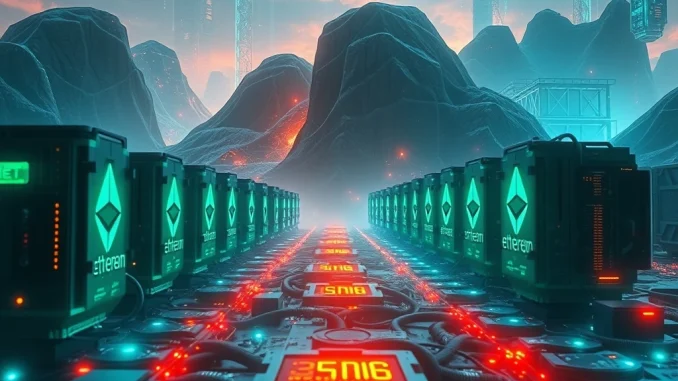
Ethereum mining remains a critical part of the blockchain under its current Proof-of-Work (PoW) system. Miners validate transactions and earn Ether (ETH) through:
- Block rewards
- Transaction fees
The process requires solving complex mathematical problems using high-performance hardware, primarily GPUs optimized for Ethereum’s Ethash algorithm.
Choosing the Right Ethereum Mining Hardware
Selecting efficient mining hardware is crucial for profitability. Key considerations include:
| Factor | Importance |
|---|---|
| Hashrate | Determines mining speed |
| Energy efficiency | Impacts operating costs |
| VRAM capacity | Affects algorithm compatibility |
| Initial cost | Determines ROI timeline |
Popular choices include Nvidia RTX and AMD RX series GPUs, known for their balance of power and efficiency.
Why Join Ethereum Mining Pools?
Most miners join pools like Ethermine or SparkPool to:
- Reduce earnings variance
- Combine computational resources
- Gain community support
Pools distribute rewards based on each miner’s contribution, offering more stable income than solo mining.
Operational Efficiency in Ethereum Mining
Smart miners focus on:
- Electricity cost management
- Hardware longevity
- Effective cooling solutions
Calculating hashrate per watt helps optimize equipment performance and resource allocation.
The Ethereum 2.0 PoS Transition: What Miners Need to Know
The shift to Proof-of-Stake will:
- Eliminate traditional mining
- Replace it with staking mechanisms
- Fundamentally change miner roles
Miners should explore staking options and alternative blockchain opportunities.
Frequently Asked Questions
Q: When will Ethereum complete its PoS transition?
A: The transition is ongoing, with full implementation expected in the coming years.
Q: Can I still profit from Ethereum mining now?
A: Yes, but profitability depends on electricity costs and hardware efficiency.
Q: What will happen to my mining hardware after the transition?
A: GPUs can be repurposed for other PoW coins or sold in secondary markets.
Q: How can I prepare for Ethereum 2.0?
A: Research staking requirements and consider gradually shifting your strategy.