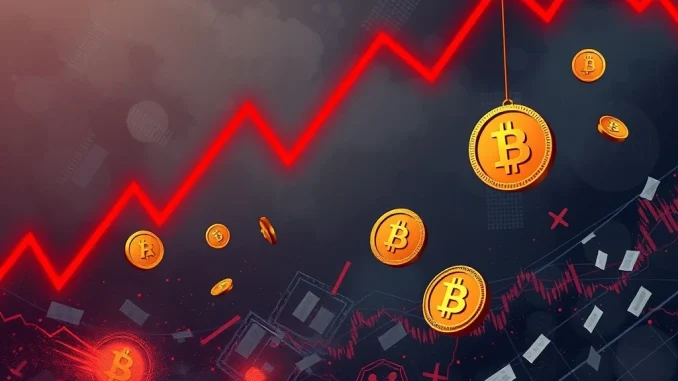
The cryptocurrency market recently experienced a sharp downturn. This volatility triggered **massive crypto liquidations**, totaling over $180 million in just 24 hours. These events highlight the inherent risks of leveraged trading. Specifically, Ethereum (ETH) perpetual futures contracts bore the brunt of this financial impact. Traders holding leveraged long positions faced significant losses as prices declined. This sudden market shift demands careful attention from all participants.
Ethereum Liquidations Dominate the Downturn
During the past 24 hours, **Ethereum liquidations** reached an astonishing $110 million. This figure alone represents a substantial portion of the total market liquidations. A closer look reveals a critical detail: 81.57% of these liquidated positions were long. Long positions profit when prices rise. Therefore, this high percentage indicates a strong bearish move. Many traders bet on ETH price increases. The market moved against them, forcing automatic closure of their positions. This cascade effect often exacerbates price drops. Such events underscore the amplified risks associated with high leverage.
Bitcoin Liquidations Show Significant Impact
Beyond Ethereum, Bitcoin (BTC) also saw considerable liquidations. Approximately $42.61 million in BTC perpetual futures contracts were liquidated. This volume confirms Bitcoin’s sensitivity to broader market movements. Like ETH, the majority of these liquidated positions were long, accounting for 71.88%. This suggests a similar pattern. Traders anticipated continued upward momentum for BTC. However, the market correction caught many off guard. Bitcoin’s liquidation volume, while less than Ethereum’s, remains substantial. It reflects widespread leveraged exposure across the market. These liquidations often signal a shift in market sentiment.
Solana Liquidations Highlight High Leverage Exposure
Solana (SOL) experienced significant liquidations as well. Over $27.62 million in SOL perpetual futures contracts were liquidated. Interestingly, Solana had the highest percentage of long liquidations among the top three assets. A remarkable 88.63% of liquidated SOL positions were long. This high ratio points to particularly aggressive bullish bets on Solana. Many traders used high leverage, hoping for quick gains. When the market turned, these highly leveraged positions were quickly wiped out. **Solana liquidations** demonstrate the extreme vulnerability of highly speculative assets during market corrections. Investors must understand these risks.
Understanding Perpetual Futures and Liquidations
To fully grasp these events, one must understand **perpetual futures** contracts. These are a type of derivative product. They allow traders to speculate on an asset’s future price without owning the underlying asset. Unlike traditional futures, they have no expiry date. Traders often use leverage with these contracts. Leverage amplifies both potential gains and losses. A liquidation occurs when a trader’s margin balance falls below the maintenance margin requirement. This happens due to adverse price movements. The exchange then automatically closes the position. This prevents further losses for the trader and the exchange. Liquidations serve as a risk management tool. However, they can be devastating for individual traders. They also contribute to market volatility.
Market Implications and Trader Risks
These widespread liquidations carry several implications. Firstly, they indicate significant market volatility. Sudden price swings trigger these forced closures. Secondly, they can create a domino effect. Large liquidations can push prices lower. This, in turn, triggers more liquidations. This cycle is known as a ‘liquidation cascade.’ Thirdly, they reveal prevalent market sentiment. The high percentage of long liquidations suggests an overly bullish market. Many traders were positioned for upside. This left them vulnerable to corrections. Traders must manage their leverage carefully. Prudent risk management is essential in such a dynamic environment. Ignoring these risks can lead to substantial capital loss. Always consider stop-loss orders.
In conclusion, the recent $180 million in **crypto liquidations** highlights market fragility. Ethereum led the charge, with Bitcoin and Solana also seeing substantial impacts. The dominance of long position liquidations points to aggressive bullish positioning. This was ultimately met with a market downturn. Understanding perpetual futures and managing leverage are crucial for traders. The cryptocurrency market remains highly dynamic. Therefore, vigilance and risk awareness are paramount for all participants. These events serve as a stark reminder of market risks.
Frequently Asked Questions (FAQs)
Q1: What exactly are crypto liquidations?
A1: Crypto liquidations occur when an exchange automatically closes a trader’s leveraged position. This happens because their collateral (margin) can no longer cover potential losses. This typically triggers when the asset’s price moves significantly against their trade direction.
Q2: Why did Ethereum lead the recent liquidations?
A2: Ethereum led liquidations primarily due to its high trading volume in perpetual futures and a significant number of traders holding leveraged long positions. When the market experienced a downturn, these bullish bets were quickly invalidated, leading to widespread forced closures.
Q3: What are perpetual futures contracts?
A3: Perpetual futures are a type of derivative contract that allows traders to speculate on the price of an asset without an expiration date. They mimic spot market prices but often involve leverage, meaning traders can control a larger position with a smaller amount of capital.
Q4: What does it mean when ‘long positions’ account for a high percentage of liquidations?
A4: A high percentage of long liquidations means that most traders who lost money were betting on the price of the cryptocurrency to go up. When the price fell instead, their positions were liquidated. This indicates a strong bearish move in the market against prevalent bullish sentiment.
Q5: How can traders avoid liquidations?
A5: Traders can avoid liquidations by using lower leverage, setting stop-loss orders to limit potential losses, maintaining sufficient margin in their accounts, and carefully monitoring market conditions. Understanding risk management is key to navigating volatile markets.