Are you tracking Ethereum’s next big move? The crypto world is buzzing with anticipation, but beneath the surface of potential gains lie significant risks. Recent insights from Coinglass data reveal that Ethereum’s price movements around the $4,000 and $3,800 levels could trigger massive liquidation events, impacting the entire crypto market. Understanding these critical thresholds is vital for any trader or investor looking to navigate the volatile landscape of digital assets.
Understanding Ethereum Liquidation Risks: What You Need to Know
When we talk about Ethereum liquidation risks, we’re referring to the forced closure of leveraged trading positions on centralized exchanges (CEXs). This happens when a trader’s margin balance falls below a required level, often due to adverse price movements. For instance, if you’re holding a long position (betting on price increase) with leverage, and the price drops significantly, the exchange might automatically close your position to prevent further losses. The same applies to short positions (betting on price decrease) if the price rises.
- What is Liquidation? It’s the automatic closing of a leveraged position by an exchange when the market moves against a trader, and their margin falls below a certain threshold.
- Why is it Significant? Large-scale liquidations can create a domino effect, amplifying price swings and leading to sudden, sharp market movements.
- Who is Affected? Primarily traders using leverage, but the resulting volatility can impact all market participants.
The Coinglass data highlights specific price points where these forced closures are concentrated, indicating areas of heightened vulnerability for Ethereum’s price action.
Diving Deep into Coinglass Data: The $4,000 and $3,800 Thresholds
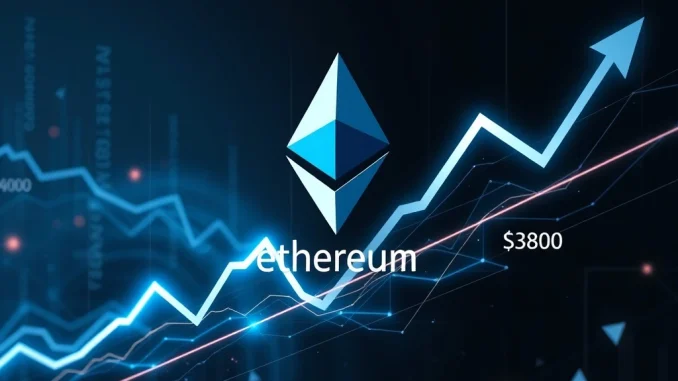
According to the analysis of Coinglass data by COINOTAG, two price levels stand out for Ethereum: $4,000 and $3,800. These aren’t just arbitrary numbers; they represent significant clusters of leveraged positions that could be liquidated if breached.
Let’s break down the potential impact:
- Breaking Above $4,000: If Ethereum’s price surges past $4,000, short positions face a staggering $979 million in liquidation risk. This means nearly a billion dollars worth of short bets could be forcibly closed, potentially fueling a rapid upward price acceleration as short sellers scramble to cover their positions. This phenomenon, often called a ‘short squeeze,’ can lead to parabolic price movements.
- Dropping Below $3,800: Conversely, if the price falls below $3,800, long positions could face $917 million in liquidation risk. Such a breakdown could trigger a sharp downward reversal as long-position holders are forced out of their trades, accelerating the decline. This is often referred to as a ‘long squeeze’ or a ‘liquidation cascade.’
These figures are not exact contract counts but rather reflect the magnitude of potential market reactions. Higher liquidation bars on charts, as explained by COINOTAG, signal stronger liquidity waves that can significantly amplify price swings when key levels are tested or breached.
Navigating Crypto Market Volatility: Strategies for Traders
The inherent volatility of the crypto market is well-known, but these specific liquidation zones add another layer of complexity. For traders, understanding these clusters is paramount for effective risk management. It’s not just about technical analysis of charts; it’s also about anticipating behavioral reactions to price triggers.
Consider these points:
- Dynamic Support and Resistance: High-intensity liquidation zones often act as dynamic support and resistance levels. When these levels are breached, the sudden influx of liquidity from forced closures can overwhelm typical price action, leading to abrupt reversals or extended trends.
- Self-Fulfilling Cycles: Large-scale liquidations can create self-fulfilling cycles. An initial price movement triggers cascading closures, which in turn amplify the price movement further. For example, a $4,000 breakout could see short sellers scrambling to cover losses, pushing the price even higher.
For those engaged in leveraged trading, vigilance around these price points is crucial. It’s about being proactive rather than reactive.
What Does This Mean for ETH Price Action?
The proximity of Ethereum’s current trading range to these significant liquidation clusters makes them focal points for both technical and behavioral analysis. While the $4,000 and $3,800 levels are not guaranteed to hold, their potential to trigger large-scale liquidations means they are more than just psychological barriers; they are structural points of vulnerability or acceleration for ETH price.
Here’s what could happen:
- Accelerated Upside: A strong push above $4,000 could lead to a rapid short squeeze, propelling ETH higher much faster than traditional buying pressure alone.
- Sharp Downside: A break below $3,800 could initiate a long squeeze, leading to a swift decline as panic selling and forced closures amplify the downward momentum.
- Increased Choppiness: Even without breaking these levels, the presence of large liquidation clusters nearby can lead to increased choppiness and volatility as traders try to push or defend these levels.
This dynamic interplay between price, leverage, and liquidation highlights the unique nature of crypto markets, where algorithmic trading and high leverage amplify swings.
Mitigating Market Volatility: Actionable Steps
Given the insights from Coinglass, how can traders and investors protect themselves and potentially capitalize on these movements? Managing exposure to sudden liquidity-driven market volatility requires careful planning.
Here are some actionable strategies:
- Adjust Leverage: Consider reducing leverage, especially when Ethereum’s price is near these critical liquidation zones. Lower leverage means you have more room for price fluctuations before your position is liquidated.
- Set Strategic Stop-Loss Orders: Place stop-loss orders strategically just outside these liquidation thresholds. This helps limit potential losses if the market moves sharply against your position. However, be aware of stop-loss hunting, where large players might intentionally push prices to trigger these orders.
- Monitor Liquidation Heatmaps: Regularly check liquidation heatmaps and data from platforms like Coinglass. These tools serve as predictive indicators, helping you anticipate potential market reactions rather than just reacting to them.
- Diversify Your Portfolio: Don’t put all your eggs in one basket. Diversifying your crypto holdings can help mitigate risks associated with sudden price swings in a single asset like Ethereum.
- Stay Informed: Keep up with the latest Ethereum news, broader crypto market trends, and macroeconomic factors that could influence price action.
The firm also notes that liquidation intensity charts serve as predictive tools, helping participants anticipate market reactions rather than simply reacting to them. By understanding where these liquidity traps lie, traders can make more informed decisions and refine their strategies.
Conclusion
Ethereum’s journey towards or away from the $4,000 and $3,800 marks is more than just a price update; it’s a high-stakes game of leverage and liquidation. Coinglass data provides a crucial lens through which to view these potential market accelerants, revealing nearly a billion dollars in liquidation risks at each level. While these thresholds are not guaranteed, their significance as dynamic support/resistance and catalysts for amplified price swings cannot be overstated. For traders, this means a renewed focus on risk management, strategic positioning, and staying informed. The insights from liquidation data empower market participants to navigate the inherent volatility of the crypto space with greater foresight, turning potential pitfalls into opportunities for calculated moves.
Frequently Asked Questions (FAQs)
Q1: What exactly is crypto liquidation?
Crypto liquidation is the forced closure of a leveraged trading position by an exchange. It occurs when a trader’s margin (collateral) falls below a certain threshold due to unfavorable price movements, preventing further losses to the exchange and the trader.
Q2: How does Coinglass data help traders?
Coinglass provides data on liquidation levels, open interest, and funding rates across various exchanges. This data helps traders identify price points where large clusters of leveraged positions exist, indicating potential areas of significant support or resistance, and anticipating where price volatility might intensify due to forced liquidations.
Q3: Why are the $4,000 and $3,800 levels so important for Ethereum?
These levels are critical because Coinglass data shows a high concentration of leveraged positions around them. A break above $4,000 could trigger a massive short squeeze, while a drop below $3,800 could lead to a significant long squeeze. These events involve hundreds of millions of dollars in potential liquidations, capable of amplifying price movements dramatically.
Q4: Can I avoid liquidation if I use leverage?
While you cannot entirely eliminate the risk of liquidation when using leverage, you can significantly mitigate it. Strategies include using lower leverage, setting strategic stop-loss orders, maintaining sufficient margin, and actively monitoring market conditions and liquidation heatmaps.
Q5: Is this information only relevant for leveraged traders?
While liquidation directly impacts leveraged traders, the resulting market volatility can affect all participants. Large liquidation cascades can lead to sharp price swings that impact spot holdings, long-term investments, and overall market sentiment. Therefore, understanding these dynamics is beneficial for all crypto investors.
Q6: Does Coinglass data guarantee price movements?
No, Coinglass data provides insights into potential market reactions based on existing leveraged positions, but it does not guarantee specific price movements. It’s a predictive tool that helps anticipate areas of heightened volatility, but other market factors, news, and overall sentiment also play significant roles in price action.