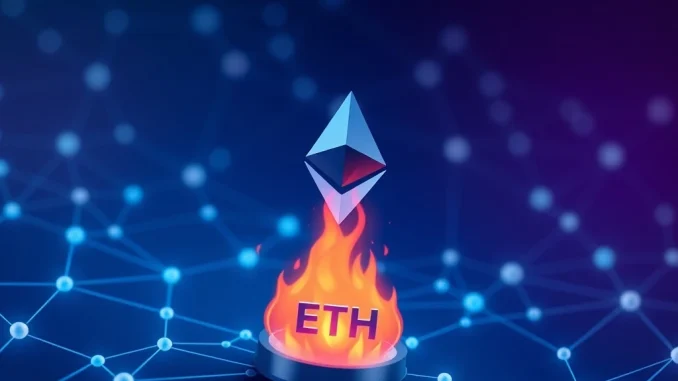
In a bold move that could reshape Ethereum’s economic landscape, Linea, an Ethereum Layer 2 protocol, has announced it will burn 20% of its net ETH transaction fees directly at the protocol level. This groundbreaking initiative marks the first implementation of its kind in the Ethereum ecosystem and promises to amplify ETH’s deflationary mechanics while creating new value for holders.
How Linea’s ETH Burning Mechanism Works
Linea’s updated roadmap reveals a sophisticated approach to Ethereum’s economics:
- 20% of all net ETH transaction fees will be permanently removed from circulation
- The burning occurs at the protocol level, automating the deflationary process
- Mirrors Ethereum’s EIP-1559 mechanism but operates at Layer 2
- Creates a self-sustaining system that benefits the entire Ethereum network
Why This Matters for Ethereum’s Future
The implications of Linea’s move extend far beyond simple fee burning:
| Benefit | Impact |
|---|---|
| Enhanced ETH scarcity | Potential price support through reduced supply |
| L2 economic alignment | Creates harmony between Layer 2 and base layer economics |
| Institutional appeal | Strengthens Ethereum’s case as a store of value |
| Developer incentives | Attracts builders to platforms with strong tokenomics |
The Strategic Partnerships Behind Linea’s Vision
ConsenSys, Linea’s developer, has joined forces with Eigen Labs and ENS Labs to execute this ambitious plan. This collaboration signals a shift in Layer 2 strategies, where supply-side adjustments are becoming crucial for long-term adoption. The initiative addresses historical concerns about token inflation that have limited L2 growth.
Potential Challenges and Considerations
While promising, Linea’s approach isn’t without questions:
- How will the market respond to this new deflationary pressure?
- Can transaction volumes sustain meaningful ETH burns?
- Will other L2 solutions follow suit, creating network-wide effects?
- How does the LINEA governance token complement the ETH burning mechanism?
What This Means for Ethereum Investors and Users
For ETH holders and Ethereum network participants, Linea’s move represents a significant development:
- Potential appreciation of ETH value through controlled supply reduction
- Stronger alignment between Layer 2 activity and Ethereum’s base layer value
- New opportunities to participate in deflationary protocols
- Enhanced long-term viability for Ethereum’s economic model
Linea’s bold initiative to burn ETH fees at the protocol level could mark a turning point for Ethereum’s Layer 2 ecosystem. By directly linking L2 activity to ETH’s scarcity, the protocol creates a powerful incentive structure that benefits all network participants. As more L2 solutions potentially adopt similar mechanisms, we may be witnessing the evolution of Ethereum into a more robust, deflationary asset with stronger fundamentals than ever before.
Frequently Asked Questions
How does Linea’s ETH burning differ from EIP-1559?
While both mechanisms burn ETH, Linea’s occurs at the Layer 2 level, creating additional deflationary pressure beyond Ethereum’s base layer burns.
What percentage of fees does Linea burn?
Linea burns 20% of its net ETH transaction fees permanently.
How might this affect ETH’s price?
By reducing circulating supply, the burns could create upward price pressure, especially if adopted widely across L2 solutions.
Does this make Linea more attractive to developers?
Yes, the improved tokenomics and alignment with Ethereum’s value could make Linea a more compelling platform for builders.
Will other L2 solutions follow Linea’s approach?
Industry analysts suggest this could start a trend as L2s compete to offer superior economic models.
How does the LINEA token fit into this system?
The LINEA token serves governance functions while the ETH burns create value capture at the base layer.