In the ever-evolving landscape of decentralized finance (DeFi), one name consistently stands tall: Ethereum. Despite a massive 3.6x surge in the overall DeFi market since late 2023, Ethereum’s dominance remains unshaken, particularly in the critical realm of Ethereum DeFi. This article delves into how Ethereum continues to cement its position as the backbone of decentralized finance, securing billions in digital assets and pioneering new frontiers.
Ethereum DeFi: Unwavering Leadership in a Dynamic Market
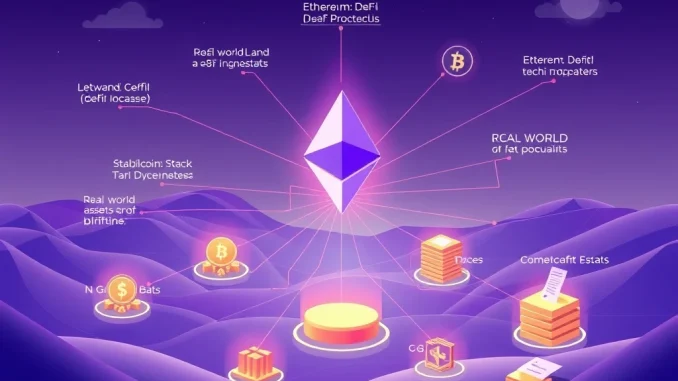
Ethereum’s position in decentralized finance is not just strong; it’s foundational. The network, alongside its robust layer-2 solutions, commands over $87 billion in total value locked (TVL), representing more than 65% of the entire DeFi market. This impressive figure has held steady even as global DeFi TVL surged by 3.6 times since October 2023, showcasing Ethereum’s remarkable resilience amidst increasing competition. Beyond just TVL, Ethereum secures an astounding $1.08 trillion in value across 56 of the top 100 tokens by market capitalization. This dwarfs competitors like Solana, which secures $404 billion across 20 tokens, underscoring Ethereum’s role as the most trusted infrastructure for digital assets.
Why Does Ethereum’s DeFi TVL Remain So Strong?
Ethereum’s sustained dominance is not a matter of luck; it’s a testament to its strategic advantages and continuous innovation. While newer blockchains may offer faster transactions or lower fees, Ethereum’s core strengths set it apart:
- First-Mover Advantage: Ethereum pioneered smart contracts, building a vast ecosystem of developers and applications that continue to choose its platform.
- Robust Security Model: With over 1 million validators and a design that eliminates single points of failure, Ethereum offers unparalleled security for digital assets.
- Developer Ecosystem: The largest and most active developer community in crypto ensures constant innovation and a steady stream of new applications.
- Scalability through Layer-2s: Solutions like Arbitrum and Optimism have enabled Ethereum to scale significantly without compromising its decentralization or security, allowing its TVL to grow while maintaining foundational principles.
The Critical Role of Ethereum Stablecoins
Ethereum’s influence extends deeply into the stablecoin market, a vital component of DeFi. Over $147 billion in Ethereum stablecoins are hosted on the network, accounting for more than 60% of the total stablecoin supply across all blockchains. This includes a massive $74 billion in USDT alone, a figure that surprisingly exceeds the combined TVL of Ethereum’s DeFi protocols.
Stablecoins are the lifeblood of decentralized finance, facilitating essential activities such as lending, borrowing, and trading while mitigating the inherent volatility of other cryptocurrencies. Ethereum’s leadership in this area solidifies its role as the primary settlement layer for stablecoin activity, a critical function for maintaining liquidity and price stability across decentralized markets.
Pioneering Tokenized Real-World Assets (RWAs) on Ethereum
Ethereum is also at the forefront of bridging traditional finance with the digital world through Tokenized Real-World Assets (RWAs). The network hosts $7.7 billion in RWAs, representing a staggering 90% of all on-chain tokenized assets. This figure has seen a remarkable 10x growth since January 2022, largely driven by institutional adoption of tokenization for treasuries, credit instruments, and funds.
The ability to tokenize high-value assets demands a network with exceptional security and decentralization. Ethereum delivers on these fronts through its vast validator network and robust framework, making it the preferred platform for institutions looking to leverage blockchain technology for traditional assets.
Blockchain Security: The Cornerstone of Ethereum’s Trust
At the heart of Ethereum’s enduring dominance is its commitment to blockchain security. The network’s long operational history and battle-tested framework have instilled deep trust among users and institutions alike. This trust is not merely conceptual; it’s demonstrated by the billions in assets secured through Ethereum’s smart contracts and layer-2 networks. The robust security model, powered by over a million validators, ensures that assets are protected from single points of failure, making it the most reliable infrastructure for digital value.
This unwavering trust creates a powerful flywheel effect: security attracts liquidity, which in turn attracts more developers and applications, further solidifying Ethereum’s position. As the DeFi ecosystem continues to mature, Ethereum’s role as its fundamental backbone is poised to strengthen, especially with ongoing improvements in scalability and its increasing integration of real-world assets.
Conclusion
Ethereum’s remarkable ability to maintain its dominance in DeFi TVL, secure the vast majority of stablecoins, and lead the charge in tokenized real-world assets underscores its foundational importance in the digital economy. Its blend of first-mover advantage, continuous innovation, unparalleled security, and a vibrant developer ecosystem ensures that it remains the go-to platform for building the future of finance. As the decentralized world evolves, Ethereum is not just adapting; it’s actively shaping the landscape.
Frequently Asked Questions (FAQs)
1. What is Ethereum’s current share of the DeFi TVL?
Ethereum and its layer-2 solutions collectively control over $87 billion in total value locked (TVL), representing more than 65% of the entire decentralized finance (DeFi) market.
2. How much of the total stablecoin supply does Ethereum host?
Ethereum hosts over $147 billion in stablecoins, which accounts for more than 60% of the total stablecoin supply across all blockchains, including a significant $74 billion in USDT.
3. What are Tokenized Real-World Assets (RWAs) and why are they important for Ethereum?
Tokenized Real-World Assets (RWAs) are representations of tangible or intangible assets (like treasuries, real estate, or credit instruments) on a blockchain. Ethereum is a leader in this space, hosting $7.7 billion in RWAs (90% of the market), because its unparalleled security and decentralization make it the ideal platform for securing high-value, institutionally-backed assets.
4. How do Layer-2 solutions contribute to Ethereum’s dominance?
Layer-2 solutions (like Arbitrum and Optimism) enhance Ethereum’s scalability by processing transactions off the main chain while still leveraging Ethereum’s security. This allows the network to handle more transactions and support a larger user base without compromising its core principles, thereby enabling continued growth in its TVL and user adoption.
5. What makes Ethereum a trusted platform for securing digital assets?
Ethereum’s trustworthiness stems from its long operational history, robust security framework, and decentralized nature. With over 1 million validators and no single points of failure, it provides a highly secure environment for digital assets, fostering confidence among both retail and institutional users.