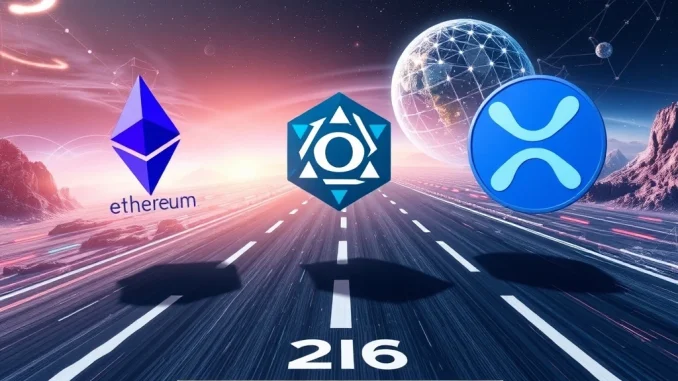
The cryptocurrency world is a relentless arena of innovation and competition. As we hurtle towards 2026, the battle for blockchain dominance is intensifying, with titans like Ethereum, Solana, and XRP leading the charge. This isn’t just about market cap; it’s about which foundational technology will power the next generation of decentralized applications, financial systems, and digital economies. Understanding the unique strategies and inherent challenges of these major players is crucial for anyone tracking the pulse of Ethereum news and the broader crypto market.
The year 2025 has seen these three giants solidify their positions, each carving out a distinct niche while eyeing broader market leadership. Ethereum (ETH) continues to emphasize its robust institutional-grade infrastructure and unparalleled developer ecosystem. Solana (SOL) doubles down on its promise of high-throughput performance and low transaction costs, making it a favorite for real-time applications. Meanwhile, XRP leverages its newfound regulatory clarity and established utility in cross-border payments. While the article notes emerging altcoins like MAGACOIN FINANCE as potential disruptors, our focus remains on these three established contenders and their strategic positioning for the coming years.
Ethereum’s Enduring Infrastructure and Developer Powerhouse
Ethereum, often dubbed the ‘world computer,’ maintains its undisputed leadership in smart contract adoption and developer activity. Its transition to a Proof-of-Stake (PoS) consensus mechanism, known as ‘The Merge,’ was a monumental achievement, significantly reducing its energy footprint and laying the groundwork for future scalability improvements. This shift has not only made Ethereum more environmentally friendly but also opened doors for more efficient network upgrades and staking opportunities.
A crucial element of Ethereum’s scalability strategy lies in its Layer-2 (L2) solutions. Platforms like Optimism, Arbitrum, Polygon, and various ZK-rollups (e.g., zkSync, StarkNet) are designed to process transactions off the main Ethereum chain, bundle them, and then settle them back on Layer-1. This dramatically increases transaction throughput and reduces gas fees, making the Ethereum ecosystem more accessible and user-friendly. The ongoing Dencun upgrade, for instance, introduced ‘proto-danksharding,’ further enhancing L2 efficiency and reducing data costs, a significant step towards a truly scalable blockchain.
- Institutional Demand: Ethereum continues to attract strong institutional interest, evidenced by the growing number of institutional investors gaining exposure through various avenues, including potential spot Ethereum ETFs. These inflows signal a growing confidence in Ethereum’s long-term viability and its role as a foundational digital asset.
- Developer Ecosystem: With the largest and most active developer community in the blockchain space, Ethereum benefits from continuous innovation. New decentralized applications (dApps), DeFi protocols, and NFT projects are constantly being built and deployed on its network, ensuring its relevance and expanding its utility.
- Challenges: Despite its strengths, Ethereum faces pressure to innovate faster. While Layer-2s mitigate scalability issues, high gas fees on the mainnet can still be a barrier for smaller transactions. Furthermore, true interoperability with other blockchain ecosystems remains a complex challenge, even as solutions like cross-chain bridges evolve.
Analysts suggest Ethereum’s dominance could solidify further if macroeconomic conditions stabilize and the momentum from ETF approvals persists. Its robust security, established network effects, and a clear roadmap for future upgrades position it strongly for continued leadership in the smart contract domain.
Solana’s Speed Advantage: A Catalyst for High-Performance Applications
When it comes to raw technical performance, Solana stands out. Its architecture, which incorporates a unique Proof-of-History (PoH) consensus mechanism alongside Proof-of-Stake, allows it to process an astonishing number of transactions per second—often exceeding 65,000—at remarkably low fees. This makes Solana crypto an ideal platform for applications requiring high throughput and near-instant finality, such as:
- Gaming: Blockchain-based games, which often involve a high volume of in-game transactions and NFT interactions, thrive on Solana’s speed.
- NFTs: The low transaction costs and fast minting times have made Solana a popular choice for NFT creators and collectors, fostering vibrant digital art and collectible communities.
- DeFi: While not as dominant as Ethereum, Solana’s DeFi ecosystem offers competitive yields and fast trading experiences, attracting users looking for efficient decentralized finance solutions.
- Real-time Applications: Emerging sectors like DePIN (Decentralized Physical Infrastructure Networks) and real-time data streaming benefit immensely from Solana’s performance capabilities.
Solana has made significant strides in addressing its earlier reliability issues, which saw occasional network outages. Recent infrastructure upgrades and continued development, including projects like Firedancer (a new validator client aimed at improving network resilience and throughput), are enhancing its stability. The success of initiatives like the Solana Saga phone also highlights its commitment to mainstream adoption and user accessibility.
Price forecasts for Solana for 2025 have ranged widely, reflecting both the optimism surrounding its adoption and scalability, and the volatility inherent in the crypto market. Solana’s long-term success, however, may hinge not just on its speed, but on its ability to build stronger bridges and interoperability with Ethereum’s broader ecosystem, rather than solely competing on performance metrics.
XRP’s Strategic Niche: Navigating Regulatory Clarity for Cross-Border Payments
XRP’s journey has been distinct, largely defined by its unique focus and, critically, its legal battle with the U.S. Securities and Exchange Commission (SEC). The resolution of the Ripple vs. SEC case brought much-needed XRP regulation clarity, distinguishing XRP as not inherently a security when sold on exchanges. This landmark ruling has been a game-changer, allowing Ripple and XRP to reposition themselves confidently in the global financial landscape.
Unlike Ethereum and Solana, which primarily compete in the decentralized application (dApp) and NFT markets, XRP’s core utility lies in facilitating fast, low-cost cross-border payments. It serves as a ‘bridge asset,’ enabling financial institutions to move value across different fiat currencies without relying on traditional, often slow and expensive, correspondent banking networks. Adoption by banking partners and its integration into various payment corridors are steadily advancing, leveraging Ripple’s On-Demand Liquidity (ODL) solution.
- Institutional Focus: XRP primarily competes in the institutional and traditional finance sectors. Its value proposition is tailored for large financial entities, payment providers, and banks looking to modernize their payment infrastructure.
- Regulatory Advantage: With the legal uncertainty largely resolved, XRP possesses a significant advantage in attracting regulated entities that require clear legal frameworks to operate within the crypto space.
- Tokenized Fiat & CBDCs: Ripple is actively involved in discussions and pilot programs for Central Bank Digital Currencies (CBDCs) and tokenized fiat, positioning XRP Ledger as a potential backbone for future digital currency infrastructure.
Analysts note that XRP’s trajectory could accelerate significantly if macro-level financial reforms and institutional infrastructure for digital assets expand globally. However, its performance remains contingent on external factors beyond the immediate crypto ecosystem’s control, such as global economic policies and the pace of traditional finance adoption.
The Broader Crypto Competition and the Path to Blockchain Dominance
The landscape of crypto competition is far from static. While Ethereum, Solana, and XRP represent significant forces, the broader market is dynamic, with numerous other Layer-1 blockchains (e.g., Avalanche, BNB Chain, Cardano) and Layer-2 solutions constantly innovating. The concept of ‘blockchain dominance’ by 2026 may not ultimately be defined by a single, all-encompassing winner, but rather by a multi-chain future where different protocols excel in specialized domains.
Key factors that will determine the success and market share of these projects include:
| Feature | Ethereum (ETH) | Solana (SOL) | XRP (XRP) |
|---|---|---|---|
| Primary Focus | Smart Contracts, DApps, DeFi, NFTs | High-Throughput DApps, Gaming, NFTs, DePIN | Cross-Border Payments, Institutional Liquidity |
| Consensus | Proof-of-Stake (PoS) | Proof-of-History (PoH) + Proof-of-Stake (PoS) | Federated Consensus (XRP Ledger Consensus Protocol) |
| Scalability | Layer-2s (Optimism, Arbitrum, ZK-Rollups) | High TPS (65k+), Parallel Processing | Fast Settlements, Low Fees |
| Key Strength | Largest Ecosystem, Decentralization, Security | Speed, Low Cost, Developer Friendliness | Regulatory Clarity (post-SEC), Institutional Ties |
| Key Challenge | Gas Fees (without L2s), Complexity | Network Stability (historical), Centralization fears | Limited DApp utility, Reliance on TradFi adoption |
| Dominance Goal | Foundational Layer for Web3 | High-Performance Consumer Apps | Global Financial Infrastructure |
- Technological Innovation: The ability to continuously improve scalability, security, and decentralization will be paramount.
- Developer Ecosystem & Community: A thriving community of developers and active users is vital for sustained growth and innovation.
- Institutional Adoption & Regulatory Framework: Clarity and acceptance from traditional financial institutions and regulators will unlock massive capital and broader use cases.
- User Experience & Accessibility: Simplification of blockchain interactions will drive mainstream adoption.
- Real-World Utility: Projects that solve tangible problems and offer genuine value beyond speculation will stand the test of time.
The race for blockchain dominance is not just about raw technical specifications but also about strategic positioning, ecosystem growth, and adaptability. Each project is playing to its strengths, understanding that the future of blockchain might be a specialized one rather than a winner-takes-all scenario.
As we look towards 2026, the competitive landscape will undoubtedly continue to evolve. Ethereum is projected to retain its leadership in smart contract infrastructure, serving as the backbone for complex decentralized applications. Solana could solidify its position as the go-to platform for high-usage consumer applications, especially in gaming and NFTs, where speed and low cost are critical. XRP, with its unique focus, is poised to solidify its role as a key player in cross-border payments and institutional finance. The ultimate success for each will lie in their ability to adapt to market demands, regulatory shifts, and technological advancements, proving their indispensable value in the rapidly expanding digital economy.
Frequently Asked Questions (FAQs)
1. What is Ethereum’s main strategy for achieving blockchain dominance by 2026?
Ethereum’s strategy for 2026 dominance revolves around solidifying its position as the foundational layer for Web3. This includes continued development of its Proof-of-Stake consensus, enhancing scalability through Layer-2 solutions like Optimism and Arbitrum, and fostering its vast developer ecosystem. It aims to remain the most secure, decentralized, and widely adopted smart contract platform, attracting institutional capital and pioneering new dApp innovations.
2. How does Solana aim to compete with Ethereum for market share?
Solana primarily competes with Ethereum by offering significantly higher transaction speeds and lower fees, making it ideal for high-throughput applications like gaming, NFTs, and real-time dApps. Its strategy focuses on performance and user experience, aiming to attract developers and users who prioritize speed and cost-efficiency. While it offers a different architectural approach, its long-term success may also depend on improved interoperability with Ethereum’s broader ecosystem.
3. What role does regulatory clarity play for XRP’s future?
Regulatory clarity, particularly following the resolution of the Ripple vs. SEC case, is crucial for XRP’s future. It allows Ripple to confidently pursue partnerships with regulated financial institutions and integrate XRP into traditional finance systems for cross-border payments. This clarity distinguishes XRP from many other cryptocurrencies and positions it as a compliant asset for institutional adoption, a key factor in its strategic niche.
4. Will there be a single winner in the blockchain dominance race by 2026?
The article suggests that blockchain dominance by 2026 may not be defined by a single winner but rather by a multi-chain future. Each project (Ethereum, Solana, XRP) is likely to solidify leadership in its specialized domain: Ethereum for foundational smart contracts, Solana for high-performance consumer applications, and XRP for cross-border payments. The future may see co-existence and interoperability rather than a winner-takes-all scenario.
5. How do Layer-2 solutions benefit Ethereum’s scalability?
Layer-2 (L2) solutions benefit Ethereum’s scalability by processing transactions off the main Ethereum blockchain (Layer-1) and then batching them for settlement on L1. This significantly increases transaction throughput and reduces gas fees, making the Ethereum network more efficient and accessible for a wider range of applications and users without compromising the security and decentralization of the mainnet.
6. How does XRP’s utility differ from general-purpose smart contract platforms like Ethereum or Solana?
XRP’s primary utility is as a bridge asset for fast, low-cost cross-border payments and institutional liquidity, leveraging the XRP Ledger. Unlike Ethereum or Solana, which are general-purpose smart contract platforms designed to host a vast array of decentralized applications (DeFi, NFTs, gaming, etc.), XRP’s focus is narrower and more specialized towards facilitating global financial transactions and potentially supporting tokenized fiat or CBDCs.