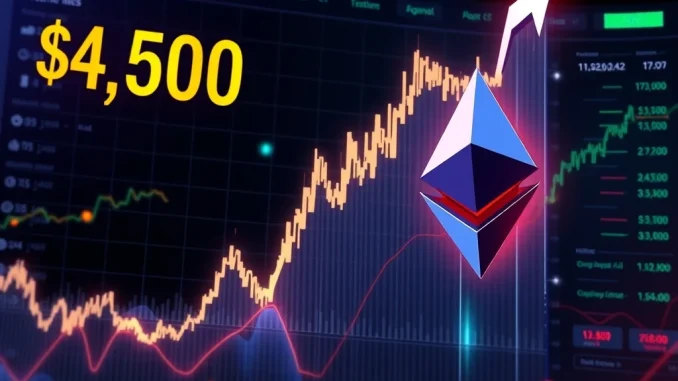
Ethereum has surged past the $4,500 threshold, a critical resistance level that has historically triggered significant market volatility. This milestone has traders and investors on high alert, as past cycles show both opportunities and risks at this price point.
Why is the $4,500 threshold so critical for Ethereum?
The $4,500 level has acted as a major resistance point in Ethereum’s price history. Key insights:
- In the 2020-21 bull run, breaking $4,500 led to a 12-month rally but was followed by a 20% correction.
- March 2024 saw a 7% pullback after Ethereum tested this level.
- The +1σ effective realized price range suggests this is a probabilistic inflection point for market stability.
How are traders responding to Ethereum’s market volatility?
Market participants are adopting cautious strategies:
| Strategy | Recent Activity |
|---|---|
| Options trading | 35% increase in volume, with $4,500 strike dominating |
| Institutional buying | Large wallet inflows suggesting $3,800 as potential floor |
What does this mean for the broader cryptocurrency market?
The $4,500 threshold isn’t just about Ethereum:
- Highly correlated altcoins like SOL and ADA show similar volatility patterns
- Liquidity fragmentation across exchanges amplifies price swings
- Macroeconomic factors like Fed policy could determine next major move
Actionable insights for navigating Ethereum’s volatility
Key considerations for market participants:
- Monitor on-chain metrics like exchange inflows/outflows
- Watch for retests of $4,500 level as support/resistance
- Consider hedging strategies given historical volatility patterns
Frequently Asked Questions
What happens when Ethereum breaks $4,500?
Historically, breaks above $4,500 have led to strong rallies but were often followed by significant corrections within months.
How reliable is the +1σ effective realized price metric?
This metric has accurately identified inflection points in past cycles by combining holder cost basis with statistical deviation.
Should I buy Ethereum at $4,500?
This depends on your risk tolerance. While institutional interest suggests upside potential, historical volatility at this level warrants caution.
How does this affect other cryptocurrencies?
Major altcoins with high ETH correlation typically experience similar volatility patterns around these key levels.