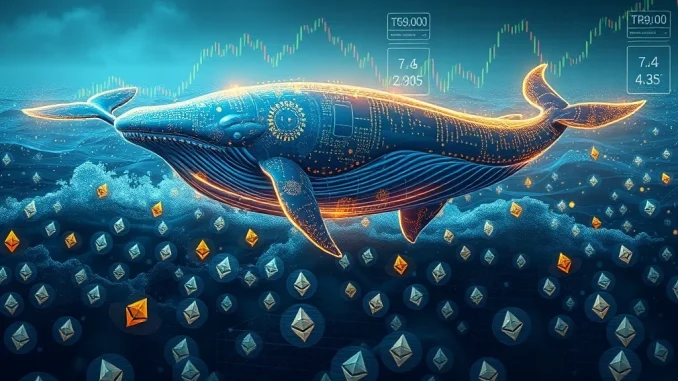
In the dynamic world of cryptocurrency, where fortunes can be made and lost in the blink of an eye, the movements of large holders—often dubbed ‘whales’—are meticulously watched. Recently, the crypto community has been buzzing about a significant move by an ETH whale who made headlines by accumulating a staggering $117 million worth of Ethereum (ETH) using borrowed funds. This bold maneuver highlights the high-stakes game played by major players and offers fascinating insights into market sentiment and potential future price action.
Understanding the ETH Whale’s Bold Move: A Closer Look at Crypto Accumulation
Imagine having enough capital to influence market trends. That’s the power of a crypto whale. An ETH whale recently executed a remarkable strategy, acquiring 32,953 ETH, valued at an astonishing $117 million, over a mere five-day period. This wasn’t just a simple purchase; it was a calculated move utilizing borrowed funds, indicating a strong conviction in Ethereum’s future trajectory. The average entry price for this massive accumulation stood at $3,552 per ETH.
According to diligent on-chain analyst @EmberCN on X, this whale’s total ETH holdings have now swelled to approximately 56,000 ETH, boasting a current valuation of around $211 million. This makes them a truly significant player in the Ethereum ecosystem. Such substantial crypto accumulation events are rare and often signal deep pockets and a long-term bullish outlook from those with privileged market insights or a high-risk tolerance.
Key Details of the Whale’s Accumulation:
- Amount Accumulated: 32,953 ETH
- Value of Accumulation: $117 million USD
- Timeframe: Over the past five days
- Average Entry Price: $3,552 per ETH
- Method: Using borrowed funds (leverage)
- Total Holdings (Post-Accumulation): 56,000 ETH
- Current Value of Total Holdings: Approximately $211 million USD
The Mechanics of Ethereum Leverage: What Does It Mean to Borrow Funds?
The term ‘leverage’ might sound complex, but in essence, it means using borrowed capital to increase potential returns from an investment. In this whale’s case, they didn’t use their own existing ETH to buy more; they took out loans, likely collateralized by other assets or even the ETH they were purchasing, to amplify their buying power. This is a common, albeit risky, strategy in traditional finance and is increasingly prevalent in the crypto space.
How Does Crypto Leverage Work?
- Borrowing Funds: An investor borrows funds from a lending platform or exchange.
- Collateral: To secure the loan, the investor typically provides collateral, often in the form of other cryptocurrencies.
- Increased Buying Power: The borrowed funds are then used to buy more of an asset, in this case, Ethereum.
- Amplified Gains (and Losses): If the price of the asset goes up, the gains are amplified because the investor controls a larger position than their initial capital would allow. However, if the price goes down significantly, the losses are also amplified, potentially leading to liquidation.
Using Ethereum leverage for such a massive accumulation suggests a strong conviction in the asset’s upward mobility. It’s a high-stakes gamble, as a significant price drop could lead to a ‘liquidation event,’ where the borrowed funds are automatically repaid by selling off the collateral, often at a loss.
What On-Chain Analysis Reveals About This ETH Accumulation
The beauty of blockchain technology lies in its transparency. Every transaction is recorded on a public ledger, allowing for ‘on-chain analysis.’ This involves examining these public records to gain insights into market behavior, identify trends, and track the movements of large entities like whales. On-chain analysts like @EmberCN play a crucial role in sifting through this vast amount of data to identify significant patterns.
Why is On-Chain Analysis Important?
- Transparency: All transactions are visible, providing a clear picture of market activity.
- Early Signals: Large movements by whales can sometimes precede significant price shifts.
- Behavioral Insights: It helps understand how large holders are positioning themselves.
- Verification: Claims of large accumulations or sales can be verified directly on the blockchain.
The fact that this on-chain analysis was able to pinpoint the whale’s activity, including their entry price and current holdings, underscores the power of this analytical approach. It offers a glimpse into the strategies of major players, providing valuable context for other market participants.
Implications for the ETH Price and Market Dynamics
When an entity accumulates such a vast amount of ETH, especially using leverage, it naturally raises questions about its potential impact on the ETH price and the broader market. While a single whale’s actions don’t dictate the entire market, they can certainly create ripples.
Potential Impacts:
- Bullish Signal: A large accumulation, particularly with leverage, often signals strong bullish sentiment from a well-capitalized investor. They believe the price will rise significantly to justify the risk.
- Increased Demand: The act of buying 32,953 ETH adds substantial buying pressure to the market, which can contribute to upward price movement.
- Market Confidence: Retail investors and smaller institutions often watch whale movements. A large accumulation can instill confidence, potentially encouraging others to buy.
- Liquidation Risk: Conversely, if the ETH price were to drop sharply, this whale’s leveraged position could face liquidation, leading to a forced sell-off of their holdings, which could add downward pressure.
This accumulation suggests that at least one major player sees significant upside potential for Ethereum in the near to medium term. It’s a testament to the ongoing interest and belief in Ethereum’s ecosystem, its utility, and its role in the decentralized future.
Navigating the Waters: Risks and Rewards of Ethereum Accumulation
While the whale’s move is impressive, it’s crucial for everyday investors to understand the inherent risks and rewards associated with such strategies, especially when involving leverage. For the whale, the reward is substantial if ETH’s price continues to climb, but the risk of liquidation is ever-present.
For Retail Investors:
- Do Your Own Research (DYOR): Never blindly follow whale movements. Their strategies are tailored to their capital and risk tolerance, which are likely vastly different from yours.
- Understand Leverage: If considering leverage, thoroughly understand its mechanics, risks, and how liquidation works. It’s not for the faint of heart or those with limited capital.
- Risk Management: Always prioritize risk management. Only invest what you can afford to lose, and consider setting stop-loss orders to protect your capital.
- Long-Term vs. Short-Term: Decide if your investment strategy is long-term holding or short-term trading. Whale accumulations often suggest a longer-term bullish outlook.
The story of this ETH whale serves as a compelling case study in high-stakes crypto investing. It reminds us of the significant capital flowing into the decentralized finance (DeFi) space and the conviction some investors have in Ethereum’s foundational technology and future growth.
This monumental accumulation by an ETH whale using daring leverage underscores the intense belief some major players have in Ethereum’s potential. The $117 million investment, bringing the whale’s total holdings to over $211 million, is a powerful signal within the crypto market. While on-chain analysis provides valuable transparency into these colossal moves, it also serves as a reminder of the inherent risks, especially with Ethereum leverage. As the crypto landscape continues to evolve, keeping an eye on such significant crypto accumulation events can offer clues about market sentiment and potential future ETH price trajectories, but always remember to navigate these volatile waters with caution and informed decisions.
Frequently Asked Questions (FAQs)
Q1: What is a ‘crypto whale’?
A crypto whale is an individual or entity that holds a very large amount of a particular cryptocurrency. Their large holdings mean their transactions can significantly impact market prices and sentiment, making their movements closely watched by other investors.
Q2: How does using ‘leverage’ work in crypto trading?
Leverage in crypto trading involves borrowing funds from an exchange or lending platform to increase your trading position beyond what your own capital would allow. For example, with 5x leverage, a $1,000 investment allows you to control a $5,000 position. While this can amplify profits, it also significantly amplifies losses and increases the risk of liquidation if the market moves against your position.
Q3: What is ‘on-chain analysis’ and why is it important for tracking whales?
On-chain analysis is the process of examining publicly available data on a blockchain ledger, such as transaction volumes, wallet addresses, and token movements. It’s crucial for tracking whales because all their transactions are recorded on the blockchain, allowing analysts to identify their accumulation or distribution patterns, entry/exit prices, and overall holdings, providing valuable insights into market trends.
Q4: What are the risks associated with a whale accumulating ETH using leverage?
The primary risk is liquidation. If the price of ETH were to drop significantly, the whale’s leveraged position could fall below the maintenance margin, leading to an automatic sale of their collateral (ETH) to repay the borrowed funds. This forced selling could potentially exacerbate a downward price movement. For the whale, it means significant losses, and for the market, it can create additional selling pressure.
Q5: Does a whale’s accumulation guarantee a price increase for ETH?
No, a whale’s accumulation does not guarantee a price increase. While large purchases can add buying pressure and signal bullish sentiment, the crypto market is influenced by numerous factors, including macroeconomic conditions, regulatory news, technological developments, and overall market sentiment. A whale’s move is one data point among many that investors should consider, but it’s not a definitive predictor of future price action.