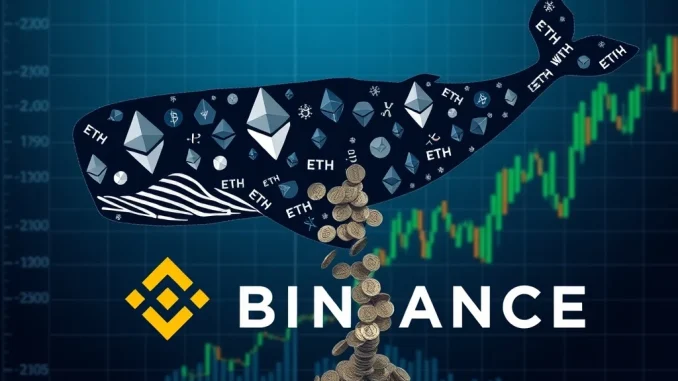
A significant event recently unfolded in the cryptocurrency world. An ETH whale, or possibly a cluster of related wallets, executed a massive transfer. This action involved moving a substantial amount of unstaked Ethereum to a major exchange. Such large movements often capture the attention of market participants. They can signal potential shifts in market dynamics.
Understanding the Massive ETH Whale Transfer
On-chain data provider Lookonchain recently reported a notable transaction. Three distinct wallets, likely controlled by the same entity, moved a significant sum of Ethereum. Specifically, 14,942 ETH was unstaked. This amount translates to approximately $64.38 million. Subsequently, these funds were deposited directly onto the Binance Exchange within a single hour. This rapid transfer immediately raised eyebrows across the crypto community. Therefore, observers are closely watching the implications.
Deposits of such magnitude to exchanges are typically interpreted in a specific way. They often suggest an intention to sell the assets. However, it is crucial to remember that not every deposit automatically results in a sale. Whales might move funds for various other strategic reasons. These reasons could include preparing for trading opportunities or consolidating assets.
The Significance of Unstaked Ethereum
Ethereum’s transition to a Proof-of-Stake (PoS) consensus mechanism introduced staking. Users can lock up their ETH to support network operations. In return, they earn rewards. However, these staked funds are not immediately liquid. They require an ‘unstaking’ process to become available for transfer or sale. This process involves a withdrawal queue. Therefore, the fact that these funds were unstaked means they were previously locked up. Their release signifies a deliberate decision by the whale.
When large amounts of unstaked Ethereum become liquid, it adds potential supply to the market. This increased supply could, in theory, exert downward pressure on prices if sold. Furthermore, it indicates a change in strategy for the whale. They are moving from a long-term holding and staking position to a more active one. This shift warrants careful observation by investors.
Why a Binance Deposit Matters for the Market
The choice of Binance as the destination is also significant. Binance is the world’s largest cryptocurrency exchange by trading volume. Its liquidity pools are vast. This makes it an ideal venue for executing large trades without causing excessive slippage. A large Binance deposit, therefore, suggests a high likelihood of trading activity. This activity could involve selling, but it could also involve complex trading strategies.
Historically, large inflows to exchanges have preceded periods of increased volatility. This volatility can be either positive or negative. Market participants often interpret such moves as a precursor to a major sell-off. This interpretation can lead to a self-fulfilling prophecy. Consequently, other traders might pre-emptively sell their holdings. This reaction can amplify any potential price movements. Conversely, if the funds are used for buying, they could fuel an upward trend. The market remains on edge awaiting further developments.
Potential Crypto Market Impact Scenarios
The transfer of $64.4 million in ETH has several potential implications for the broader crypto market impact. Firstly, if the whale intends to sell, it could create significant selling pressure. This pressure might lead to a short-term dip in Ethereum’s price. Other altcoins, particularly those correlated with ETH, could also experience a ripple effect. This is because Ethereum often acts as a bellwether for the wider altcoin market.
Secondly, the whale might be preparing for over-the-counter (OTC) deals. OTC desks facilitate large trades without impacting exchange order books. This method is often preferred by institutions and large holders. It allows them to execute trades discreetly. Such a move would have less immediate impact on spot prices. However, it still signifies a shift in ownership of a large asset block.
- Scenario 1: Direct Sell-Off. The most immediate concern is a direct sale. This would increase selling pressure on ETH.
- Scenario 2: OTC Deal. Funds could be moved for an OTC transaction. This would bypass public order books.
- Scenario 3: Strategic Trading. The whale might use the funds for complex trading strategies or arbitrage.
- Scenario 4: Re-Staking or DeFi. Funds could be moved to re-stake through another platform or deploy into DeFi protocols on Binance.
Analyzing the Ethereum Price Reaction
The immediate reaction of the Ethereum price to such a large transfer is often psychological. Traders and algorithms detect these large movements quickly. They often react by adjusting their positions. This can lead to increased volatility. The actual price impact depends on whether the funds are indeed sold. It also depends on the market’s overall liquidity at the time.
In a bull market, such selling pressure might be absorbed relatively easily. Strong buying demand can counteract the supply. However, in a bear or consolidating market, even a moderate sell-off can trigger larger price drops. Therefore, monitoring the subsequent actions of these wallets is critical. This will reveal the true intent behind the large deposit. Analysts are using on-chain tools to track these wallets closely.
Broader Market Sentiment and Investor Behavior
Whale movements often influence broader market sentiment. When a large holder makes a significant move, it can create uncertainty. Retail investors, in particular, may feel anxious. They might fear a major price correction. This fear can lead to panic selling. Conversely, if the market absorbs the funds without significant price drops, it can signal resilience. This resilience can then boost confidence among investors. Thus, these events serve as crucial indicators of market health and investor conviction.
Market participants often track whale activity as a leading indicator. They believe that large holders possess superior information or market foresight. Therefore, their actions are scrutinized. However, it is important to exercise caution. Not all whale moves are indicative of market tops or bottoms. Sometimes, they are simply rebalancing portfolios. Sometimes, they are moving assets for operational reasons.
Tools for Tracking Whale Activity
On-chain analytics platforms play a vital role in monitoring these large transactions. Lookonchain, as cited in this report, is one such tool. Other platforms like Whale Alert, Arkham Intelligence, and Nansen also provide similar insights. These tools track large transfers across various blockchains. They provide real-time alerts. This allows market participants to react quickly to significant movements. Therefore, staying informed through these platforms is essential for traders.
These platforms help in identifying wallets associated with exchanges, large institutions, or known whales. They provide transparency in a decentralized ecosystem. However, interpreting the data requires expertise. A large transfer does not always mean a bearish outlook. It simply means a change in asset custody. Further analysis is always necessary to understand the full implications. Thus, context is always key when evaluating whale movements.
Conclusion: Navigating the Waters of Whale Activity
The recent transfer of 14,942 unstaked Ethereum to Binance by an apparent ETH whale cluster is a noteworthy event. While a large Binance deposit often suggests an intent to sell, the actual crypto market impact remains to be seen. The potential influence on Ethereum price and the broader market cannot be overstated. However, a nuanced understanding is crucial. Not all large deposits lead to immediate sell-offs. Investors should continue to monitor on-chain data and market reactions closely. This vigilance helps in making informed decisions in a dynamic market. Ultimately, understanding whale behavior is vital for navigating the complex cryptocurrency landscape.
Frequently Asked Questions (FAQs)
Q1: What is an ETH whale?
An ETH whale refers to an individual or entity holding a very large amount of Ethereum. These large holders can significantly influence market prices and sentiment through their transactions.
Q2: Why is unstaking Ethereum significant?
Unstaking Ethereum means converting previously locked ETH (used for network validation) back into a liquid form. This makes the funds available for trading, selling, or other financial activities, potentially increasing market supply.
Q3: Does a large Binance deposit always mean a sell-off?
Not necessarily. While a large deposit to an exchange like Binance often suggests an intent to sell due to easy liquidity, funds might also be moved for OTC deals, strategic trading, or re-staking through a different service.
Q4: How might this ETH whale move affect the Ethereum price?
If the whale sells, it could increase selling pressure, potentially leading to a price drop. However, if the market absorbs the supply or the funds are used for other purposes, the impact might be minimal or even bullish if new demand arises.
Q5: How can I track whale activity in the crypto market?
You can track whale activity using on-chain analytics platforms such as Lookonchain, Whale Alert, Arkham Intelligence, and Nansen. These tools provide real-time data on large cryptocurrency transfers.
Q6: What is the broader crypto market impact of such large transactions?
Large transactions by whales can influence overall market sentiment, potentially causing volatility. They might signal a shift in market trends or investor confidence, affecting not just ETH but also other correlated digital assets.