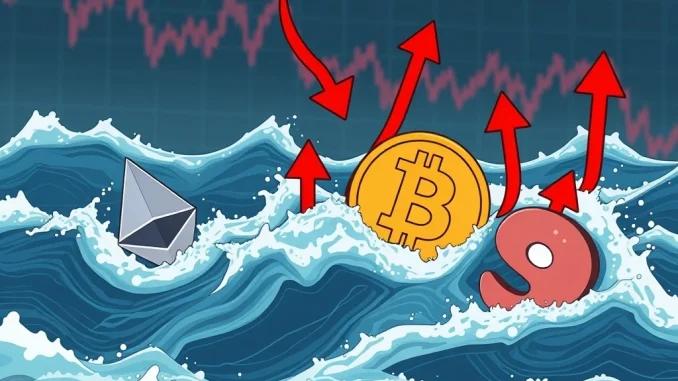
The cryptocurrency market recently experienced a dramatic downturn. This resulted in a staggering wave of **ETH liquidations** and other digital assets. Over the past 24 hours, a brutal $421 million in liquidations swept across the market. Long positions, betting on price increases, faced the harshest impact. This event underscores the inherent volatility of **perpetual futures** trading and the significant risks involved.
Understanding Crypto Liquidations: What Happened?
A **crypto liquidation** occurs when an exchange forcefully closes a trader’s leveraged position. This happens due to a partial or total loss of the trader’s initial margin. Essentially, the market moved against their bet. For instance, if a trader opens a ‘long’ position, they expect the price to rise. If the price falls significantly, their position is liquidated to prevent further losses for the exchange.
This recent market movement saw considerable pressure on leveraged traders. Data reveals that Ethereum (ETH) perpetual futures alone accounted for a massive $220 million in liquidations. Notably, 62.24% of these were long positions. This indicates a sharp decline in ETH’s price, catching many bullish traders off guard. Such events are common in highly leveraged markets. They serve as a stark reminder of the rapid shifts that can occur.
Bitcoin Liquidations Follow Ethereum’s Lead
Following closely behind Ethereum, **Bitcoin liquidations** also saw substantial figures. BTC futures recorded $160 million in liquidations during the same 24-hour period. A significant 71.05% of these were long positions. This pattern mirrors ETH’s performance, suggesting a broader market downtrend. Bitcoin, as the largest cryptocurrency, often influences the sentiment of the entire market. Its price movements frequently trigger cascading effects across altcoins.
When Bitcoin experiences a sharp drop, traders holding leveraged long positions face immense pressure. Their collateral quickly diminishes. Consequently, exchanges automatically close these positions. This prevents their account balance from falling below zero. The large percentage of long liquidations highlights widespread bullish sentiment before the price drop. Traders anticipated further gains, yet the market had other plans.
Solana Liquidations Add to Market Turmoil
The impact of the market downturn was not limited to just ETH and BTC. **Solana liquidations** also contributed significantly to the overall total. SOL futures saw $41.21 million in liquidations. Here too, long positions constituted the majority, specifically 67.83%. Solana has gained popularity as a high-performance blockchain. Its ecosystem has attracted considerable investment and trading activity. Therefore, its futures market is also highly active and susceptible to volatility.
These liquidation events across major cryptocurrencies paint a clear picture. The market experienced a sudden and sharp correction. Leveraged traders who were betting on continued upward momentum bore the brunt. Understanding these dynamics is crucial for any participant in the crypto space. It emphasizes the importance of risk management. Furthermore, it highlights the unpredictable nature of digital asset prices.
The Role of Perpetual Futures in Market Volatility
The term **perpetual futures** refers to a type of derivative contract. Unlike traditional futures, they have no expiry date. This allows traders to hold positions indefinitely. However, they come with a funding rate mechanism. This rate helps peg the contract price to the spot price. Perpetual futures also allow for high leverage. This means traders can control large positions with a relatively small amount of capital.
While leverage can amplify gains, it also dramatically magnifies losses. A small price movement against a highly leveraged position can quickly lead to liquidation. This recent $421 million event serves as a prime example. It demonstrates the inherent risks associated with using high leverage in a volatile market. Traders must always consider their risk tolerance. They should also implement robust risk management strategies.
Mitigating Risks in Leveraged Crypto Trading
For traders engaging in **perpetual futures**, managing risk is paramount. Here are some key strategies to consider:
- Use Lower Leverage: While tempting, high leverage dramatically increases liquidation risk. Opting for lower leverage can provide more breathing room during market fluctuations.
- Set Stop-Loss Orders: A stop-loss order automatically closes a position when it reaches a certain price. This limits potential losses and prevents full liquidation.
- Diversify Your Portfolio: Avoid putting all capital into one highly leveraged position. Diversification can spread risk across different assets or trading strategies.
- Monitor Funding Rates: High positive funding rates can indicate an overheated long market, potentially signaling a correction. Conversely, negative rates might suggest an oversold short market.
- Understand Market Sentiment: While not always predictive, understanding the prevailing market sentiment can offer clues about potential price movements and liquidation risks.
These practices are essential for navigating the complex and often unpredictable crypto futures market. They help protect capital during periods of high volatility. Furthermore, they contribute to more sustainable trading practices.
Conclusion: Navigating the Turbulent Crypto Seas
The recent wave of liquidations, led by Ethereum and impacting Bitcoin and Solana, highlights a critical aspect of cryptocurrency trading: volatility. While **perpetual futures** offer significant opportunities for profit, they also carry substantial risks, especially for leveraged long positions. This event serves as a potent reminder for all traders. Prudent risk management, informed decision-making, and a deep understanding of market mechanics are not just advisable; they are absolutely essential for survival in the dynamic crypto landscape. Staying informed and cautious remains the best approach.
Frequently Asked Questions (FAQs)
Q1: What exactly are crypto liquidations?
A1: Crypto liquidations occur when an exchange forcibly closes a trader’s leveraged position. This happens because the market price moves against their bet, causing their margin (collateral) to fall below a certain threshold. It prevents the trader’s account from incurring a negative balance.
Q2: Why were long positions hit hardest during this event?
A2: Long positions are bets that an asset’s price will increase. When the market experiences a sudden and significant price drop, as it did, these long positions quickly lose value. If the losses exceed the margin held, the positions are liquidated to cover potential debt.
Q3: What are perpetual futures and how do they differ from traditional futures?
A3: Perpetual futures are a type of derivative contract that allows traders to speculate on the future price of an asset without an expiry date. Unlike traditional futures, which have a fixed settlement date, perpetual futures can be held indefinitely, but they use a funding rate mechanism to keep their price close to the spot market.
Q4: How can traders protect themselves from liquidation?
A4: Traders can protect themselves by using lower leverage, setting stop-loss orders to limit potential losses, diversifying their portfolios, and closely monitoring market conditions and funding rates. Understanding risk management is crucial.
Q5: Is this level of liquidation common in the crypto market?
A5: Significant liquidation events are not uncommon in the highly volatile cryptocurrency market, especially during periods of sharp price movements. They are a regular feature of leveraged trading and can occur when market sentiment shifts rapidly or unexpected news emerges.