The **Ethereum market** currently flashes a critical warning. Recent analysis indicates that the **ETH derivatives** sector is exhibiting concerning signs of overheating. This development suggests heightened risk for traders and the broader ecosystem. Understanding these indicators is crucial for anyone involved in cryptocurrency.
Understanding the **ETH Derivatives** Surge
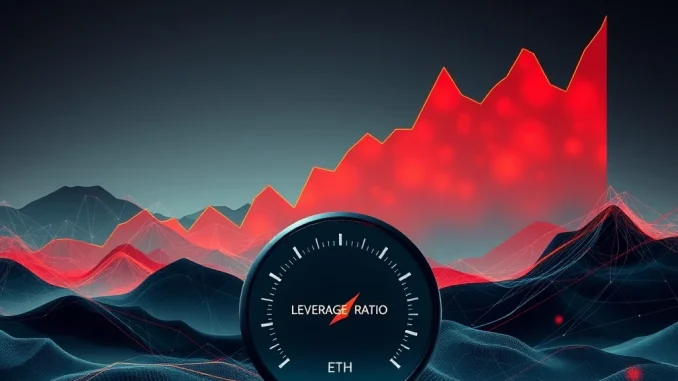
The **ETH derivatives** market is experiencing a significant surge. Specifically, Binance’s Estimated Leverage Ratio (ELR) for ETH has reached an unprecedented 0.53. This metric, as reported by Cointelegraph, is a vital indicator. It quantifies the amount of leverage employed by traders. The ELR is calculated by dividing the total open interest by the exchange’s reserves. A higher ratio typically points to excessive market optimism. Consequently, it also signals an increased risk of substantial forced liquidations. Therefore, market participants should exercise caution.
The **Leverage Ratio** Explained: A Double-Edged Sword
The **leverage ratio** offers deep insights into market sentiment. Essentially, it shows how much borrowed capital traders are using. When this ratio climbs, it means more traders are taking on bigger risks. They aim for larger profits from smaller price movements. However, this strategy carries significant peril. Elevated leverage makes the market highly susceptible to rapid price swings. Even a small correction can trigger a cascade of selling pressure. This leads directly to **crypto liquidations**, where positions are forcibly closed. This process can quickly amplify market downturns, creating a cycle of fear.
Key points about the leverage ratio:
- It reflects market sentiment and trader confidence.
- A high ratio suggests aggressive risk-taking.
- It increases the vulnerability to sudden price drops.
- It can trigger mass **crypto liquidations**, harming the **Ethereum market**.
Navigating **ETH Price** Volatility: Key Technical Levels
From a technical perspective, the **ETH price** faces a pivotal moment. Short-term momentum remains largely positive, which is encouraging. However, the crucial question revolves around the sustainability of the current rally. Analysts are closely watching key resistance and support levels. If ETH fails to reclaim the $4,700 mark, its upward movement could stall. This might confine the asset to a trading range between $4,350 and $4,700. A decisive drop below $4,350 would be a bearish signal. Such a move could potentially trigger a broader seasonal correction. Traders must monitor these levels diligently.
Important price thresholds to watch:
- $4,700: A critical resistance level for sustained upward movement.
- $4,350: A key support level; a break below could signal a correction.
- Range-bound potential: If $4,700 is not reclaimed, ETH might trade between $4,350 and $4,700.
What This Means for the **Ethereum Market**
The current situation in the **Ethereum market** demands a cautious approach. While optimism is natural in a bull market, excessive leverage introduces fragility. The all-time high ELR for ETH highlights this potential instability. Market participants should prioritize risk management. Understanding the implications of high leverage can prevent significant losses. Historically, periods of extreme optimism often precede market corrections. Therefore, prudence is paramount. Monitoring these derivatives metrics offers valuable foresight into potential shifts.
The convergence of an overheated derivatives market and critical technical price levels creates a complex scenario. Investors should consider diversifying portfolios. They should also maintain realistic expectations for short-term gains. The underlying strength of Ethereum’s technology remains undisputed. However, market dynamics can introduce considerable volatility. Vigilance will be key for navigating the coming weeks.
Conclusion
The **ETH derivatives** market currently shows clear signs of overheating. Binance’s record-high Estimated Leverage Ratio underscores this risk. While the **ETH price** has shown positive momentum, its sustainability remains uncertain. Traders and investors must pay close attention to key technical levels. A failure to hold crucial support or break significant resistance could lead to increased volatility and **crypto liquidations**. The overall **Ethereum market** requires a careful and informed strategy during this period of elevated leverage. Staying informed and managing risk effectively are crucial steps for all participants.
Frequently Asked Questions (FAQs)
What does an ‘overheating’ ETH derivatives market mean?
An ‘overheating’ ETH derivatives market signifies that traders are using an exceptionally high amount of leverage. This means they are borrowing heavily to amplify their positions. This increases both potential gains and, more importantly, potential losses, making the market more volatile and prone to sharp corrections.
How is the Estimated Leverage Ratio (ELR) calculated?
The Estimated Leverage Ratio (ELR) is calculated by dividing the total open interest (the total number of outstanding derivatives contracts) by the exchange’s reserves (the amount of cryptocurrency held by the exchange). A higher ratio indicates greater leverage being used by traders.
Why is a high leverage ratio dangerous for the Ethereum market?
A high leverage ratio makes the Ethereum market highly vulnerable to sudden price drops. When prices fall, leveraged positions quickly incur losses. This can trigger forced liquidations, where exchanges automatically close these positions. These liquidations create selling pressure, which can accelerate the price decline and cause a cascade effect.
What are the critical ETH price levels to watch?
According to analysis, the critical resistance level for ETH is $4,700. If ETH cannot reclaim this level, it might trade within a range. The key support level is $4,350; a break below this could signal a seasonal correction.
How can traders mitigate risks in an overheated market?
Traders can mitigate risks by reducing their leverage, setting strict stop-loss orders, taking profits at key resistance levels, and diversifying their portfolios. Avoiding over-exposure to a single asset and maintaining a cautious approach are also crucial strategies.
Does an overheated derivatives market always lead to a price crash?
While an overheated derivatives market significantly increases the risk of a correction or crash, it does not guarantee one. It is an indicator of heightened vulnerability. Other factors, such as broader market sentiment, macroeconomic news, and fundamental developments for Ethereum, also play a role in price movements.