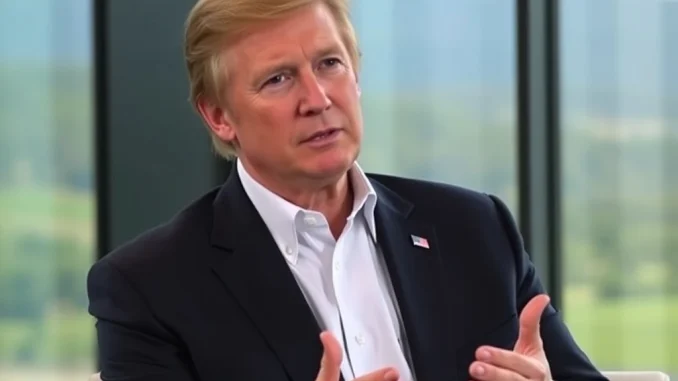
The financial world often buzzes with predictions about its future. Recently, Eric Trump, co-founder of World Liberty Financial (WLFI) and son of former President Donald Trump, made a significant declaration. He firmly believes the blockchain future of finance is not just a possibility but an inevitability. This statement, made during a CNN interview, highlights a growing recognition of decentralized technologies across the globe.
Eric Trump’s Stance on Blockchain Innovation
Eric Trump’s remarks underscore a profound conviction regarding blockchain’s transformative power. He articulated his belief that this technology will fundamentally reshape financial systems. Indeed, his involvement with World Liberty Financial suggests a practical interest in innovative financial solutions. Many industry observers interpret his comments as a strong endorsement for digital asset evolution. Furthermore, such high-profile support can significantly influence public perception. Eric Trump blockchain advocacy brings a notable voice to the discussion. His perspective adds weight to the ongoing dialogue about financial modernization and technological advancement.
Understanding President Trump’s Crypto Industry Support
Interestingly, Eric Trump also shared insights into his father’s views on the crypto space. He mentioned never discussing cryptocurrency directly with his father. However, Eric Trump stated his belief that the former President is a “strong supporter of the crypto industry.” This distinction is important. It implies an understanding of the broader digital asset landscape. President Trump’s administration saw various discussions surrounding digital currencies. His stance, as interpreted by his son, suggests a positive inclination towards innovation. Consequently, this perceived support could inspire further confidence among investors and developers. The implications for President Trump crypto views are widely discussed within financial circles.
World Liberty Financial and Digital Transformation
Eric Trump’s association with World Liberty Financial (WLFI) provides context for his statements. WLFI aims to integrate modern financial solutions. Therefore, their focus naturally extends to emerging technologies like blockchain. This connection suggests a strategic alignment with future financial trends. The company’s initiatives could potentially leverage blockchain for enhanced security and efficiency. Ultimately, WLFI’s role might involve pioneering new applications for distributed ledger technology. Their efforts contribute to the broader adoption of these systems. This strategic positioning highlights a proactive approach to evolving financial landscapes.
The Broader Implications for Cryptocurrency Adoption
High-profile endorsements, like Eric Trump’s, often accelerate public acceptance. When figures from traditional business and political spheres voice support, it legitimizes the technology. This can reduce skepticism among mainstream investors. Consequently, it paves the way for wider cryptocurrency adoption. Such statements encourage institutions to explore blockchain’s potential. They also foster a more receptive environment for regulatory frameworks. Moreover, increased awareness can drive demand for blockchain-based services. The overall impact on the digital economy is substantial, marking a shift towards digital assets.
The Road Ahead for Blockchain Technology in Finance
Blockchain technology promises several advancements for the financial sector. It offers enhanced transparency and improved security. Transaction speeds can also increase significantly. Furthermore, it can reduce operational costs. However, challenges remain, including scalability and regulatory clarity. The industry is actively working to address these issues. Experts predict a gradual integration of blockchain solutions. This will likely occur across various financial services. From payments to asset management, blockchain’s potential is vast. The journey towards a fully decentralized financial system continues. It presents both opportunities and hurdles for innovators and established institutions alike.
Eric Trump’s declaration about the blockchain future of finance marks a significant moment. His endorsement, coupled with insights into President Trump’s perceived support, adds considerable weight to the crypto conversation. These statements highlight a growing acceptance of digital assets and blockchain technology. They signal a future where decentralized systems play a central role in global finance. The ongoing evolution of this space promises continued innovation and transformation for economies worldwide.
Frequently Asked Questions (FAQs)
What did Eric Trump say about blockchain?
Eric Trump, co-founder of World Liberty Financial, stated in a CNN interview that he firmly believes blockchain is the future of finance. He emphasized its transformative potential for financial systems.
Does Eric Trump discuss cryptocurrency with his father, Donald Trump?
No, Eric Trump mentioned that he has never discussed cryptocurrency directly with his father. However, he believes President Trump is a strong supporter of the crypto industry.
What is World Liberty Financial (WLFI)?
World Liberty Financial (WLFI) is a company co-founded by Eric Trump. It focuses on modern financial solutions and likely explores emerging technologies like blockchain for its services and strategic initiatives.
Why is blockchain considered the future of finance?
Blockchain offers enhanced security, transparency, and efficiency for financial transactions. It can reduce costs, speed up processes, and create more robust financial systems through decentralization and immutable ledgers.
How do high-profile endorsements impact cryptocurrency adoption?
Endorsements from prominent figures like Eric Trump can significantly boost public confidence and legitimacy for blockchain and cryptocurrencies. This often leads to increased mainstream interest, investment, and broader adoption.
What are some challenges facing blockchain technology in finance?
Key challenges include achieving greater scalability to handle high transaction volumes, ensuring regulatory clarity across different jurisdictions, and overcoming integration complexities with existing traditional financial infrastructure.