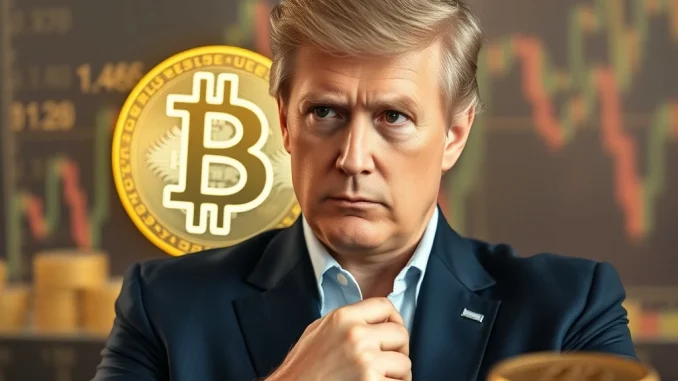
Eric Trump, the prominent second son of former President Donald Trump, recently made a significant statement regarding Bitcoin. He declared Bitcoin the “modern-day gold” during an interview with CNBC. Furthermore, Trump suggested that cryptocurrency represents the undeniable future of financial markets. Walter Bloomberg reported these comments via X, sparking widespread discussion across the crypto community and traditional finance sectors alike.
Eric Trump Bitcoin Endorsement: A Powerful Statement
The endorsement from a figure like Eric Trump carries considerable weight. His family name is synonymous with business and public discourse. Consequently, his comments draw attention to Eric Trump Bitcoin views. He views the leading digital asset as a contemporary alternative to traditional safe-haven assets. This perspective aligns with a growing narrative within the crypto space.
- Bitcoin offers decentralization.
- It provides scarcity, similar to gold.
- Its global accessibility appeals to many investors.
Many proponents argue that Bitcoin shares key characteristics with gold. It possesses a finite supply. This characteristic makes it resistant to inflation. Additionally, no single entity controls its issuance. This decentralization prevents manipulation by governments or central banks. Therefore, its appeal as a store of value grows.
Bitcoin as Modern-Day Gold: An In-Depth Comparison
The comparison of Bitcoin to modern-day gold is not new. However, it gains traction with high-profile endorsements. Gold has historically served as a hedge against economic uncertainty. It also acts as a reliable store of value. Bitcoin enthusiasts contend that the digital currency fulfills these roles in the 21st century. Gold is physical, requiring secure storage. Bitcoin, in contrast, is digital and portable. Users can store it on a hardware wallet or even in their minds through a seed phrase. This digital nature offers unparalleled convenience.
Furthermore, Bitcoin’s verifiable scarcity stands out. Only 21 million Bitcoins will ever exist. This hard cap makes it inherently deflationary. Gold mining, conversely, continues to discover new reserves. This means gold’s supply can theoretically increase, albeit slowly. Consequently, Bitcoin’s predictable supply schedule makes it a compelling alternative.
Key Similarities and Differences:
- Scarcity: Both are scarce assets. Bitcoin has a fixed supply limit, while gold’s supply increases slowly.
- Store of Value: Both are considered stores of value, especially during economic downturns.
- Portability: Bitcoin is highly portable and easily transferable globally. Gold is physical and less portable.
- Divisibility: Bitcoin is highly divisible into satoshis. Gold is less divisible in practical terms.
- Decentralization: Bitcoin is decentralized. Gold’s market is influenced by central banks and large institutions.
The Cryptocurrency Future: Reshaping Financial Markets
Eric Trump’s statement also emphasized that cryptocurrency future is bright. He sees it as the future of financial markets. This vision suggests a world where digital assets play a central role. Traditional banking systems often involve intermediaries. They also incur significant fees and delays. Blockchain technology, underpinning cryptocurrencies, offers a different model. It promises faster, cheaper, and more transparent transactions.
Indeed, the adoption of digital assets extends beyond just Bitcoin. Ethereum, stablecoins, and various altcoins contribute to a burgeoning ecosystem. These technologies enable decentralized finance (DeFi), non-fungible tokens (NFTs), and Web3 applications. Consequently, these innovations are slowly but surely transforming how people interact with money and assets. Governments worldwide are also exploring central bank digital currencies (CBDCs). This further validates the shift towards digital money.
Digital Assets: A Paradigm Shift in Investment
The rise of digital assets represents a significant paradigm shift. Investors are increasingly diversifying their portfolios with cryptocurrencies. Institutional interest has surged over recent years. Major financial institutions now offer crypto-related services. These include custody solutions and investment products like Bitcoin ETFs. This institutional embrace lends credibility to the asset class. It also facilitates easier access for retail investors.
Moreover, the technological advancements in blockchain continue to impress. Scalability solutions are improving transaction speeds. Enhanced security measures protect user funds. These developments address some of the earlier concerns surrounding cryptocurrencies. As a result, digital assets are moving from niche investments to mainstream financial instruments. They challenge traditional notions of value and ownership.
Navigating the Evolving Financial Markets Landscape
The assertion that cryptocurrency will define future financial markets highlights an ongoing transformation. Traditional markets are adapting to this new digital reality. Stock exchanges are exploring tokenized securities. Banks are leveraging blockchain for cross-border payments. The convergence of traditional finance (TradFi) and decentralized finance (DeFi) is a key trend. This convergence could lead to hybrid financial systems. These systems would combine the best aspects of both worlds.
However, challenges remain. Regulatory frameworks are still evolving globally. Market volatility can be significant. Security risks, while decreasing, persist. Despite these hurdles, the momentum for digital assets is undeniable. Many experts believe that cryptocurrencies will not replace traditional finance entirely. Instead, they will integrate and coexist, creating a more efficient and inclusive global financial system. Eric Trump’s comments reflect this optimistic outlook for the future.
Conclusion: A Glimpse into Tomorrow’s Economy
Eric Trump’s remarks serve as a potent reminder of Bitcoin’s growing influence. His comparison of Bitcoin to modern-day gold underscores its perceived value. His belief in cryptocurrency as the future of financial markets signals a broader acceptance. As digital assets continue to mature, their integration into global finance seems inevitable. This evolution promises to reshape how we save, invest, and transact. Ultimately, the future looks increasingly digital, with Bitcoin at its forefront.
Frequently Asked Questions (FAQs)
Q1: What did Eric Trump say about Bitcoin?
A1: Eric Trump stated in a CNBC interview that Bitcoin is the “modern-day gold.” He also believes that cryptocurrency represents the future of financial markets, according to a report by Walter Bloomberg.
Q2: Why is Bitcoin often compared to gold?
A2: Bitcoin is compared to gold due to its scarcity, serving as a store of value, and its resistance to inflation. Both assets are seen as hedges against economic uncertainty, but Bitcoin offers digital portability and a fixed supply limit.
Q3: What does Eric Trump mean by “future of financial markets”?
A3: He implies that cryptocurrencies and blockchain technology will increasingly underpin global financial systems. This includes enabling faster, cheaper, and more transparent transactions, and fostering new financial instruments like DeFi and tokenized assets.
Q4: Are digital assets becoming mainstream?
A4: Yes, digital assets are gaining mainstream acceptance. Institutional investors are increasing their exposure. Furthermore, major financial firms offer crypto services. This indicates a growing integration into traditional investment portfolios and financial infrastructure.
Q5: What are the main challenges for the cryptocurrency future?
A5: Key challenges include evolving regulatory landscapes, market volatility, and ongoing security concerns. Despite these, continuous technological advancements and increasing adoption are addressing many of these issues.