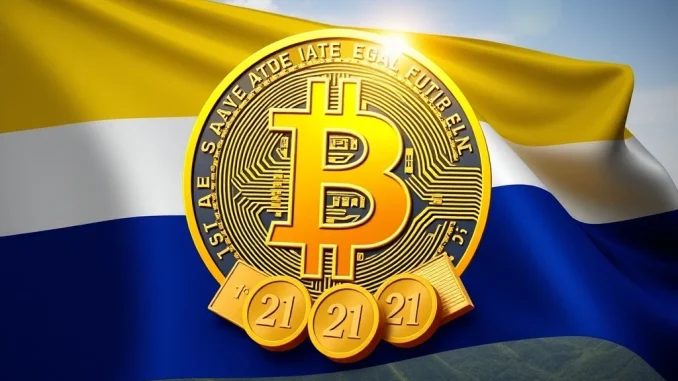
El Salvador recently made a significant move, marking a pivotal moment in its embrace of digital currency. The nation purchased 21 BTC on September 7th, commemorating the fourth anniversary of its decision to make Bitcoin legal tender. This strategic **El Salvador Bitcoin** acquisition underscores the country’s ongoing commitment to its innovative financial policy. The quantity of coins, 21, directly references Bitcoin’s fixed maximum supply of 21 million, adding a layer of symbolic depth to the purchase.
El Salvador’s Bold Bitcoin Strategy Marks Four Years
On September 7, 2021, El Salvador etched its name in financial history. It became the first sovereign nation to officially adopt Bitcoin as legal tender. This bold move sparked global debate and fascination. Now, four years later, the country continues to reinforce its position. The recent **El Salvador Bitcoin** acquisition serves as a powerful statement. It signals unwavering dedication to its pioneering digital asset strategy. This consistent approach aims to integrate Bitcoin further into the national economy.
The symbolic purchase of 21 BTC on this anniversary highlights a deep understanding of Bitcoin’s core principles. Bitcoin’s scarcity, capped at 21 million units, is a fundamental aspect of its value proposition. By mirroring this number, El Salvador communicates its long-term belief in Bitcoin’s economic model. This action also resonates with the global cryptocurrency community. It reaffirms El Salvador’s role as a key player in the ongoing evolution of digital finance.
Pioneering Bitcoin Legal Tender Status
The decision to make **Bitcoin legal tender** was revolutionary. It transformed how citizens and businesses in El Salvador interact with money. This policy allowed Bitcoin to be used for all transactions, alongside the U.S. dollar. Initially, the implementation faced challenges. However, the government pushed forward, establishing infrastructure like the Chivo wallet. This digital platform facilitated Bitcoin transactions for many Salvadorans. The goal was to boost financial inclusion and reduce remittance costs. Consequently, this initiative offered a new economic pathway for the nation.
The legal tender status provided a real-world testing ground for Bitcoin. It demonstrated its potential as a daily transactional currency. Businesses were mandated to accept Bitcoin, fostering a new digital economy. This move also attracted international attention. Many watched closely to observe the outcomes of this unprecedented experiment. Therefore, El Salvador’s journey with **Bitcoin legal tender** has offered invaluable lessons for other nations considering similar paths.
Strategic BTC Purchase and National Holdings
El Salvador’s latest **BTC purchase** is not an isolated event. It forms part of a larger, consistent strategy of Bitcoin accumulation. Under President Nayib Bukele’s leadership, the country has regularly bought Bitcoin. These purchases often coincide with market dips or significant national events. The total amount of Bitcoin held by El Salvador remains a topic of interest. These reserves are viewed as a strategic national asset. They represent a long-term investment in the future of digital currency.
The government’s approach to its Bitcoin treasury is transparent. Public announcements often accompany these acquisitions. This transparency helps build trust within the crypto community. It also showcases a commitment to the asset’s potential. By accumulating Bitcoin, El Salvador aims to diversify its national reserves. This strategy potentially hedges against traditional economic volatility. Ultimately, each **BTC purchase** reinforces the nation’s vision for a Bitcoin-centric future.
Driving Global Bitcoin Adoption Forward
El Salvador’s pioneering efforts have significantly influenced the global discourse around **Bitcoin adoption**. Its experiment demonstrates that a sovereign nation can successfully integrate a decentralized digital currency. This has encouraged other countries to explore similar possibilities. While no other nation has fully followed suit yet, many are observing closely. El Salvador provides a real-world case study for the benefits and challenges of large-scale Bitcoin integration.
Furthermore, the nation’s commitment has spurred innovation within its borders. New businesses and educational programs focused on Bitcoin have emerged. This fosters a vibrant local ecosystem. El Salvador’s example also highlights the importance of public education and robust infrastructure for successful **Bitcoin adoption**. Its journey serves as a blueprint, offering insights into the practicalities of a digital economy on a national scale.
The Future of El Salvador Cryptocurrency Initiatives
El Salvador’s vision extends beyond simply holding Bitcoin. The nation is actively pursuing several ambitious **El Salvador cryptocurrency** initiatives. One notable project is the ‘Bitcoin City’ concept. This planned city aims to be a tax-free haven for crypto innovation, powered by geothermal energy from volcanoes. Another significant undertaking involves ‘Volcano Bonds.’ These Bitcoin-backed bonds seek to fund the development of Bitcoin City and further Bitcoin infrastructure. These projects demonstrate a holistic approach to integrating digital assets.
The government continues to explore new ways to leverage Bitcoin for national development. This includes potential applications in tourism, infrastructure, and financial services. The long-term goal is to establish El Salvador as a global hub for Bitcoin and blockchain technology. These ongoing **El Salvador cryptocurrency** endeavors highlight the nation’s unwavering commitment to its digital future. They represent a bold step towards a more technologically advanced and financially inclusive society.
In conclusion, El Salvador’s purchase of 21 BTC on its fourth anniversary is more than a symbolic gesture. It is a powerful reaffirmation of a nation’s pioneering spirit in the digital age. From being the first to adopt **Bitcoin legal tender** to its ongoing strategic **BTC purchase** and ambitious future plans, El Salvador continues to lead. Its journey offers invaluable insights into the potential of **Bitcoin adoption** and the future of **El Salvador cryptocurrency** initiatives on a global scale. The world watches as this small nation continues to chart a new course for financial innovation.
Frequently Asked Questions (FAQs)
1. Why did El Salvador purchase exactly 21 BTC?
El Salvador purchased 21 BTC as a symbolic gesture. The number 21 directly references Bitcoin’s maximum supply, which is capped at 21 million coins. This highlights the country’s belief in Bitcoin’s scarcity and long-term value.
2. When did El Salvador make Bitcoin legal tender?
El Salvador officially made Bitcoin legal tender on September 7, 2021. This historic decision made it the first country in the world to adopt Bitcoin as an official currency.
3. What are the main goals of El Salvador’s Bitcoin strategy?
El Salvador’s Bitcoin strategy aims to achieve several goals: promoting financial inclusion, reducing remittance costs, attracting foreign investment, boosting tourism, and diversifying national reserves. It also seeks to position the country as a leader in digital finance.
4. What is the ‘Volcano Bond’ initiative?
The ‘Volcano Bond’ is a proposed financial instrument by El Salvador, backed by Bitcoin. The funds raised from these bonds are intended to finance the construction of ‘Bitcoin City’ and expand the country’s Bitcoin mining infrastructure, powered by geothermal energy.
5. How has Bitcoin adoption impacted the average Salvadoran citizen?
Bitcoin adoption has introduced new financial tools, such as the Chivo wallet, allowing many unbanked citizens to access digital payments. It has also enabled easier and cheaper international remittances, directly benefiting families receiving money from abroad. However, challenges related to education and technological access persist.