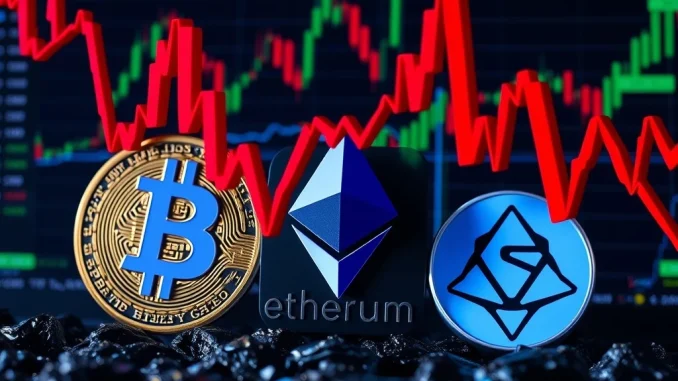
The cryptocurrency market often experiences sudden shifts. Recently, a significant event occurred, leading to substantial **crypto liquidations** across major digital assets. Over a 24-hour period, a staggering $156 million in leveraged positions were closed. This financial wipeout affected traders holding Bitcoin (BTC), Ethereum (ETH), and Solana (SOL) futures contracts. Understanding these events is crucial for anyone involved in the volatile world of crypto trading.
Understanding Recent Crypto Liquidations
Crypto liquidations happen when a trader’s leveraged position is forcibly closed. This occurs because they cannot meet the margin requirements. Essentially, the market moves against their bet, and their collateral is no longer sufficient. These events are common in the **futures market**, where traders use borrowed funds to amplify potential gains. However, leverage also magnifies losses. Therefore, even small price movements can trigger large-scale liquidations. Such occurrences often indicate periods of high market volatility. They also highlight the inherent risks associated with leveraged trading.
Bitcoin Liquidations: The King’s Exposure
Bitcoin, the leading cryptocurrency, also faced considerable pressure. Over the last 24 hours, **Bitcoin liquidations** totaled $39.33 million. A significant portion of these were long positions, accounting for 57.86%. This means many traders were betting on BTC’s price to rise. When the price instead fell, their positions were automatically closed. Such events can create further selling pressure. They contribute to downward price movements in the short term. This demonstrates how quickly market sentiment can shift for even the most established digital asset.
Ethereum Liquidations: ETH’s Significant Plunge
Ethereum experienced the largest liquidation volume among the major cryptocurrencies. **Ethereum liquidations** reached $89.14 million within 24 hours. Long positions constituted a substantial 73.05% of this total. This indicates a strong bullish sentiment among ETH traders before the price drop. Many expected Ethereum to climb higher. However, market forces moved in the opposite direction. This led to a cascade of forced selling. The high volume of ETH liquidations underscores its sensitivity to market fluctuations. It also highlights the widespread use of leverage in its futures market.
Solana Liquidations: A Surprising Short Squeeze?
Solana, a prominent altcoin, also saw significant activity. **SOL liquidations** amounted to $27.90 million. Interestingly, short positions accounted for 57.97% of this total. This differs from BTC and ETH, where long liquidations dominated. A high percentage of short liquidations often suggests a rapid price increase. Traders betting on a price decline were caught off guard. Their positions were then closed out. This type of event is sometimes called a short squeeze. It can lead to further upward momentum as shorts cover their positions. Therefore, SOL’s liquidation pattern points to a distinct market dynamic during this period.
The Mechanics Behind Futures Market Turmoil
The **futures market** is a complex environment. Traders enter into contracts to buy or sell an asset at a predetermined price on a future date. Perpetual futures contracts are unique. They have no expiration date. This makes them popular for speculative trading. However, they also come with inherent risks. Leverage allows traders to control large positions with a relatively small amount of capital. For example, 10x leverage means a $1,000 investment controls $10,000 worth of crypto. While this can amplify profits, it also means a small 10% price move against the position can wipe out the initial capital. This is when liquidations occur.
Market volatility is a primary trigger for these events. Sudden price swings can quickly push positions past their liquidation price. When one position is liquidated, it can create a ripple effect. This causes further price movement. Consequently, more liquidations may follow. This chain reaction is known as a liquidation cascade. It often exacerbates market downturns or rallies. Understanding these mechanisms helps traders appreciate the amplified risks in leveraged trading environments. Furthermore, it highlights the importance of prudent risk management strategies.
Implications for Crypto Traders
These liquidation events carry significant implications for individual crypto traders. First, they represent substantial financial losses for those involved. Second, they serve as a stark reminder of the dangers of over-leveraging. Many new traders are drawn to the promise of high returns. They may not fully grasp the risks. Moreover, large liquidations can impact market sentiment. They often create fear and uncertainty. This can lead to further selling pressure across the broader market. Therefore, traders must always prioritize risk management. They should use stop-loss orders. They also need to manage their position sizes carefully. Avoiding excessive leverage is a critical step for long-term success in the volatile crypto space.
Navigating Volatility: Lessons from Crypto Liquidations
The recent wave of **crypto liquidations** offers valuable lessons. It underscores the unpredictable nature of the cryptocurrency market. Even major assets like Bitcoin and Ethereum are not immune to rapid price changes. Solana’s distinct liquidation pattern further shows diverse market dynamics. Traders must remain vigilant. They need to adapt their strategies. Moreover, market participants should prioritize education. Understanding the mechanics of perpetual futures is essential. Knowledge of leverage and margin trading is also vital. This approach helps in making informed decisions. It also helps in mitigating potential losses.
Ultimately, these events highlight the importance of responsible trading. The allure of quick profits can be strong. However, a disciplined approach is paramount. This includes setting realistic expectations. It also means managing risk effectively. By doing so, traders can better navigate the inherent volatility. They can also protect their capital. The **futures market** will continue to be a battleground for bulls and bears. Therefore, vigilance and caution remain key for all participants.
Frequently Asked Questions (FAQs)
What exactly are crypto liquidations?
Crypto liquidations occur when a trader’s leveraged position is automatically closed by an exchange. This happens because the market price moves against their trade, causing their margin (collateral) to fall below a required threshold. The exchange closes the position to prevent further losses.
Why did Bitcoin liquidations primarily involve long positions?
Bitcoin liquidations predominantly involved long positions (57.86%) because a majority of traders were betting on BTC’s price to increase. When the price instead declined, these bullish bets were liquidated as they could no longer meet their margin requirements.
How do Ethereum liquidations compare to Bitcoin’s?
Ethereum liquidations were significantly higher, totaling $89.14 million compared to Bitcoin’s $39.33 million. Both saw a majority of long positions liquidated, with ETH having an even higher percentage (73.05%) of long liquidations, indicating a strong bullish sentiment that was ultimately unwound.
What does it mean when SOL liquidations are mostly short positions?
When SOL liquidations are mostly short positions (57.97%), it suggests that traders betting on Solana’s price to fall were caught off guard by a price increase. This forced them to close their positions, often contributing to further upward price momentum in what is known as a short squeeze.
What is the role of the futures market in these liquidation events?
The futures market is where these liquidations primarily occur. It allows traders to use leverage, meaning they trade with borrowed funds. While leverage can amplify profits, it also magnifies losses, making positions highly susceptible to liquidation during periods of market volatility.
How can traders protect themselves from crypto liquidations?
Traders can protect themselves by using less leverage, setting stop-loss orders to limit potential losses, managing their position sizes, and maintaining sufficient margin in their accounts. Understanding market risks and avoiding emotional trading are also crucial strategies.