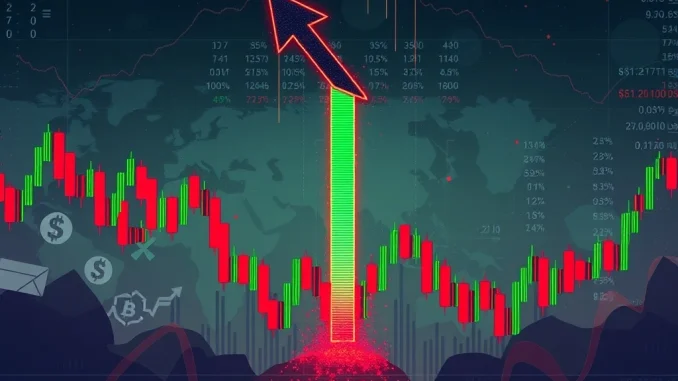
The cryptocurrency market just experienced a seismic event that sent ripples through trading desks globally. In a breathtaking display of market dynamics, a staggering $102 million worth of crypto liquidations occurred in just one hour, contributing to a colossal $751 million wiped out over the past 24 hours. These figures aren’t just numbers; they represent immense pressure, swift price movements, and a stark reminder of the inherent risks in highly leveraged trading. If you’re involved in the crypto space, understanding these events is not just important—it’s crucial for navigating the unpredictable currents of digital assets.
Understanding the Avalanche of Crypto Liquidations
When we talk about crypto liquidations, we’re referring to the forced closure of a trader’s leveraged position by an exchange. This happens when a trader’s margin balance falls below the maintenance margin requirement. Essentially, if the market moves against a highly leveraged position, the exchange automatically closes it to prevent further losses and protect its own solvency. It’s a mechanism designed to manage risk, but for traders, it means losing their collateral.
Think of it like this:
- You borrow money (leverage) to amplify your potential gains from a crypto trade.
- You put down a smaller amount of your own capital (margin) as collateral.
- If the price moves favorably, your gains are magnified.
- If the price moves unfavorably, your losses are also magnified.
- If your losses eat too much into your margin, the exchange steps in and liquidates your position to prevent you from losing more than your collateral, and to prevent them from losing money.
The recent figures indicate a rapid and widespread deleveraging event, where many traders who were betting on a particular price direction saw their positions wiped out in quick succession. This often creates a cascading effect, where one liquidation triggers another, exacerbating price movements.
The Mechanics of Futures Liquidated: A Closer Look at Leverage
The term ‘futures liquidated‘ specifically points to the derivatives market, where traders speculate on the future price of an asset without owning the underlying asset itself. Futures contracts are a popular tool for both hedging and speculation, but they come with significant risks due to the use of leverage.
Here’s a simplified breakdown of how it works:
- Opening a Position: A trader opens a long (betting on price increase) or short (betting on price decrease) position using leverage, e.g., 10x or 50x.
- Margin Requirement: They deposit a small percentage of the total trade value as initial margin.
- Price Movement: If the price moves against their position, their equity (value of their position minus borrowed funds) starts to diminish.
- Margin Call & Liquidation: If the equity drops to a certain level (maintenance margin), the exchange issues a margin call, requesting more funds. If the trader fails to add more collateral quickly, or if the price drops too fast, the position is automatically liquidated.
The sheer volume of $102 million in an hour suggests a sudden, sharp price swing that caught many highly leveraged traders off guard. This often happens during periods of high volatility, where even small percentage changes in price can lead to significant losses for leveraged positions.
Navigating Extreme Market Volatility: Causes and Consequences
The crypto market is infamous for its market volatility, and events like these liquidations are a direct consequence. Several factors contribute to this:
- Macroeconomic Factors: Global economic data, inflation reports, interest rate changes, and geopolitical events can all influence investor sentiment and risk appetite.
- Regulatory News: Announcements from governments or financial bodies regarding crypto regulation can cause immediate and significant price reactions.
- Whale Movements: Large holders (whales) moving significant amounts of crypto can signal potential large trades, creating uncertainty.
- Liquidation Cascades: As mentioned, liquidations themselves can trigger further liquidations, creating a domino effect that amplifies price swings.
- Speculative Nature: A significant portion of crypto trading is speculative, making the market highly sensitive to news and sentiment.
The consequences of such volatility are far-reaching. For individual traders, it means potential rapid loss of capital. For the broader market, it can lead to reduced confidence, increased fear, and a ‘flight to safety’ as investors pull out of riskier assets. However, for some experienced traders, volatility also presents opportunities for quick gains, albeit with higher risks.
Actionable Insights for Crypto Trading in Turbulent Times
Given the inherent risks highlighted by these massive liquidations, how can you approach crypto trading more safely and effectively? Here are some actionable insights:
1. Master Risk Management
This is paramount. Never trade with money you cannot afford to lose. Define your risk tolerance before entering any trade. For every trade, consider:
- Position Sizing: Only allocate a small percentage of your total portfolio to any single trade, especially leveraged ones.
- Stop-Loss Orders: Always set a stop-loss order. This automatically closes your position if the price reaches a certain unfavorable level, limiting your potential losses.
- Take-Profit Orders: Similarly, consider setting take-profit orders to secure gains at predefined levels.
2. Understand Leverage
While leverage can amplify gains, it equally amplifies losses. Many experts advise against using high leverage, especially for beginners. Start with lower leverage (e.g., 2x-5x) if you must use it, and only when you fully comprehend the associated risks.
3. Diversify Your Portfolio
Don’t put all your eggs in one basket. Diversifying across different cryptocurrencies and even other asset classes can help mitigate risk during market downturns.
4. Stay Informed, Not Overwhelmed
Keep an eye on market news, but avoid making impulsive decisions based on every headline. Understand the fundamental drivers of the assets you trade.
5. Practice with Paper Trading
Many exchanges offer paper trading accounts where you can practice with virtual money. This is an excellent way to test strategies and get comfortable with the platform without risking real capital.
The Dominance of Bitcoin Futures in Liquidation Events
While the recent liquidations affected various cryptocurrencies, it’s often the case that Bitcoin futures lead the pack in terms of liquidation volume. Why is this? Bitcoin is the largest cryptocurrency by market capitalization and often acts as the bellwether for the entire crypto market. Its price movements tend to dictate the broader market sentiment.
Furthermore, Bitcoin futures contracts are the most liquid and widely traded derivatives in the crypto space. This means more traders are using leverage on Bitcoin, making it more susceptible to large-scale liquidations during periods of high volatility. When Bitcoin experiences a significant price swing, the ripple effect on altcoins and their respective futures markets is often immediate and profound.
The sheer volume of $751 million in liquidations over 24 hours underscores the interconnectedness of the crypto market. A major move in Bitcoin can cascade through Ethereum, Solana, and other altcoins, leading to widespread deleveraging across the board.
Summary: Navigating the Crypto Storm
The recent $102 million in futures liquidated within an hour, part of a staggering $751 million in 24 hours, serves as a powerful reminder of the inherent risks and rewards in the cryptocurrency market. These events highlight the critical importance of understanding leveraged trading, managing risk effectively, and being prepared for extreme market volatility. While the crypto space offers incredible opportunities, it demands respect for its unpredictable nature. By adopting prudent trading strategies, staying informed, and prioritizing capital preservation, traders can better navigate these turbulent waters and potentially emerge stronger.
Frequently Asked Questions (FAQs)
1. What exactly is a crypto liquidation?
A crypto liquidation is the automatic closure of a trader’s leveraged position by an exchange. This occurs when the value of the trader’s collateral (margin) falls below a certain threshold, known as the maintenance margin, due to unfavorable price movements. The exchange liquidates the position to prevent further losses for both the trader and the exchange.
2. Why do futures get liquidated?
Futures positions get liquidated primarily because they involve leverage. Traders borrow funds to amplify their potential returns, but this also magnifies potential losses. If the market moves against a leveraged position to a point where the trader’s margin is insufficient to cover potential losses, the exchange will liquidate the position to protect itself and the trader’s remaining capital.
3. How does market volatility affect my crypto investments?
Market volatility means rapid and significant price swings. For spot investments (non-leveraged), high volatility can lead to quick gains or losses in your portfolio’s value. For leveraged positions, high volatility dramatically increases the risk of liquidation, as even small adverse price movements can quickly deplete your margin and trigger forced closures.
4. What are the biggest risks in crypto futures trading?
The biggest risks in crypto futures trading include: high leverage leading to amplified losses, rapid liquidations during volatile periods, counterparty risk (though less common with reputable exchanges), and the potential for significant capital loss if risk management strategies are not strictly followed.
5. How can I protect myself from liquidations?
To protect yourself from liquidations, you should: avoid excessive leverage, always use stop-loss orders to limit potential losses, maintain sufficient margin in your account, diversify your portfolio, and continuously educate yourself on market dynamics and risk management techniques. Only trade with capital you are prepared to lose.