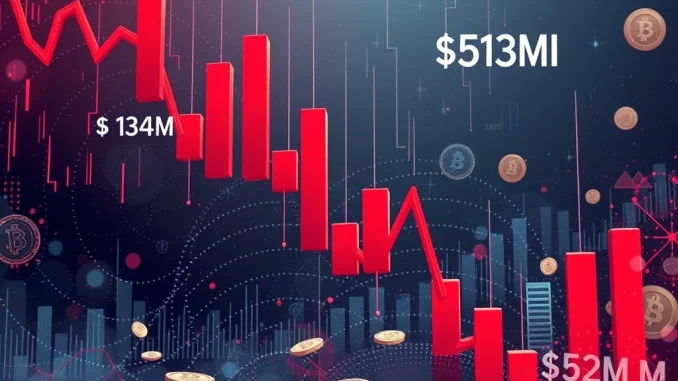
The cryptocurrency market recently experienced a significant event. Major exchanges recorded a **sudden wipeout** of **$134 million worth of futures liquidated** in just one hour. This rapid downturn underscores the inherent volatility in digital asset markets. Over the past 24 hours, the total figure climbed to an alarming **$532 million worth of futures liquidated**. This substantial sum impacts traders and the broader **futures market** alike. Therefore, understanding these events is crucial for anyone involved in **cryptocurrency trading**.
Understanding Crypto Liquidations: What Happened?
When we talk about **crypto liquidations**, we refer to the forced closure of a trader’s leveraged position. This occurs because they no longer meet the margin requirements for that trade. Recently, this phenomenon hit the market hard. Specifically, $134 million in futures contracts were closed out involuntarily in a single hour. This immediate impact sent ripples across the entire ecosystem. Subsequently, the 24-hour total, reaching $532 million, highlights sustained selling pressure and rapid price movements.
Furthermore, these liquidations often amplify price swings. As positions close, they create additional selling or buying pressure. This can lead to a cascading effect. Many traders use leverage to increase their potential returns. However, leverage also magnifies potential losses. Thus, small price movements can trigger large liquidations.
The Mechanics of Leverage Trading and Market Volatility
**Leverage trading** is central to understanding these events. Traders borrow funds to open positions larger than their initial capital. For instance, a 10x leverage means a trader can control $1,000 worth of crypto with just $100 of their own money. While this offers amplified profits, it also carries amplified risks. If the market moves against a leveraged position by a certain percentage, the exchange automatically closes the position. This is a liquidation.
The recent **market volatility** played a key role. Sudden price drops, possibly triggered by a large sell-off or macroeconomic news, pushed many leveraged positions below their maintenance margin. Consequently, exchanges executed automatic liquidations. Bitcoin (BTC) and Ethereum (ETH) futures contracts often bear the brunt of such events. They represent the largest share of the derivatives market. Therefore, their movements significantly influence the broader crypto landscape.
Impact on Cryptocurrency Trading and Investor Sentiment
The recent liquidations undoubtedly affect **cryptocurrency trading**. Individual traders face substantial losses. For those holding leveraged positions, a liquidation means their entire margin for that trade is wiped out. This can be a devastating financial blow. Moreover, the fear generated by such events can lead to a negative shift in investor sentiment. Traders might become more cautious. They may reduce their exposure to volatile assets or decrease their leverage. This collective shift can further influence market dynamics.
Furthermore, these events serve as a stark reminder of the risks involved. The allure of quick gains through leverage often overshadows the potential for rapid losses. Consequently, prudent risk management becomes paramount. Traders must always consider their risk tolerance. They should also implement stop-loss orders to limit potential downsides.
Analyzing the Broader Futures Market Reaction
The **futures market** is a crucial component of the crypto ecosystem. It allows traders to speculate on future prices without owning the underlying asset. Large liquidation events, like the recent one, signal significant shifts in market sentiment. They often indicate that too many traders were positioned in one direction. When the market reverses, these over-leveraged positions unravel quickly. This creates a chain reaction. The $532 million liquidated in 24 hours suggests a significant recalibration of expectations among derivatives traders.
Major exchanges, including Binance, OKX, and Bybit, are typically where these large volumes of futures trading occur. While specific data varies, such widespread liquidations usually affect multiple platforms simultaneously. This indicates a broad market movement rather than an isolated incident on a single exchange. Consequently, analysts often monitor liquidation data closely. It provides insights into market health and potential future price movements.
Navigating Market Volatility: Strategies for Traders
Given the persistent **market volatility**, traders must adopt robust strategies. Firstly, understanding leverage limits is crucial. Using lower leverage reduces the risk of liquidation. Secondly, implementing stop-loss orders is a fundamental risk management tool. A stop-loss automatically closes a position when it reaches a predetermined price, thereby limiting losses. Thirdly, diversification can help. Spreading investments across different assets reduces exposure to any single asset’s price swings.
Furthermore, staying informed about market news and technical analysis is vital. Unexpected announcements or significant chart patterns can precede large price movements. Therefore, informed decision-making is key. Finally, avoiding emotional trading is essential. Panic selling or FOMO (Fear Of Missing Out) often leads to poor choices during periods of high volatility. A disciplined approach helps mitigate risks.
The Road Ahead for the Cryptocurrency Trading Landscape
The recent **crypto liquidations** serve as a powerful reminder of the dynamic nature of digital asset markets. While such events can be unsettling, they are also a natural part of a maturing market. They help flush out excessive leverage and unhealthy speculation. As the market evolves, regulatory frameworks are also developing. These frameworks aim to provide more stability and protection for investors. However, the fundamental principles of supply, demand, and sentiment will always drive price action.
For participants in **cryptocurrency trading**, continuous learning and adaptation are necessary. The ability to interpret market signals and manage risk effectively determines long-term success. The **futures market** will continue to attract significant capital. Yet, understanding its mechanisms and potential pitfalls remains paramount. Ultimately, prudent trading practices will help individuals navigate periods of intense **market volatility** and capitalize on future opportunities.
Frequently Asked Questions (FAQs)
Q1: What exactly are crypto liquidations?
Crypto liquidations occur when a trader’s leveraged position is automatically closed by an exchange. This happens because the trader’s margin falls below a required level due to adverse price movements. The exchange closes the position to prevent further losses and protect its own capital.
Q2: Why did $134 million worth of futures liquidate in one hour?
This rapid liquidation likely resulted from a sudden and significant price drop in major cryptocurrencies like Bitcoin or Ethereum. Traders with highly leveraged long positions would have seen their margin depleted quickly, triggering automatic closures across multiple exchanges.
Q3: How does leverage trading contribute to large liquidations?
Leverage trading allows traders to control large positions with a small amount of capital. While this amplifies potential profits, it also magnifies losses. Even a small price movement against a highly leveraged position can lead to a margin call and subsequent liquidation, as the trader’s initial capital is quickly exhausted.
Q4: What is the impact of these liquidations on the broader cryptocurrency market?
Large liquidations can increase market volatility and create a cascading effect. The forced selling can push prices lower, triggering more liquidations. This can lead to a temporary downturn in market sentiment, causing traders to become more cautious and potentially reduce their exposure to risky assets.
Q5: How can traders protect themselves from crypto liquidations?
Traders can protect themselves by using lower leverage, setting stop-loss orders, and managing their risk exposure effectively. Diversifying portfolios, staying informed about market conditions, and avoiding emotional trading are also crucial strategies to mitigate the risks associated with market volatility.
Q6: Is this level of market volatility normal for cryptocurrency trading?
While the exact figures vary, significant liquidation events are not uncommon in the highly volatile cryptocurrency market. They highlight the speculative nature of derivatives trading in crypto and underscore the importance of robust risk management practices for all participants.