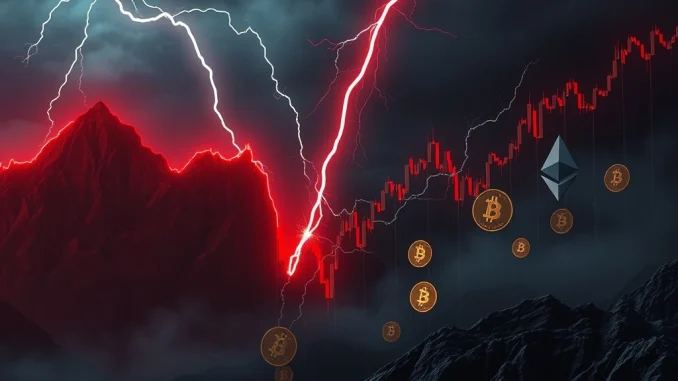
The cryptocurrency market often experiences sudden shifts. Recently, **crypto liquidations** reached a staggering sum. Approximately $200 million in cryptocurrency futures positions vanished across major exchanges in just four hours. This rapid unwinding of leveraged trades signals significant **crypto market volatility**.
Understanding the Surge in Crypto Liquidations
Market data reveals a sharp downturn for many traders. Specifically, $200 million in **cryptocurrency futures** positions were liquidated. This occurred over a brief four-hour period. A substantial 82.72% of this total comprised long positions. This means traders betting on price increases faced the brunt of the market move. These long liquidations alone amounted to $166 million. Looking at a broader timeframe, total liquidations surged to $624 million over the past 24 hours. Such figures highlight the inherent risks of leveraged trading in digital assets.
Liquidations are a common, yet often painful, event in futures trading. They happen when a trader’s margin balance falls below the maintenance margin requirement. This occurs due to adverse price movements. Exchanges automatically close these positions to prevent further losses. This mechanism protects both the exchange and the trader from accumulating excessive debt. However, it often leads to significant capital losses for the individual trader.
What Drives Cryptocurrency Futures Liquidations?
Several factors contribute to large-scale **futures liquidations**. Primarily, sudden and significant price movements trigger these events. When an asset’s price drops sharply, long positions become vulnerable. Conversely, a sudden price surge can liquidate short positions. High leverage amplifies these effects. Even small price changes can lead to substantial losses on leveraged trades. This makes managing risk paramount for traders.
Key drivers include:
- Unexpected Price Swings: Rapid upward or downward movements in major cryptocurrencies like Bitcoin or Ethereum.
- High Leverage: Traders often use significant leverage, magnifying potential gains but also losses.
- Market Sentiment Shifts: News events, regulatory changes, or macroeconomic factors can quickly alter investor mood.
- Whale Activity: Large trades by institutional players can create enough momentum to trigger a cascade of liquidations.
These elements combine to create a dynamic environment. Traders must therefore remain vigilant. They need to adapt quickly to evolving market conditions.
The Impact of Long Positions Liquidated
The recent data shows a clear trend: the majority of the liquidated capital came from long positions. This indicates a strong bearish impulse in the market. When **long positions liquidated**, it suggests that a significant number of traders anticipated higher prices. Their expectations were not met. This imbalance between long and short liquidations often provides insight into market sentiment. A dominance of long liquidations points to a sudden downturn catching bullish traders off guard. It can also exacerbate price drops as forced selling adds downward pressure.
Consider the broader implications. Large liquidations can create a ripple effect. As positions are closed, market sell orders are executed. This can push prices even lower. Other leveraged positions then fall below their margin thresholds. This creates a cascading effect. Such events contribute to increased **crypto market volatility**. They often lead to sharp, rapid price declines. Therefore, understanding the distribution of liquidated positions is crucial for market analysis.
Navigating Cryptocurrency Futures Markets
Trading **cryptocurrency futures** requires a robust risk management strategy. Leverage offers amplified returns but also carries amplified risks. Traders must carefully consider their position sizing. Setting appropriate stop-loss orders is also essential. A stop-loss order automatically closes a position at a predetermined price. This limits potential losses. It acts as a crucial safety net in volatile markets.
Diversification also plays a role. Spreading investments across different assets can mitigate risk. Furthermore, staying informed about market news and technical analysis helps traders make better decisions. Avoid over-leveraging, especially during periods of high uncertainty. This helps protect capital. Educating oneself on market mechanics is always a good practice.
Broader Implications for Crypto Market Volatility
Episodes of extensive **crypto liquidations** often serve as a stark reminder of the inherent **crypto market volatility**. While digital assets offer significant growth potential, they also present substantial risks. Investors and traders should always exercise caution. They must understand the mechanisms behind futures trading. These events can trigger short-term market corrections. They can also shake investor confidence. However, they are also a natural part of a maturing market. They help flush out excessive leverage. This can sometimes pave the way for more sustainable growth.
Ultimately, these market dynamics shape the future of digital asset trading. They underscore the need for continuous learning and adaptation. The $200 million liquidation event is a significant data point. It offers valuable lessons for all participants in the crypto ecosystem. It highlights the power of market forces. It also emphasizes the importance of disciplined trading practices.
Frequently Asked Questions (FAQs)
What are crypto liquidations?
Crypto liquidations occur when an exchange forcibly closes a trader’s leveraged position. This happens because their margin balance falls below the required maintenance level due to adverse price movements. The liquidation prevents further losses and protects the exchange.
Why did $200 million in cryptocurrency futures liquidate so quickly?
This rapid liquidation typically results from a sudden, sharp price movement in the underlying cryptocurrency. Traders using high leverage are particularly vulnerable. Even small price changes can trigger margin calls and subsequent liquidations.
What is the difference between long and short liquidations?
Long liquidations happen when the price of an asset drops, forcing traders who bet on price increases (long positions) to close their trades. Short liquidations occur when the price rises, affecting traders who bet on price decreases (short positions).
How does high leverage contribute to futures liquidations?
High leverage allows traders to control large positions with a relatively small amount of capital. While this amplifies potential profits, it also magnifies losses. A small adverse price movement can quickly deplete a trader’s margin, leading to liquidation.
What can traders do to avoid being liquidated in cryptocurrency futures?
Traders can implement several risk management strategies. These include using lower leverage, setting strict stop-loss orders, diversifying their portfolio, and closely monitoring market conditions. Understanding market volatility and avoiding over-exposure are crucial.
What does the dominance of long positions liquidated signify?
When long positions account for the majority of liquidations, it suggests that the market experienced a significant downward price movement. This indicates that a large number of traders were positioned for a price increase but were caught off guard by the decline, leading to their leveraged bets being closed out.