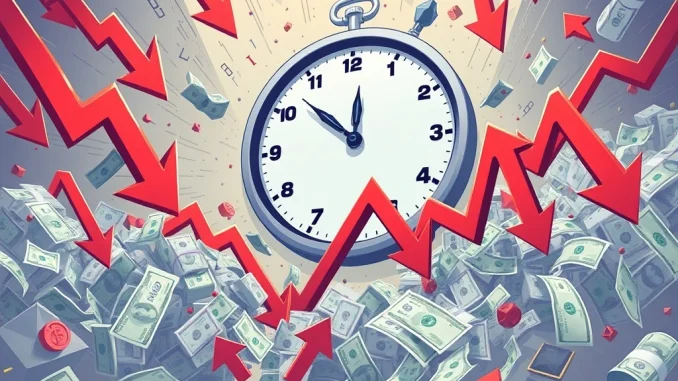
The cryptocurrency market often demonstrates extreme volatility. Recently, a significant event sent ripples across major exchanges. In just one hour, a staggering $105 million worth of futures contracts faced liquidation. This rapid sell-off caught many traders off guard. Furthermore, the past 24 hours saw total liquidations reach an alarming $311 million. This surge underscores the inherent risks within leveraged trading.
Massive Crypto Liquidations Shake Futures Market
Recent data reveals a sharp downturn for many leveraged positions. Major cryptocurrency exchanges reported the immediate impact. Specifically, $105 million in crypto liquidations occurred within a single 60-minute window. This rapid event highlights intense selling pressure or sudden price movements. Traders holding highly leveraged positions felt the brunt of this volatility. Consequently, their positions closed automatically to prevent further losses for the exchange.
Over a broader 24-hour period, the total figure escalated to $311 million. This broader liquidation wave indicates sustained market uncertainty. It also reflects a period of significant price swings across various digital assets. Such events are not uncommon in the dynamic crypto futures market. However, their scale and speed always command attention. They serve as a stark reminder of the potential for rapid capital shifts.
Understanding Cryptocurrency Futures Trading Risks
To grasp the full impact, one must understand cryptocurrency futures. These financial contracts allow traders to speculate on the future price of an asset. Traders do not own the underlying asset itself. Instead, they bet on its price direction. A key feature of futures trading is leverage. Leverage enables traders to control large positions with a relatively small amount of capital. For example, 10x leverage means a trader can control $10,000 worth of crypto with just $1,000.
While leverage can amplify profits, it also dramatically increases trading risks. If the market moves against a leveraged position, losses mount quickly. When a trader’s margin (the collateral held by the exchange) falls below a certain threshold, a liquidation occurs. The exchange automatically closes the position. This prevents the trader’s balance from falling into negative territory. Therefore, understanding these mechanisms is crucial for any participant in the futures market.
- Long Liquidations: Occur when the price drops, forcing buyers (long positions) to close.
- Short Liquidations: Happen when the price rises, compelling sellers (short positions) to close.
- Margin Calls: A warning from the exchange that a trader’s margin is running low.
Bitcoin Futures and Broader Market Volatility
Bitcoin often acts as the bellwether for the entire cryptocurrency ecosystem. Its price movements frequently dictate the sentiment of the broader market. Therefore, significant liquidations in Bitcoin futures often trigger similar events across altcoins. The recent $105 million liquidation wave likely started with a sharp price move in Bitcoin. When Bitcoin experiences a sudden drop, for instance, many long positions become vulnerable. This initiates a cascade of liquidations.
Several factors contribute to such pronounced market volatility. Macroeconomic news, such as inflation reports or interest rate changes, can influence investor sentiment. Regulatory developments also play a significant role. Furthermore, large institutional trades, often referred to as ‘whale’ movements, can create substantial price shifts. These factors combine to create an unpredictable environment. Traders must stay informed about these external influences. They directly impact the stability of their leveraged positions.
For example, a sudden news event might cause Bitcoin’s price to fall by 5%. This seemingly small drop can wipe out highly leveraged long positions. The forced selling from these liquidations then pushes the price even lower. This creates a feedback loop, affecting more positions. This domino effect is a characteristic of high-leverage markets. It underscores why careful risk management remains paramount.
Impact on Traders and Market Sentiment
Such large-scale liquidations have a profound impact beyond just financial losses. They significantly affect market sentiment. Fear and uncertainty often increase following major liquidation events. Traders may become more cautious. Some might reduce their leverage or exit the market entirely. This shift in sentiment can lead to reduced trading volume and further price instability. Moreover, the psychological toll on individual traders can be substantial. Losing a significant portion of capital quickly can be disheartening.
Market analysts often view large liquidations as a ‘washout’ event. This means the market has purged excessive leverage. While painful for those affected, some believe it can pave the way for a healthier, more stable market rebound. However, this is not guaranteed. The market’s direction depends on various other fundamental and technical factors. Therefore, interpreting these events requires a nuanced perspective.
Navigating High-Stakes Futures Trading
The recent liquidations serve as a critical lesson for anyone involved in futures trading. High leverage carries inherent risks. While it offers the potential for amplified gains, it also exposes traders to amplified losses. Therefore, responsible trading practices are essential. Implementing robust risk management strategies becomes vital. Traders should prioritize capital preservation over aggressive profit-seeking.
Key strategies include setting stop-loss orders. These orders automatically close a position if the price reaches a predetermined level. This limits potential losses. Furthermore, managing position sizes appropriately is crucial. Avoid allocating too much capital to a single trade. Diversifying one’s portfolio also helps mitigate risk. Understanding market cycles and technical analysis can provide valuable insights. These tools help traders make more informed decisions. Ultimately, continuous education and discipline are paramount for navigating the volatile crypto futures market successfully.
The cryptocurrency market remains a dynamic and often unpredictable arena. Events like the recent $105 million liquidation remind all participants of the significant risks involved. While the potential for substantial returns exists, it comes hand-in-hand with considerable volatility. Traders must approach the futures market with caution. They should employ sound risk management strategies. This prudent approach helps protect capital and ensures long-term participation in this exciting space.
Frequently Asked Questions (FAQs)
What is a crypto liquidation?
A crypto liquidation occurs when an exchange automatically closes a trader’s leveraged position. This happens because the market moves against their trade, and their margin (collateral) falls below a required level. The exchange liquidates the position to prevent the trader’s account balance from becoming negative.
Why do liquidations happen in the futures market?
Liquidations primarily happen due to sudden or significant price movements in the underlying asset. Traders use leverage to amplify potential gains. However, this also amplifies losses. If the price moves sufficiently against a leveraged position, the collateral becomes insufficient to cover potential losses, triggering a liquidation.
What is the difference between long and short liquidations?
Long liquidations occur when traders holding ‘long’ positions (betting on a price increase) face losses due to a price drop. Their positions are closed. Short liquidations happen when traders holding ‘short’ positions (betting on a price decrease) suffer losses because the price rises. Their positions are then closed.
How do crypto liquidations impact the broader market?
Large-scale crypto liquidations can exacerbate price movements. When many positions are liquidated, it often involves forced selling, pushing prices further down. This can create a cascading effect, triggering more liquidations and increasing overall market volatility. It can also impact market sentiment, leading to increased fear or uncertainty.
How can traders avoid liquidation when trading Bitcoin futures?
Traders can employ several strategies to avoid liquidation. These include using lower leverage, setting stop-loss orders to limit potential losses, managing position sizes, and maintaining sufficient margin in their accounts. Diversifying investments and thoroughly understanding market conditions also help mitigate risks associated with Bitcoin futures trading.
Which factors contribute to market volatility and liquidations?
Numerous factors contribute to market volatility, which can lead to liquidations. These include macroeconomic news (e.g., inflation, interest rates), regulatory announcements, significant institutional trades (whale movements), geopolitical events, and technical market patterns. These elements can cause rapid and unpredictable price swings, affecting leveraged positions.