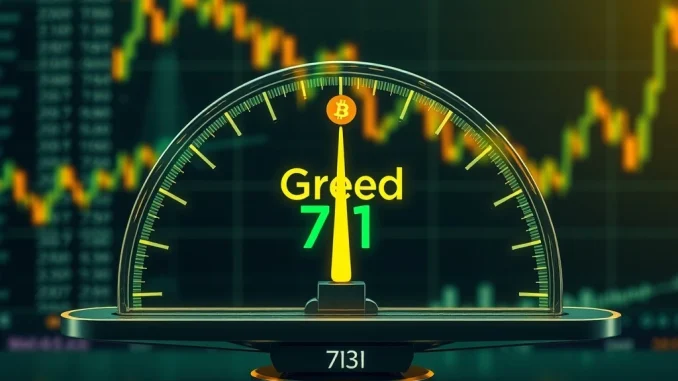
The cryptocurrency market often operates on a rollercoaster of emotions. The **Crypto Fear & Greed Index** serves as a vital tool to gauge this collective sentiment. Recently, this influential index registered a value of 71. This reading, despite a slight dip from the previous day, clearly indicates that **market greed** continues to dominate investor psychology.
Decoding the Crypto Fear & Greed Index
Investors closely monitor the **Crypto Fear & Greed Index**. It provides a clear snapshot of prevailing attitudes in the volatile digital asset space. The index operates on a simple scale. It ranges from 0, representing **Extreme Fear**, to 100, signifying **Extreme Optimism**. A higher number suggests growing investor confidence and enthusiasm. Conversely, a lower number indicates widespread apprehension or panic. This dynamic tool helps market participants understand the emotional undercurrents driving price movements.
Several crucial factors contribute to the index’s calculation. Each component carries a specific weighting, ensuring a comprehensive assessment of **crypto market sentiment**:
- Volatility (25%): This measures current price fluctuations compared to average values. Higher volatility often signals fear.
- Trading Volume (25%): Strong, sustained trading volumes in a positive market typically indicate greed.
- Social Media Mentions (15%): An analysis of crypto-related hashtags and sentiment on platforms like X (formerly Twitter) reveals public mood.
- Surveys (15%): While currently paused, these polls previously captured direct investor sentiment.
- Bitcoin’s Market Cap Dominance (10%): An increasing dominance often suggests a flight to safety, indicating fear. A decreasing dominance can show speculative interest in altcoins, hinting at greed.
- Google Search Volume (10%): Tracking search queries related to Bitcoin and other cryptocurrencies can reveal public interest and potential FOMO (Fear Of Missing Out).
What Drives Crypto Market Sentiment?
Understanding the forces behind **crypto market sentiment** is crucial for informed decision-making. The index’s current reading of 71, while a three-point drop, firmly places the market in a ‘Greed’ zone. This means investors are generally optimistic. They are willing to take on more risk. This prevailing sentiment often stems from recent price rallies or positive news. Furthermore, a sense of momentum builds as more participants join the upward trend. This can create a self-reinforcing cycle of optimism. Ultimately, this drives prices higher. However, such sustained greed also warrants caution. Excessive optimism can lead to unsustainable market conditions.
The Pivotal Role of Bitcoin Sentiment
Bitcoin remains the cornerstone of the cryptocurrency market. Consequently, **Bitcoin sentiment** heavily influences the overall Fear & Greed Index. Bitcoin’s price movements and its market capitalization dominance are key indicators. When Bitcoin performs strongly, it often pulls the entire market upward. This fosters a sense of widespread confidence. Conversely, a significant drop in Bitcoin’s price can trigger a broader market downturn. This can quickly shift sentiment towards fear. The index assigns 10% of its weight to Bitcoin’s market cap dominance. This highlights its importance. A rising dominance might suggest investors are consolidating holdings in Bitcoin, potentially indicating caution or a flight from riskier altcoins. Conversely, a falling dominance could imply a speculative shift into altcoins, often associated with a greedy market phase.
Interpreting Market Greed at 71
A reading of 71 on the **Crypto Fear & Greed Index** signifies strong **market greed**. This level suggests that investors are generally feeling confident. They are eager to participate in the market. Many perceive current conditions as favorable for gains. Such optimism can fuel further price increases. However, it also raises important questions. Is the market becoming overbought? Are speculative bubbles forming? Historically, periods of extreme greed have often preceded market corrections. Investors should therefore exercise prudence. They must balance enthusiasm with a realistic assessment of risks. While optimism is beneficial, unchecked greed can lead to irrational decisions. These include taking on excessive leverage or chasing unsustainable pumps.
The Fear and Greed Index Explained: Historical Context and Investor Strategy
To fully grasp the significance of the **Fear and Greed Index explained**, we must consider its historical context. Historically, readings in the ‘Extreme Fear’ zone (0-24) have often presented opportune buying moments. This is when prices are low and many investors are capitulating. Conversely, ‘Extreme Greed’ (75-100) has frequently signaled potential market tops. During these times, prices are high and many are speculating excessively. Therefore, a reading of 71, while not yet ‘Extreme Greed,’ is certainly approaching it. This calls for a strategic approach. Savvy investors often use the index as a contrarian indicator. They consider buying during fear and selling during greed. This strategy aims to capitalize on market inefficiencies driven by emotion. Ultimately, the index serves as a reminder. Emotional swings can significantly impact asset prices. Disciplined decision-making remains paramount.
Implications of Persistent Market Greed
Persistent **market greed** has several implications for both short-term traders and long-term investors. For traders, a greedy market might present opportunities for quick gains. However, it also increases the risk of sudden pullbacks. These can liquidate leveraged positions. Long-term investors, conversely, might consider rebalancing portfolios. They might take some profits off the table. This helps to reduce exposure to potential downturns. Furthermore, new investors entering a market driven by greed face elevated risks. They might buy assets at inflated prices. This leaves them vulnerable to significant losses if sentiment shifts. Education and a well-defined investment strategy become critical in such environments. Always conduct thorough research before making investment decisions. Do not solely rely on sentiment indicators.
In conclusion, the **Crypto Fear & Greed Index** at 71 clearly signals a market dominated by optimism. While this indicates robust investor interest, it also serves as a crucial reminder. Vigilance is always necessary. Understanding the components and historical context of the index empowers investors. They can then navigate the dynamic world of cryptocurrencies more effectively. Ultimately, balanced judgment, not pure emotion, should guide investment choices.
Frequently Asked Questions (FAQs)
What is the Crypto Fear & Greed Index?
The Crypto Fear & Greed Index is a tool that measures the current emotional state of the cryptocurrency market. It ranges from 0 (Extreme Fear) to 100 (Extreme Optimism), helping investors gauge overall market sentiment.
How is the Crypto Fear & Greed Index calculated?
The index calculates market sentiment based on six weighted factors: volatility (25%), trading volume (25%), social media mentions (15%), surveys (15%), Bitcoin’s market cap dominance (10%), and Google search volume (10%).
What does a reading of 71 on the index signify?
A reading of 71 indicates that ‘greed’ currently prevails in the market. This suggests high investor optimism and a willingness to take on risk, though it’s still below ‘Extreme Greed’ (75-100).
How does Bitcoin sentiment influence the index?
Bitcoin’s performance and its market cap dominance are significant factors. Strong Bitcoin performance often boosts overall **crypto market sentiment**, contributing to higher greed readings. Conversely, Bitcoin downturns can quickly shift the index towards fear.
Should investors rely solely on the Fear & Greed Index?
No, investors should not rely solely on the Fear & Greed Index. It is a valuable sentiment indicator, but it should be used in conjunction with fundamental analysis, technical analysis, and a well-defined personal investment strategy to make informed decisions.
What are the risks of persistent market greed?
Persistent **market greed** can lead to inflated asset prices and speculative bubbles. This increases the risk of market corrections. Investors might experience significant losses if they buy assets at unsustainable highs or use excessive leverage.