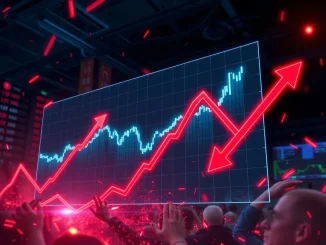
The cryptocurrency market recently witnessed a significant event. A staggering $210 million worth of crypto futures faced liquidation within a single hour. This sudden downturn caught many traders off guard. Furthermore, the past 24 hours recorded an even larger sum. Major exchanges processed $455 million in total liquidations. This dramatic event highlights the inherent cryptocurrency market volatility. Such rapid shifts often trigger widespread concern. Consequently, investors are now closely monitoring market conditions.
Understanding Crypto Futures Liquidation
What exactly does crypto futures liquidation mean? It occurs when a trader’s leveraged position is forcibly closed. This happens due to a significant price drop in the underlying asset. The trader’s margin balance falls below the maintenance margin requirement. Exchanges automatically close these positions. This action prevents further losses to the trader and the exchange. Therefore, it acts as a risk management tool.
Leveraged trading amplifies both gains and losses. Traders borrow funds to increase their market exposure. However, this strategy carries substantial risks. A small price movement against their position can lead to a margin call. If the trader cannot add more collateral, liquidation follows. Consequently, their entire position gets wiped out. This mechanism ensures market stability in volatile conditions.
The recent $210 million liquidation in an hour underscores the market’s sensitivity. Such large-scale events are not uncommon. Nevertheless, their suddenness always surprises participants. The total $455 million in liquidations over 24 hours further emphasizes this trend. These figures primarily represent long positions. This means traders bet on rising prices. However, a sharp market dip invalidated their predictions.
The Impact of Leveraged Trading on Market Stability
Leveraged trading plays a dual role in the futures market. It offers opportunities for substantial profits. Yet, it also introduces significant systemic risk. When prices move sharply, a cascade of liquidations can occur. One liquidation can trigger another. This creates a “long squeeze” or “short squeeze.” Such events exacerbate market downturns. They can also accelerate price recoveries. Therefore, understanding this dynamic is crucial.
Cryptocurrency market volatility is a defining characteristic. Various factors contribute to these rapid price swings. Macroeconomic news, regulatory changes, and large whale movements are common triggers. Geopolitical events also play a role. The recent liquidations likely stemmed from a combination of these elements. Market analysts are currently investigating specific catalysts. They aim to provide clearer insights.
For individual traders, liquidations are financially devastating. They lose their initial margin and any associated profits. This can lead to significant capital depletion. Moreover, it often instills fear and caution. Many traders may then reduce their exposure. Some might even exit the derivatives trading market entirely. This collective sentiment impacts future market activity.
Navigating the Futures Market Landscape
The futures market is complex. It requires careful risk management. Traders must understand margin requirements. They also need to set stop-loss orders. These tools help limit potential losses. Furthermore, diversification across different assets can reduce overall risk. Education remains a vital component for success. Experienced traders advise starting with smaller positions.
Major cryptocurrency exchanges facilitate these futures contracts. They provide the infrastructure for derivatives trading. These platforms also manage the liquidation process. Their automated systems execute liquidations swiftly. This ensures market integrity. However, even these systems can face stress during extreme volatility. Transparency in reporting liquidation data is essential.
Large-scale crypto futures liquidation events have occurred periodically. For instance, May 2021 saw billions liquidated. Similar patterns emerged in 2022. These past events serve as stark reminders. The market’s unpredictable nature remains constant. Each event offers valuable lessons for traders. It reinforces the need for robust trading strategies.
Mitigating Risks in Derivatives Trading
Engaging in derivatives trading demands prudence. Firstly, never trade with more capital than you can afford to lose. Secondly, understand the specific leverage ratios offered. Higher leverage means higher risk. Thirdly, employ effective position sizing techniques. This involves adjusting trade size based on account balance. Finally, stay informed about market news. Knowledge empowers better decision-making.
Despite these significant liquidations, the cryptocurrency market often demonstrates resilience. Prices typically recover after sharp downturns. However, the path to recovery can be uneven. These events also cleanse the market of overleveraged positions. This can lead to a healthier, more sustainable market in the long run. The underlying technology remains strong.
The recent $210 million crypto futures liquidation serves as a potent reminder. It highlights the inherent risks of leveraged positions. It also underscores the dynamic nature of cryptocurrency market volatility. Traders must approach the futures market with caution. Responsible derivatives trading practices are paramount. Continuous learning and adaptability will always be key for navigating this exciting yet challenging landscape.
Frequently Asked Questions (FAQs)
Q1: What is crypto futures liquidation?
A1: Crypto futures liquidation occurs when an exchange forcibly closes a trader’s leveraged position. This happens because the market price moves against their trade, causing their margin balance to fall below a required threshold. The exchange closes the position to prevent further losses.
Q2: Why do large liquidations happen in the cryptocurrency market?
A2: Large liquidations often occur due to high cryptocurrency market volatility. Sharp price movements, fueled by factors like macroeconomic news or significant sell-offs, trigger margin calls. Traders using high leveraged trading ratios are particularly susceptible, leading to cascading liquidations.
Q3: How does leveraged trading contribute to these events?
A3: Leveraged trading allows traders to control large positions with a relatively small amount of capital. While this amplifies potential profits, it also significantly increases risk. A small adverse price change can quickly deplete a trader’s margin, leading to swift liquidation.
Q4: What is the overall impact of such liquidations on the futures market?
A4: Significant liquidations can intensify price movements, both downwards and sometimes upwards (in the case of short squeezes). They can also shake investor confidence and lead to increased caution. However, they can also “cleanse” the futures market of overleveraged positions, potentially paving the way for more stable growth.
Q5: How can traders protect themselves from crypto futures liquidation?
A5: Traders can protect themselves by using lower leveraged trading ratios, setting stop-loss orders, and managing their position sizes carefully. Maintaining sufficient margin in their accounts and staying informed about market conditions are also crucial strategies.