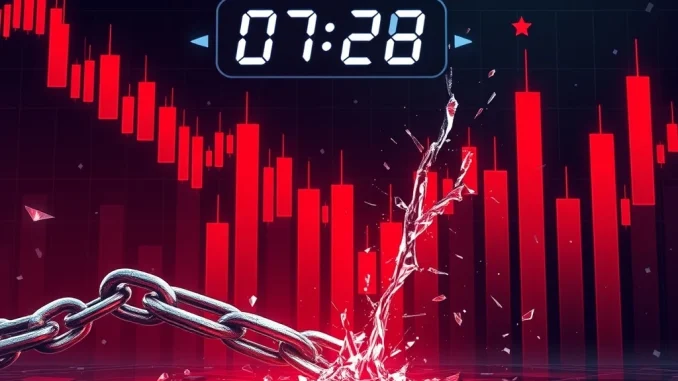
The cryptocurrency market recently experienced a significant event. Major exchanges recorded a staggering **crypto futures liquidation** of $119 million in just one hour. This rapid sell-off indicates considerable market stress. Furthermore, the past 24 hours saw a total of $389 million in futures contracts liquidated. Such figures highlight the inherent volatility within the digital asset space. Investors and traders must understand the forces at play. These sudden movements often trigger broader discussions about risk management and market stability. Therefore, examining these events closely becomes crucial for anyone involved in crypto.
Crypto Futures Liquidation: Unpacking the Immediate Impact
The recent **crypto futures liquidation** event sent ripples across the digital asset landscape. A liquidation occurs when an exchange forcibly closes a trader’s leveraged position. This happens because the trader’s margin falls below the maintenance level. Essentially, they can no longer cover potential losses. The $119 million figure represents a substantial amount of capital wiped out swiftly. This happened in merely 60 minutes. Consequently, many traders faced unexpected losses. The 24-hour total of $389 million further emphasizes the scale of these **market liquidation events**. This suggests a broader downtrend or a sudden price swing. Such rapid liquidations often accelerate price declines. They force more positions to close. This creates a cascading effect.
For instance, if a trader opens a long position with 10x leverage, a 10% price drop liquidates their entire position. Conversely, a short position faces liquidation if the price rises significantly. These events are not uncommon in highly leveraged markets. However, their magnitude provides a clear signal. They point to underlying shifts in market sentiment or external economic factors. Understanding this immediate impact is vital. It helps investors prepare for future volatility. Moreover, it underscores the risks associated with highly leveraged trading strategies.
Understanding Cryptocurrency Market Volatility and Its Triggers
The inherent **cryptocurrency market volatility** plays a central role in such liquidation events. Digital asset prices can swing wildly. Several factors contribute to this characteristic. Firstly, the market operates 24/7. Traditional markets have closing hours. Crypto markets do not. This continuous trading allows for rapid price discovery. Secondly, the market is relatively nascent. It possesses lower liquidity compared to traditional finance. This means large orders can move prices significantly. Thirdly, macroeconomic news often impacts crypto. Inflation reports, interest rate changes, and geopolitical events all play a part. For example, a hawkish Federal Reserve stance can lead to sell-offs. This directly affects Bitcoin and altcoin prices.
Moreover, regulatory developments can trigger substantial price movements. A country announcing new crypto restrictions might cause a dip. Conversely, positive regulatory clarity can boost confidence. Social media sentiment also holds sway. Influential figures or major news can shift sentiment quickly. Ultimately, these combined factors create an environment. It is an environment where prices fluctuate dramatically. This amplified volatility directly contributes to **market liquidation events**. Traders must therefore monitor these diverse influences. They should assess potential impacts on their positions.
The Mechanics of Futures Contracts Crypto and Leveraged Trading
To fully grasp liquidations, one must understand **futures contracts crypto**. A futures contract is an agreement. It allows parties to buy or sell an asset at a predetermined price on a specific future date. In crypto, these contracts often track assets like Bitcoin or Ethereum. They allow traders to speculate on future price movements. Crucially, these contracts frequently involve **leveraged crypto trading**. Leverage means using borrowed funds to increase potential returns. For example, 10x leverage means a $1,000 investment controls $10,000 worth of crypto. While leverage can magnify profits, it equally amplifies losses.
Here’s how it works simply:
- You deposit a small amount, called **margin**, as collateral.
- The exchange lends you additional funds, increasing your position size.
- A small adverse price movement can quickly erode your margin.
- If your margin falls below a certain threshold, the exchange automatically liquidates your position.
This automatic liquidation protects the exchange from losses. However, it can be devastating for the trader. Understanding the intricacies of **futures contracts crypto** is paramount. Traders must also recognize the double-edged nature of leverage. It presents both opportunity and substantial risk. Without proper knowledge, engaging in **leveraged crypto trading** can lead to significant financial setbacks.
Who is Affected by Cryptocurrency Market Liquidations?
When **market liquidation events** occur, their impact extends beyond individual traders. Primarily, retail traders who engage in **leveraged crypto trading** are most vulnerable. Many enter positions with high leverage, hoping for quick gains. They often lack the capital to withstand significant price swings. Consequently, their positions are the first to be liquidated. This can lead to substantial personal financial losses. For these individuals, such events serve as harsh lessons in risk management. They underscore the importance of caution.
Institutional investors, while generally more sophisticated, are not immune. They typically employ more robust risk management strategies. However, large-scale liquidations can still affect their portfolios. Such events can also impact overall market sentiment. A wave of liquidations often signals bearish momentum. This can cause further selling pressure. It might deter new capital from entering the market. Moreover, these events can affect exchange liquidity. While exchanges profit from liquidation fees, prolonged periods of high volatility and large liquidations can stress their systems. Ultimately, widespread **crypto futures liquidation** can lead to a loss of confidence. This affects the broader **cryptocurrency market** ecosystem. Therefore, the ripple effects are felt by almost all participants.
Navigating Risks in a Volatile Futures Market
Given the inherent risks, navigating the futures market requires a disciplined approach. Traders must prioritize risk management. Firstly, never invest more than you can afford to lose. This fundamental principle protects your overall financial health. Secondly, implement strict stop-loss orders. A stop-loss automatically closes a position when it reaches a predefined price. This limits potential losses. Thirdly, manage your position sizing effectively. Avoid over-leveraging. A smaller position with lower leverage offers more resilience against price fluctuations. Understanding the dynamics of **cryptocurrency market volatility** is key here.
Diversification also plays a role. Do not put all your capital into a single asset or strategy. Spreading investments across different assets can mitigate risk. Furthermore, continuous education is essential. The crypto market evolves rapidly. Staying informed about market trends, technical analysis, and global economic news empowers better decision-making. Lastly, avoid emotional trading. Fear and greed often lead to poor choices. Stick to a well-defined trading plan. Ultimately, responsible **leveraged crypto trading** relies on knowledge, discipline, and a clear understanding of the risks involved. These strategies help protect capital. They also promote sustainable engagement in the volatile digital asset space.
The recent **crypto futures liquidation** highlights the dynamic nature of the digital asset market. Rapid price movements can quickly impact leveraged positions. The $119 million liquidated in an hour and $389 million over 24 hours underscore this reality. Traders must exercise extreme caution. They should employ robust risk management strategies. Understanding **cryptocurrency market volatility** and the mechanics of **futures contracts crypto** is essential. Ultimately, informed and disciplined trading practices are paramount for navigating these challenging conditions successfully. These **market liquidation events** serve as powerful reminders. They reinforce the need for prudence in a fast-paced environment.
Frequently Asked Questions (FAQs)
What is crypto futures liquidation?
Crypto futures liquidation occurs when an exchange automatically closes a trader’s leveraged position. This happens because their margin collateral falls below the required maintenance level. It prevents further losses for the exchange.
Why did $119 million in crypto futures get liquidated in one hour?
A rapid **crypto futures liquidation** of this magnitude typically indicates a sharp, sudden price movement in the underlying cryptocurrency. This movement triggers numerous stop-loss orders and margin calls for highly leveraged positions, leading to forced closures.
What causes cryptocurrency market volatility?
**Cryptocurrency market volatility** stems from several factors. These include 24/7 trading, lower liquidity compared to traditional markets, macroeconomic news, regulatory changes, and social media sentiment. All these can cause rapid price swings.
How does leveraged crypto trading increase risk?
**Leveraged crypto trading** allows traders to control a large position with a small amount of capital. While it can magnify profits, it also amplifies losses. A small adverse price movement can quickly wipe out a trader’s entire margin, leading to liquidation.
How can traders protect themselves from market liquidation events?
Traders can mitigate risks by using stop-loss orders, managing position size, avoiding excessive leverage, and diversifying their portfolios. Continuous education and avoiding emotional trading are also crucial for navigating **market liquidation events** effectively.
Are futures contracts crypto suitable for beginners?
Generally, **futures contracts crypto** and leveraged trading are not recommended for beginners. They involve significant risk and require a deep understanding of market mechanics, technical analysis, and risk management principles. It is better for new traders to start with spot trading.