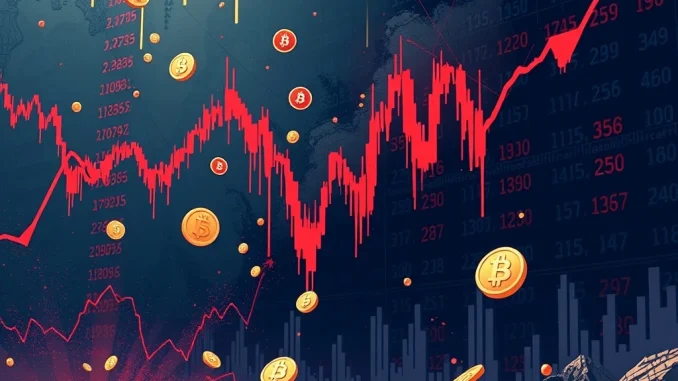
The cryptocurrency market recently experienced a seismic event. Over a single hour, major exchanges processed an astounding $285 million worth of crypto futures liquidation. This rapid sell-off sent shockwaves through the digital asset space. Furthermore, the past 24 hours witnessed an even larger scale of financial upheaval, with liquidations soaring past $2.01 billion. Such significant figures underscore the inherent risks and high stakes involved in the volatile world of crypto trading. Many traders faced unexpected losses, highlighting the unpredictable nature of leveraged positions.
Unpacking the Crypto Futures Liquidation Wave
A crypto futures liquidation occurs when a trader’s leveraged position is forcibly closed. This happens because they no longer meet the margin requirements to keep the trade open. When the market moves sharply against a trader’s prediction, their initial margin deposit becomes insufficient. Consequently, the exchange steps in to close the position. This prevents further losses for both the trader and the exchange. These events are not uncommon in highly volatile markets. However, the sheer scale of recent liquidations demands closer inspection. It suggests a confluence of factors led to this significant market correction.
Understanding the mechanics behind these events is crucial. Traders use leverage to amplify their potential returns. For example, a 10x leverage allows a trader to control $1000 worth of assets with just $100 of their own capital. While this can lead to substantial profits, it also magnifies losses. A small price movement in the wrong direction can quickly deplete the trader’s margin. This triggers an automatic liquidation. Therefore, these liquidations often create a cascading effect. One liquidation can push prices lower, which in turn triggers more liquidations.
The Mechanics of Leverage Trading
Leverage trading is a double-edged sword in the cryptocurrency landscape. It allows participants to open positions much larger than their actual capital. This can lead to impressive gains when the market moves favorably. However, the downside risk is equally magnified. Traders essentially borrow funds from an exchange to increase their exposure. They must maintain a certain amount of collateral, known as margin, to keep their positions active. If the value of their collateral falls below a specific threshold, a margin call occurs. If the trader fails to add more funds, their position is liquidated.
Several key points define leverage trading:
- Magnified Exposure: Traders can control large positions with minimal capital.
- Increased Risk: Small price movements can lead to significant losses.
- Margin Requirements: Collateral needed to maintain a leveraged position.
- Liquidation Price: The specific price point at which a position is automatically closed.
Furthermore, different exchanges offer varying levels of leverage. Some platforms allow leverage up to 100x or even higher. This extreme leverage can be incredibly dangerous for inexperienced traders. It also contributes to rapid price swings and large liquidation events during periods of high market stress. Therefore, understanding the risks associated with leverage is paramount for any participant in the crypto derivatives market.
What Triggered This Market Volatility?
Identifying the precise triggers for such immense market volatility is often complex. Multiple factors typically converge to create these conditions. Macroeconomic developments frequently play a significant role. For instance, global economic uncertainty, interest rate hikes, or changes in central bank policies can influence investor sentiment. This, in turn, impacts risk assets like cryptocurrencies. News regarding regulatory crackdowns or major hacks can also cause sudden price drops. These events often lead to panic selling and a surge in liquidation orders.
Technical analysis also offers insights. Breaching key support levels can trigger stop-loss orders. These automatic sell orders further accelerate price declines. Large institutional traders, often referred to as ‘whales,’ can also influence market movements. Their significant trades can create ripples across the market. Sometimes, a series of smaller, unrelated events can combine. This creates a ‘perfect storm’ for rapid liquidations. For example, a minor negative news item, coupled with a breach of a technical support level, could trigger a cascade. The lack of clear, single cause often makes these events harder to predict and manage.
Analyzing the Futures Market Dynamics
The health and sentiment of the futures market provide crucial indicators for the broader cryptocurrency ecosystem. Traders closely monitor metrics like open interest and funding rates. Open interest refers to the total number of outstanding derivatives contracts that have not been settled. A high open interest, especially when combined with high leverage, suggests potential for large liquidations. If prices move against the prevailing sentiment, many leveraged positions could be at risk. This creates a volatile environment.
Funding rates are another vital metric. In perpetual futures contracts, funding rates are periodic payments made between long and short traders. This mechanism helps keep the perpetual futures price close to the spot price. A positive funding rate means long traders pay short traders, indicating bullish sentiment. Conversely, a negative funding rate suggests bearish sentiment. During the recent liquidation event, funding rates likely saw significant fluctuations. This indicated a rapid shift in market sentiment and increased pressure on long positions. Therefore, analyzing these dynamics helps understand the market’s underlying health and potential future movements.
Implications of Cryptocurrency Liquidation
The recent cryptocurrency liquidation event carries significant implications for various market participants. For individual traders, the immediate consequence is often substantial financial loss. Many traders, especially those using high leverage, can see their entire capital wiped out in minutes. This can be devastating, leading to emotional distress and a loss of confidence in the market. Furthermore, these events highlight the importance of robust risk management strategies. Without proper planning, even experienced traders can fall victim to rapid market shifts. It serves as a stark reminder of the volatile nature of digital assets.
Beyond individual traders, these liquidations impact the broader market. A large-scale liquidation event can exacerbate price declines. As positions are forcibly closed, more sell orders flood the market. This pushes prices even lower. This cascading effect can create a downward spiral. It often affects multiple cryptocurrencies simultaneously. The increased volatility can deter new investors and institutions from entering the market. This creates a more cautious trading environment. However, such events can also ‘cleanse’ the market of excessive leverage. This potentially sets the stage for a more stable recovery in the long term. Therefore, while painful, liquidations are a natural part of a maturing, yet still highly speculative, market.
Navigating High-Risk Environments
Navigating high-risk environments in cryptocurrency trading requires a disciplined approach. Traders must prioritize risk management above all else. Firstly, avoiding excessive leverage is critical. While it promises larger returns, it dramatically increases the risk of liquidation. Secondly, implementing strict stop-loss orders can limit potential losses. A stop-loss automatically closes a position when it reaches a predetermined price. This prevents further capital erosion. Thirdly, position sizing is crucial. Never risk more capital than you can afford to lose on a single trade. Diversifying one’s portfolio can also mitigate risk. Spreading investments across different assets reduces exposure to any single asset’s downturn.
Additionally, continuous education about market dynamics and trading strategies is vital. Staying informed about macroeconomic trends, regulatory news, and technical indicators helps traders make better decisions. Emotional discipline also plays a significant role. Panic selling or making impulsive decisions during periods of high volatility often leads to further losses. Therefore, a calm and rational approach, coupled with well-defined trading rules, is essential for long-term success in the volatile crypto market. Learning from past liquidation events can help refine these strategies. It prepares traders for future market challenges.
The recent crypto futures liquidation event, totaling over $2.01 billion in 24 hours, serves as a powerful reminder of the inherent risks in cryptocurrency trading. While such events can be financially devastating for many, they also highlight the market’s dynamic nature. They underscore the importance of prudent leverage trading practices and robust risk management. As the futures market continues to evolve, traders must remain vigilant. Understanding the forces driving market volatility and the mechanics of cryptocurrency liquidation is paramount. This knowledge allows participants to navigate these turbulent waters more effectively. Ultimately, disciplined trading and continuous learning are key to surviving and potentially thriving in this high-stakes environment.
Frequently Asked Questions (FAQs)
Q1: What exactly is a crypto futures liquidation?
A crypto futures liquidation occurs when a trader’s leveraged position is automatically closed by an exchange. This happens because the trader’s margin (collateral) falls below the required level due to adverse price movements. The exchange closes the position to prevent further losses for the trader and itself.
Q2: Why did such a large amount of futures get liquidated so quickly?
Large liquidations typically result from a combination of factors. These include high leverage usage by traders, significant market volatility driven by macroeconomic news or technical breaches, and a cascade effect where initial liquidations trigger further price drops and more liquidations.
Q3: How does leverage trading contribute to these liquidation events?
Leverage trading allows traders to control large positions with a small amount of capital. While this amplifies potential profits, it also magnifies losses. A small price movement against a leveraged position can quickly deplete the margin, leading to a swift liquidation.
Q4: What are the main risks of trading in the crypto futures market?
The primary risks include high volatility, the potential for rapid and significant losses due to leverage, and the complexity of derivatives instruments. Traders also face risks related to exchange stability and regulatory changes.
Q5: How can traders protect themselves from future liquidation events?
Traders can protect themselves by using lower leverage, setting strict stop-loss orders, practicing sound position sizing, diversifying their portfolios, and continuously educating themselves on market dynamics and risk management strategies. Avoiding emotional trading during volatile periods is also crucial.