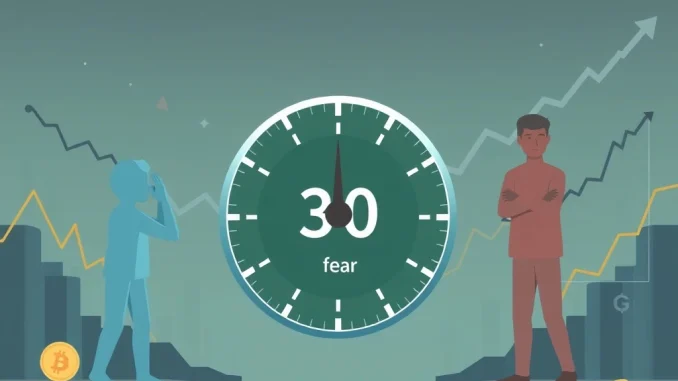
The **Crypto Fear & Greed Index** serves as a vital barometer for the ever-changing cryptocurrency landscape. It offers a snapshot of the prevailing emotions driving the market. Currently, this crucial indicator hovers at 30, signaling that **cryptocurrency market sentiment** remains firmly entrenched in a state of fear. This reading provides a sobering perspective for investors and traders alike.
Understanding the Crypto Fear & Greed Index
The **Crypto Fear & Greed Index**, compiled by data provider Alternative, rose three points recently. It moved from the previous day’s reading, settling at 30. Despite this slight uptick, the overall market sentiment continues to reflect fear. The index measures market sentiment on a comprehensive scale. Zero indicates extreme fear, while 100 represents extreme optimism. This range helps investors gauge the collective mood.
How does this powerful tool calculate its reading? It relies on several key factors:
- Volatility (25%): This component assesses how much Bitcoin’s price fluctuates. High volatility often suggests a fearful market.
- Trading Volume (25%): Significant trading volumes, especially during price drops, can indicate panic selling or strong accumulation.
- Social Media Mentions (15%): Analysis of sentiment on platforms like Twitter helps capture public mood.
- Surveys (15%): Although currently paused, these polls directly ask investors about their market outlook.
- Bitcoin’s Market Cap Dominance (10%): An increasing dominance often suggests investors are moving to Bitcoin as a perceived safe haven.
- Google Search Volume (10%): Trending search queries for terms like ‘Bitcoin price manipulation’ or ‘crypto crash’ can indicate growing fear.
Each factor contributes to the overall score, providing a holistic view of **cryptocurrency market sentiment**.
Decoding Persistent Market Fear and Its Implications
A reading of 30 on the **Crypto Fear & Greed Index** firmly places the market in the ‘Fear’ zone. This persistent state suggests that many investors are hesitant. They may be selling assets or avoiding new investments. Historically, periods of extreme fear have often presented opportunities for long-term investors. Conversely, extreme greed can signal an impending market correction. This makes the index a valuable counter-indicator for some.
When **Bitcoin fear** dominates, several market behaviors become common. Traders might liquidate positions to avoid further losses. New money may hesitate to enter the market. This can lead to decreased liquidity and prolonged sideways price action. Furthermore, a fearful market often overreacts to negative news. Small setbacks can trigger larger sell-offs. Therefore, understanding this sentiment is crucial for informed decision-making.
The Role of Market Psychology in Crypto Trading
Market psychology plays a profound role in the crypto space. Fear and greed are powerful emotions that drive human behavior. These emotions significantly influence investment decisions. During times of greed, investors might chase pumps. They could buy assets at inflated prices, driven by the fear of missing out (FOMO). This often leads to unsustainable rallies. Consequently, these rallies often end in sharp corrections.
Conversely, fear can lead to panic selling. Investors might sell their holdings at a loss. They do this even if the long-term fundamentals remain strong. The **Crypto Fear & Greed Index** acts as a tool to measure this collective psychological state. It helps individuals detach from their own emotions. By observing the index, investors can make more rational choices. They can avoid succumbing to the herd mentality. Therefore, a deep understanding of **market psychology** is essential for navigating volatile crypto markets.
Navigating the Current Crypto Market Analysis
Current **crypto market analysis** indicates a challenging environment. The index’s sustained ‘Fear’ reading reflects this reality. High inflation, rising interest rates, and geopolitical tensions all contribute to investor caution. These macroeconomic factors often impact riskier assets like cryptocurrencies. Consequently, investors become more risk-averse. They prefer safer investments during uncertain times.
For example, a sustained period of fear could lead to:
- Lower trading volumes across exchanges.
- Reduced institutional investment.
- Prolonged consolidation phases for major cryptocurrencies.
- Increased scrutiny from regulators.
Despite these challenges, some analysts view current conditions as a cleansing period. They believe it removes speculative froth from the market. This perspective suggests that a healthier, more mature market could emerge. However, prudent investors still exercise caution. They rely on thorough **crypto market analysis** to guide their strategies.
What a 30-Point Index Means for Bitcoin and Altcoins
A 30-point reading primarily reflects sentiment around Bitcoin, given its dominance in the index calculation. When **Bitcoin fear** is high, altcoins often suffer even more. Bitcoin usually acts as the bellwether for the broader crypto market. Therefore, if Bitcoin struggles, altcoins tend to experience greater percentage losses. This happens due to their higher volatility and smaller market caps.
However, periods of fear can also reveal resilience. Some projects with strong fundamentals might hold their value better. This often happens as investors seek out quality. A fearful market tests the conviction of investors. It also separates speculative assets from those with real utility. Therefore, while a low index score signals widespread apprehension, it also provides an opportunity for careful evaluation of individual assets.
Strategies for Investors During Fearful Periods
During times of persistent market fear, investors can adopt several strategies. Firstly, maintaining a long-term perspective is crucial. Short-term fluctuations often obscure the bigger picture. Secondly, dollar-cost averaging can mitigate risk. This involves investing a fixed amount regularly, regardless of price. It smooths out the average purchase price over time.
Furthermore, conducting thorough research becomes paramount. Focus on projects with strong use cases and solid development teams. Avoid chasing speculative pumps. Lastly, managing risk through diversification is always wise. Do not put all your capital into one asset. By following these principles, investors can navigate fearful markets more effectively. They can also position themselves for potential future growth.
The **Crypto Fear & Greed Index** at 30 reinforces a cautious outlook for the cryptocurrency market. While it signals ongoing fear, it also provides valuable insights into market psychology. Savvy investors often use such periods for accumulation or strategic planning. They understand that market sentiment is cyclical. Ultimately, navigating these times requires discipline, research, and a clear understanding of the forces at play.
Frequently Asked Questions (FAQs)
What does a Crypto Fear & Greed Index of 30 signify?
A Crypto Fear & Greed Index of 30 signifies that the market is currently in a state of ‘Fear.’ This means investors are generally hesitant, cautious, and may be selling assets due to concerns about future price declines.
How is the Crypto Fear & Greed Index calculated?
The index is calculated using a combination of factors. These include market volatility (25%), trading volume (25%), social media mentions (15%), surveys (15%), Bitcoin’s market cap dominance (10%), and Google search volume (10%).
Should I buy or sell when the index shows ‘Fear’?
The index is a sentiment indicator, not direct financial advice. Historically, some investors view extreme fear as a potential buying opportunity (when others are fearful), while extreme greed might signal a time to be cautious. Your decision should align with your personal investment strategy and risk tolerance.
What impact does Bitcoin’s dominance have on the index?
Bitcoin’s market cap dominance accounts for 10% of the index calculation. An increasing dominance often indicates that investors are moving funds into Bitcoin, sometimes seen as a safer asset during uncertain times, which can contribute to a fearful sentiment for altcoins.
How often is the Crypto Fear & Greed Index updated?
The Crypto Fear & Greed Index is typically updated daily, providing a fresh snapshot of market sentiment for the cryptocurrency space.
What factors could shift the market from ‘Fear’ to ‘Greed’?
A shift from ‘Fear’ to ‘Greed’ would require sustained positive developments. These could include clearer regulatory frameworks, significant institutional adoption, a general improvement in macroeconomic conditions, and a strong, sustained upward price trend for Bitcoin and other major cryptocurrencies.