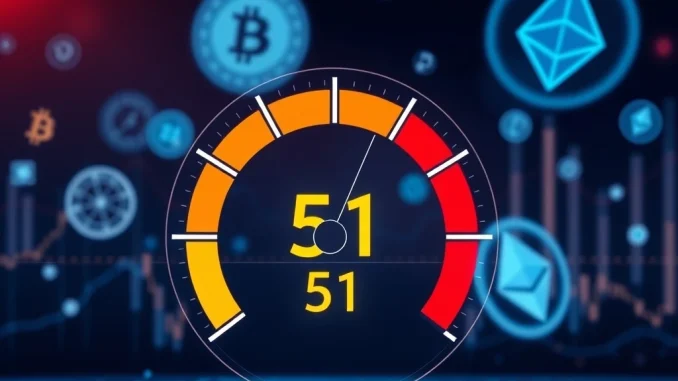
The cryptocurrency world constantly seeks indicators to gauge its unpredictable nature. Recently, a significant shift occurred. The Crypto Fear & Greed Index, a widely watched barometer of investor emotion, rose seven points. This movement pushed the index from a state of “Fear” to a more balanced “Neutral” position at 51. This crucial change in market sentiment often signals evolving perspectives among crypto participants.
Understanding the Crypto Fear & Greed Index: A Core Metric
The Crypto Fear & Greed Index provides a snapshot of the emotional state dominating the cryptocurrency market. Data provider Alternative.me calculates this index. It operates on a simple yet profound principle: extreme fear can indicate a buying opportunity, while extreme greed might suggest a market correction is imminent. This index measures market sentiment on a scale from 0 to 100. A score of 0 signifies extreme fear, suggesting investors are highly anxious. Conversely, a score of 100 represents extreme greed, indicating exuberance and potential overvaluation.
Many traders and analysts monitor this index closely. It offers valuable insights beyond mere price movements. Therefore, understanding its components becomes essential for informed decision-making. This tool helps investors recognize when market emotions might be driving irrational behavior. Its shift to neutral sentiment at 51 suggests a more balanced outlook, moving away from panic or excessive enthusiasm.
How the Index Measures Market Sentiment
The index does not rely on a single data point. Instead, it aggregates various factors to paint a comprehensive picture of market sentiment. Each component carries a specific weight, contributing to the overall score. These components include:
- Volatility (25%): This measures the current volatility and maximum drawdowns of Bitcoin compared to its average over the last 30 and 90 days. High volatility often signals a fearful market.
- Trading Volume (25%): This component analyzes current trading volume and market momentum, comparing it to average values. High buying volumes in a rising market indicate greed.
- Social Media Mentions (15%): This factor scrapes various social media platforms for crypto-related hashtags and sentiment analysis. A surge in positive or negative mentions can sway the index.
- Surveys (15%): Although currently paused, this component previously gathered public opinion through weekly polls. It provided direct insight into investor psychology.
- Bitcoin Dominance (10%): An increasing dominance of Bitcoin in the total crypto market cap can signal fear, as investors might be moving into the perceived safe haven of BTC. A decreasing dominance often indicates increased altcoin speculation, which suggests greed.
- Google Search Volume (10%): This tracks search trends for terms like “Bitcoin price manipulation” or “Bitcoin bubble.” Rising search interest in negative terms typically indicates fear.
These diverse inputs ensure a robust and multi-faceted assessment of the market’s emotional state. Consequently, the index provides a more nuanced view than simply observing price charts.
The Significance of a Neutral Shift for the Crypto Market
The move to 51, firmly in the “Neutral” zone, carries considerable weight for the entire crypto market. For weeks, the index lingered in the “Fear” territory. This indicated widespread apprehension among investors. Such periods often see price stagnation or declines. Investors become hesitant to commit capital. The recent seven-point surge suggests a tangible shift in this dynamic. It implies that the intense selling pressure might be subsiding. Furthermore, it indicates that buyers are gradually re-entering the market.
A neutral reading can signify several things. Firstly, it might represent a period of consolidation. Prices could stabilize after recent movements. Secondly, it could act as a staging ground for future trends. Neither extreme fear nor extreme greed currently dominates. This creates an environment where more rational decision-making can prevail. Investors might now be evaluating fundamentals more closely. They may be less swayed by raw emotion. This can foster a healthier market environment in the short term. The transition to neutral sentiment often precedes more significant directional moves, making it a closely watched development.
Interpreting Bitcoin Sentiment at 51
Bitcoin, as the largest cryptocurrency by market capitalization, heavily influences the overall index. Therefore, a neutral reading on the Crypto Fear & Greed Index directly reflects changing Bitcoin sentiment. When Bitcoin’s sentiment moves from fear to neutral, it often pulls the broader market along. Investors typically view Bitcoin as the benchmark for the entire asset class. Its stability or perceived safety affects altcoins significantly. A neutral Bitcoin sentiment implies that the immediate panic has subsided. However, it does not yet suggest widespread bullishness. This period might see Bitcoin trading within a range. It could also prepare for its next major move. Historically, periods of neutral sentiment have sometimes served as accumulation phases. Smart money might quietly build positions before a larger rally. Conversely, it could also precede further declines if positive catalysts fail to materialize. The current reading suggests a wait-and-see approach is dominant.
Historical Context: What Past Shifts Reveal
Looking at historical data from the Crypto Fear & Greed Index offers valuable context. Periods of extreme fear (scores below 20) have often coincided with market bottoms. These times presented prime buying opportunities for those brave enough to enter. Conversely, extreme greed (scores above 80) frequently preceded market corrections or tops. Savvy investors often used these moments to take profits. The index’s movement into the neutral zone is less dramatic but equally important. It signifies a transition phase. For instance, after extended periods of fear, a shift to neutral often marks the beginning of a recovery. It does not guarantee a bull run, however. It simply suggests the market has found a temporary equilibrium. This equilibrium often precedes a clearer trend development. Thus, observing this shift helps investors prepare for potential future market directions. It provides a historical lens through which to view current market behavior.
Navigating the Crypto Market with a Neutral Index
For participants in the crypto market, a neutral index reading prompts careful consideration. It is not a direct buy or sell signal. Instead, it serves as an emotional compass. When the index indicates neutral sentiment, investors often employ different strategies. Some might use this period for dollar-cost averaging. They slowly accumulate assets without being swayed by extreme price swings. Others might focus on technical analysis. They look for specific chart patterns or support/resistance levels. This helps them identify potential entry or exit points. The absence of extreme emotion allows for more analytical decision-making. It encourages investors to look beyond the immediate headlines. Instead, they can focus on long-term fundamentals and project roadmaps. This balanced approach becomes crucial during times of market equilibrium. It minimizes impulsive actions driven by fear or euphoria.
Beyond the Index: Other Influences on Market Sentiment
While the Crypto Fear & Greed Index is a powerful tool, it does not operate in isolation. Numerous other factors continuously influence overall market sentiment. Macroeconomic conditions, for instance, play a significant role. Inflation rates, interest rate decisions by central banks, and global economic stability can heavily impact investor confidence. Regulatory developments also exert considerable influence. News of stricter regulations or favorable legislative frameworks can cause immediate shifts in market mood. Furthermore, technological advancements within the crypto space, such as major network upgrades or breakthroughs in scaling solutions, can generate optimism. The adoption of cryptocurrencies by institutions and major corporations also boosts sentiment. These external factors interact with the index components. They collectively shape the market’s emotional landscape. Therefore, a holistic view is always essential for comprehensive analysis.
The Evolving Role of Bitcoin Sentiment in the Digital Economy
The sentiment surrounding Bitcoin holds particular importance. It acts as a bellwether for the entire digital asset ecosystem. Bitcoin’s price movements often dictate the direction of altcoins. This happens due to its sheer market dominance and historical role. A positive Bitcoin sentiment can create a ripple effect. It brings optimism to smaller projects. Conversely, negative Bitcoin news can trigger widespread sell-offs. The index’s reliance on Bitcoin dominance as a component highlights this relationship. When investors become fearful, they often retreat to Bitcoin. They view it as a more stable store of value within the volatile crypto space. When confidence returns, they might then diversify into altcoins. This makes Bitcoin’s emotional state a crucial indicator for the health and direction of the broader crypto market. Its evolution is continuously monitored by investors worldwide.
The recent shift of the Crypto Fear & Greed Index to a neutral 51 marks a significant moment. It indicates a move away from the prevailing fear that gripped the crypto market. This transition reflects a more balanced investor outlook. It also suggests a period of potential stabilization or consolidation. While the index provides invaluable insight into market sentiment, it remains one tool among many. Investors should always combine its readings with fundamental analysis and other technical indicators. This ensures a well-rounded understanding of the dynamic cryptocurrency landscape. The shift to neutral sentiment offers a chance for more rational evaluation, paving the way for future market movements.
Frequently Asked Questions (FAQs)
What is the Crypto Fear & Greed Index?
The Crypto Fear & Greed Index is a tool that measures the current emotional state of the cryptocurrency market. It ranges from 0 (extreme fear) to 100 (extreme greed), helping investors understand if the market is overly anxious or overly euphoric.
How is the Crypto Fear & Greed Index calculated?
It is calculated using a weighted average of several factors. These include volatility (25%), trading volume (25%), social media mentions (15%), Bitcoin’s market cap dominance (10%), and Google search volume (10%). Surveys previously contributed 15% but are currently paused.
What does a “Neutral” reading on the index mean?
A “Neutral” reading, typically between 40 and 60, indicates that neither extreme fear nor extreme greed dominates the market. It suggests a period of balanced sentiment, potential consolidation, or uncertainty about the next major market direction.
Why is Bitcoin’s dominance a factor in the index?
Bitcoin’s market cap dominance reflects its influence on the broader crypto market. An increasing dominance often suggests investors are moving into Bitcoin as a perceived safe haven (fear), while decreasing dominance can indicate increased altcoin speculation (greed).
Should I base my investment decisions solely on the Fear & Greed Index?
No, the Crypto Fear & Greed Index is a sentiment indicator, not a definitive investment signal. It provides valuable context about market psychology. However, investors should always combine it with fundamental analysis, technical analysis, and their own risk assessment before making any investment decisions.
What happens after the index moves from Fear to Neutral?
Historically, a shift from Fear to Neutral often signals a reduction in selling pressure and a potential for market stabilization. It can precede periods of consolidation or act as a precursor to a more sustained recovery, though it does not guarantee a bull run. The market often seeks a new direction after such a shift.