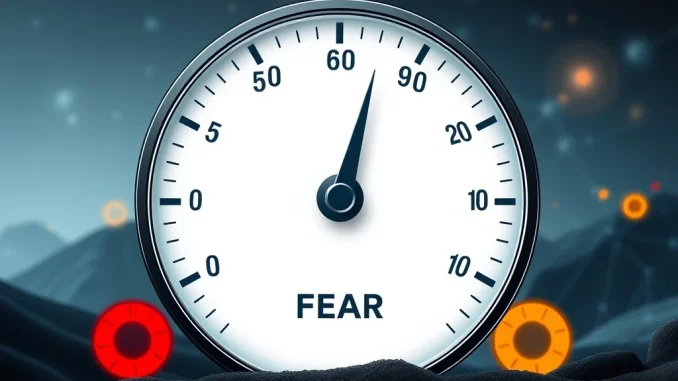
The cryptocurrency world often operates on a rollercoaster of emotions. Understanding these emotional shifts is crucial for investors. Currently, the **Crypto Fear & Greed Index** serves as a vital barometer for investor sentiment. This widely observed metric has registered a value of 44, holding steady in the ‘Fear’ territory for another day. This consistent reading signals a prevalent cautious mood across the **crypto market**, prompting many to analyze its implications.
Understanding the Crypto Fear & Greed Index
The **Crypto Fear & Greed Index** provides a unique lens into the collective psychological state of cryptocurrency investors. Developed by Alternative.me, it distills various market factors into a single, easy-to-understand score. The index operates on a scale from 0 to 100:
- 0-24: Extreme Fear – Investors are highly anxious, often indicating a potential buying opportunity.
- 25-49: Fear – A prevailing cautious sentiment, suggesting undervaluation or market instability.
- 50-74: Greed – Investors are optimistic, sometimes signaling an overbought market.
- 75-100: Extreme Greed – Euphoria dominates, often preceding a market correction.
Therefore, a score of 44 firmly places the market in the ‘Fear’ category. This suggests that investors are currently hesitant. They are possibly withdrawing funds or exercising extreme caution when making new investments. Historically, periods of extreme fear have often presented significant buying opportunities for long-term investors. Conversely, extreme greed can signal an impending market correction. Consequently, monitoring this index helps gauge the overall **market sentiment**.
The Anatomy of Market Sentiment: How the Index is Calculated
The index is not based on arbitrary feelings. Instead, it relies on a sophisticated algorithm that analyzes six key factors, each weighted differently. These factors provide a comprehensive snapshot of investor behavior and market dynamics. Understanding these components is essential to grasp why the index sits at 44.
Volatility (25%)
Volatility measures how much the price of Bitcoin changes. High volatility, especially when prices are falling, indicates fear. Investors become nervous during sharp price swings. Conversely, stable prices might suggest complacency or a lack of strong conviction. This component assesses current price movements compared to historical averages. Elevated volatility often translates into a lower index score.
Trading Volume (25%)
Trading volume reflects market activity. High trading volume in a falling market often suggests panic selling. Conversely, strong buying volume during a rally indicates confidence. The index considers current volume and momentum. Low trading volumes can also indicate investor apathy or a wait-and-see approach. Thus, significant shifts in volume heavily influence the **market sentiment** score.
Social Media Mentions (15%)
Social media platforms like X (formerly Twitter) are central to crypto discussions. The index analyzes specific hashtags and keywords. It counts the number of posts and their sentiment. A surge in negative mentions or panic-inducing phrases contributes to ‘Fear.’ Conversely, positive sentiment boosts the ‘Greed’ score. This factor captures the public’s immediate emotional response to market events.
Surveys (15%)
Although currently paused, surveys historically gathered direct input from investors. They asked about market expectations and investment intentions. These direct insights offered a clear picture of individual investor confidence or apprehension. When active, surveys provided a valuable qualitative layer to the index’s quantitative data.
Bitcoin Dominance (10%)
Bitcoin dominance measures Bitcoin’s market capitalization relative to the entire cryptocurrency market. An increasing Bitcoin dominance often suggests investors are moving out of altcoins and into Bitcoin, seen as a safer haven. This shift can indicate a lack of confidence in the broader altcoin market. Conversely, decreasing dominance can signal increased risk appetite for altcoins. Therefore, Bitcoin’s position significantly impacts the overall **crypto market** sentiment.
Google Search Volume (10%)
Google search trends reveal retail investor interest. A surge in searches for terms like “Bitcoin price manipulation” or “crypto crash” indicates panic. Meanwhile, searches for “buy Bitcoin” during a dip might suggest opportunistic buying. This component reflects the general public’s curiosity and fear or greed-driven queries. It acts as a proxy for widespread retail investor concern or excitement.
Navigating the Current ‘Fear’ Territory at 44
The persistent reading of 44 in the ‘Fear’ zone presents a complex scenario for investors. It is not extreme fear, which often signals a bottom. However, it is certainly not a bullish signal either. This moderate fear suggests caution is warranted. Investors may be hesitant due to macroeconomic factors. They might also be reacting to regulatory uncertainties. Furthermore, a lack of significant positive catalysts could be contributing to this sustained sentiment.
For some, this period of **cryptocurrency fear** could represent an accumulation phase. Seasoned investors often ‘buy the dip’ when others are fearful. However, it is crucial to conduct thorough research. This involves not just looking at the index but also analyzing fundamental project strengths. Moreover, technical analysis helps identify potential support levels. The index acts as a guide, not a definitive trading signal. It indicates the psychological landscape. Thus, prudent decision-making remains paramount.
Implications for the Crypto Market
A sustained period of ‘Fear’ can have several implications for the broader **crypto market**. Firstly, it may lead to continued price stagnation or gradual declines. Secondly, new capital might be hesitant to enter the market. Thirdly, it could test the conviction of existing holders. The index suggests that the market lacks strong bullish momentum. However, it also indicates that extreme panic selling has not yet taken hold. This balanced but cautious state requires careful monitoring.
Investors should observe key support and resistance levels. They should also pay attention to macroeconomic indicators. Changes in interest rates, inflation data, and global economic stability all influence crypto prices. Furthermore, significant regulatory news can shift sentiment quickly. The current index reading underscores the need for a well-thought-out investment strategy. It highlights the importance of managing risk effectively.
Conclusion: Prudence in a Fearful Market
The **Crypto Fear & Greed Index** holding steady at 44 reflects a market gripped by moderate ‘Fear.’ This sentiment is a culmination of various factors, from volatility and trading volume to social media buzz and **Bitcoin dominance**. While ‘Fear’ can signal potential buying opportunities, it also emphasizes the need for caution. Investors must combine this sentiment indicator with comprehensive fundamental and technical analysis. Staying informed and making rational decisions, rather than emotional ones, remains the best approach in these uncertain times. The **crypto market** is dynamic; therefore, understanding its underlying psychology is a powerful tool for navigating its complexities.
Frequently Asked Questions (FAQs)
Q1: What does a Crypto Fear & Greed Index score of 44 mean?
A score of 44 indicates that the market is currently in the ‘Fear’ territory. This means investors are generally cautious or apprehensive, rather than extremely fearful or overly greedy. It suggests a prevailing hesitant sentiment among participants in the crypto market.
Q2: How often is the Crypto Fear & Greed Index updated?
The Crypto Fear & Greed Index is updated daily. This allows investors to track real-time shifts in market sentiment and react accordingly to new data points.
Q3: Is the Crypto Fear & Greed Index only based on Bitcoin?
While Bitcoin’s performance and data heavily influence the index (especially through volatility, trading volume, and Bitcoin dominance), it aims to reflect the overall cryptocurrency market sentiment. Its components consider broader market activity and sentiment indicators.
Q4: Should I buy when the index shows ‘Fear’?
Historically, periods of ‘Fear’ (especially ‘Extreme Fear’) have often presented good buying opportunities for long-term investors. However, the index is just one tool. It should be combined with thorough research, fundamental analysis of projects, and a personal risk assessment before making any investment decisions. A score of 44 is ‘Fear,’ not ‘Extreme Fear,’ suggesting caution is still advised.
Q5: What factors contribute most to the Crypto Fear & Greed Index?
The index is calculated using six main factors: volatility (25%), trading volume (25%), social media mentions (15%), surveys (15%), Bitcoin dominance (10%), and Google search volume (10%). Volatility and trading volume collectively account for half of the index’s weighting.