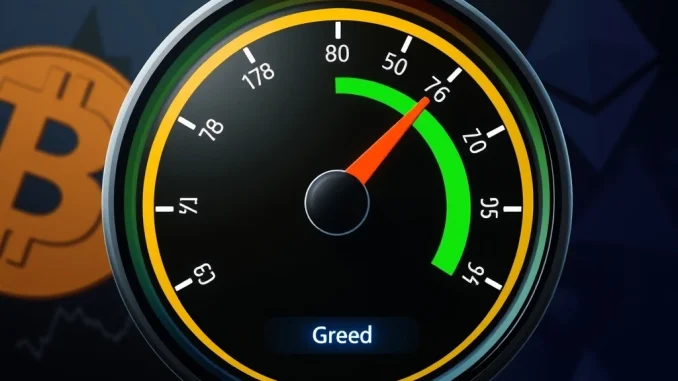
The cryptocurrency market is a dynamic realm, often driven by powerful emotions. Understanding these emotions can provide a significant edge. Recently, the **Crypto Fear & Greed Index** has made headlines, soaring to 72 and firmly planting itself in the ‘Greed’ zone. This isn’t just a number; it’s a crucial snapshot of the prevailing **crypto market sentiment**, offering insights into the collective psychology of participants in the digital asset space.
What is the Crypto Fear & Greed Index and Why Does it Matter?
Developed by software platform Alternative.me, the **Crypto Fear & Greed Index** serves as a barometer for the emotional state of the cryptocurrency market. It’s designed to help investors understand if the market is leaning towards extreme fear, which often signals a potential buying opportunity, or extreme greed, which might precede a market correction. The index operates on a scale from 0 to 100, where:
- 0-24: Extreme Fear – Investors are very worried, prices might be undervalued.
- 25-49: Fear – Investors are anxious, potential for accumulation.
- 50-74: Greed – Investors are optimistic, prices might be getting high.
- 75-100: Extreme Greed – Investors are euphoric, market might be due for a correction.
When the index registers 72, as it has now, it indicates that market participants are feeling quite optimistic, perhaps even euphoric. This high reading suggests that many are eager to buy, driven by positive price action and the fear of missing out (FOMO).
Understanding the Pillars of Crypto Market Sentiment
The index is not based on guesswork. It meticulously aggregates data from six key factors, each contributing to the overall **crypto market sentiment**. Each factor offers a unique lens into market psychology:
- Volatility (25%): This component measures the current volatility and maximum drawdowns of Bitcoin compared to its average values over the last 30 and 90 days. High volatility can sometimes signal uncertainty, but sustained upward volatility often fuels optimism and pushes the index higher.
- Market Momentum/Volume (25%): This factor analyzes the current trading volume and market momentum, comparing it with average values. Strong, consistent buying volume in a rising market is a clear indicator of growing investor interest and contributes significantly to a ‘Greed’ reading.
- Social Media (15%): The index scans social media platforms, particularly Twitter, for specific cryptocurrency-related keywords and analyzes the sentiment of these mentions. A surge in positive, excited chatter about crypto, coupled with high engagement, contributes to a ‘Greed’ score.
- Surveys (15%): While currently paused, these surveys previously gauged public opinion and sentiment towards the market, providing direct insights into investor confidence.
- Bitcoin Dominance (10%): This metric measures Bitcoin’s share of the total cryptocurrency market capitalization. A rising Bitcoin dominance can indicate either a flight to safety (investors moving to the most established asset) or, in a bullish environment, strong confidence in Bitcoin that often leads the broader market, influencing overall positive sentiment.
- Google Trends (10%): By analyzing search queries related to cryptocurrencies, this component provides insight into public interest. For example, a spike in searches for “how to buy Bitcoin” or “best altcoins to buy” can indicate growing public interest and a speculative mindset, contributing to a ‘Greed’ reading.
Decoding Market Volatility: A Double-Edged Sword
**Market volatility** is a significant component, making up a quarter of the index’s calculation. While extreme, sudden downward swings can signal fear, sustained upward price movements, even with notable daily swings, often fuel a sense of optimism and drive the index higher. When prices are consistently climbing, the fear of missing out (FOMO) kicks in, prompting more individuals to enter the market. Conversely, a sharp increase in selling pressure and price drops would quickly shift this component towards ‘Fear’.
The Power of Bitcoin Dominance in Shaping Outlook
**Bitcoin dominance**, accounting for 10% of the index, is a fascinating metric. When Bitcoin’s market share grows, it can sometimes signify investors seeking refuge in the most established cryptocurrency during uncertain times. However, in a bull market, it often reflects a strong leading rally in Bitcoin that pulls the entire altcoin market up with it, contributing to a widespread positive sentiment. Currently, its contribution to the 72 score suggests a positive interpretation of Bitcoin’s strength influencing overall market confidence.
Navigating the “Greed Zone”: What Does 72 Mean for You?
Being in the **greed zone** at 72 means the market is currently experiencing significant optimism and high investor confidence. Historically, high greed levels can precede market corrections or periods of consolidation. When everyone is confident and buying, asset prices can become overextended, making them more vulnerable to pullbacks. This doesn’t mean a crash is imminent, but it is a signal to exercise increased caution.
For investors, this state suggests that many are driven by emotion rather than purely fundamental analysis, potentially leading to irrational exuberance. While exciting, this period calls for strategic thinking:
- For existing holders: It might be a time to consider partial profit-taking, especially on positions that have seen substantial gains.
- For those looking to enter: It may be prudent to wait for potential pullbacks or to dollar-cost average into positions rather than making large, impulsive buys at potentially elevated prices.
- For traders: Increased volatility can present opportunities, but also heightened risks.
It’s a moment to balance optimism with a realistic assessment of risk.
Actionable Insights for the Savvy Investor
The Crypto Fear & Greed Index is a valuable tool, but it should be part of a broader investment strategy. Here are some actionable insights:
- Combine with Other Indicators: Use the index in conjunction with technical analysis, on-chain data, and fundamental research for a holistic view.
- Manage Emotions: High greed can trigger FOMO. Develop a disciplined approach to avoid impulsive decisions driven by market hype.
- Implement Risk Management: Consider setting clear entry and exit strategies. This might include setting stop-loss orders or defining profit targets to protect your capital.
- Look for Divergences: If the index shows extreme greed but other fundamental or technical indicators suggest weakness, it could signal a potential reversal.
- Educate Yourself: Understand the underlying factors that move the index, allowing you to interpret its readings more effectively.
Beyond the Numbers: Limitations and Nuances
While helpful, the Crypto Fear & Greed Index has its limitations. It is primarily a sentiment indicator and, to some extent, backward-looking. Market sentiment can shift rapidly, sometimes within hours, making the index a snapshot rather than a crystal ball. It doesn’t account for complex macroeconomic factors, regulatory changes, or specific project developments that can significantly impact the market. Furthermore, the temporary pausing of the ‘Surveys’ component means one piece of the puzzle is currently inactive, which might slightly alter its overall weighting or accuracy. It’s a powerful tool, but it’s just one piece of a much larger, intricate market puzzle.
Conclusion: Riding the Waves of Market Emotion
The recent rise of the **Crypto Fear & Greed Index** to 72 clearly underscores a palpable shift towards widespread optimism in the crypto market. While this surge into the ‘Greed zone’ is exciting for many, it also serves as a crucial reminder to approach the market with a balanced and informed perspective. Understanding the underlying factors like **market volatility** and **Bitcoin dominance** helps paint a clearer picture of why sentiment is shifting. Ultimately, this index is a valuable tool for gauging collective **crypto market sentiment**, empowering investors to make more informed, less emotionally driven decisions in the dynamic and often unpredictable world of digital assets. It encourages a proactive, rather than reactive, approach to navigating market cycles.
Frequently Asked Questions (FAQs)
1. What is the Crypto Fear & Greed Index?
The Crypto Fear & Greed Index is a tool that measures the current emotional state of the cryptocurrency market. It ranges from 0 (extreme fear) to 100 (extreme greed), helping investors gauge whether the market is overly pessimistic or optimistic.
2. How is the Crypto Fear & Greed Index calculated?
It’s calculated based on six weighted factors: volatility (25%), market momentum/volume (25%), social media sentiment (15%), surveys (15% – currently paused), Bitcoin dominance (10%), and Google Trends data (10%).
3. What does it mean when the index is in the “Greed” zone?
When the index is in the “Greed” zone (50-74), it indicates that investors are feeling optimistic and confident, often leading to increased buying activity. While this can signal a strong market, historically, extreme greed can precede market corrections.
4. Should I buy or sell based solely on the Crypto Fear & Greed Index?
No, the index should not be the sole basis for investment decisions. It’s a sentiment indicator and a valuable tool to be used in conjunction with other forms of analysis, such as technical analysis, fundamental research, and your own risk assessment. It helps you understand the prevailing market psychology.
5. What is Bitcoin dominance and why is it important for the index?
Bitcoin dominance is the ratio of Bitcoin’s market capitalization to the total cryptocurrency market capitalization. It’s important because Bitcoin often leads the broader crypto market. Its dominance can indicate market stability (flight to safety) or strong bullish momentum that influences overall market sentiment.
6. Are there any limitations to using the Crypto Fear & Greed Index?
Yes, the index has limitations. It’s primarily a sentiment indicator and can be backward-looking. It doesn’t account for all external factors like macroeconomic events or regulatory changes, and market sentiment can shift very quickly. It’s best used as one data point among many.