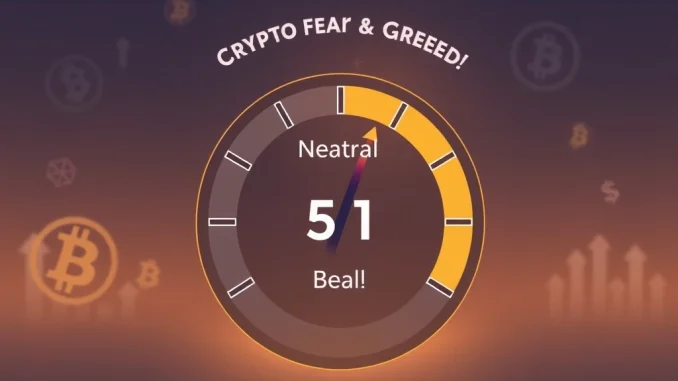
The Crypto Fear & Greed Index currently stands at 51, maintaining a crucial neutral stance. This figure, reflecting recent market sentiment, offers valuable insights for investors. It suggests neither extreme optimism nor overwhelming panic dominates the cryptocurrency market right now. Therefore, understanding this neutral position becomes paramount for informed decision-making.
Understanding the Crypto Fear & Greed Index
The Crypto Fear & Greed Index serves as a vital barometer for the digital asset space. It condenses complex market data into a single, easily understandable score. Essentially, it helps participants gauge whether the market is overly fearful, potentially signaling a buying opportunity, or excessively greedy, which might suggest a correction is due. Developed by Alternative.me, this widely watched indicator measures the prevailing emotional state of the crypto market. Consequently, it assists investors in interpreting collective market sentiment effectively.
The index operates on a simple scale. A reading of 0 indicates ‘Extreme Fear,’ while 100 signifies ‘Extreme Greed.’ A neutral score, like the current 51, implies a balanced outlook. This balanced perspective often precedes significant price movements or periods of consolidation. Historically, extreme fear often presents strong buying opportunities for assets like Bitcoin. Conversely, extreme greed frequently precedes market corrections. Thus, monitoring this index provides a unique lens into the psychology driving the cryptocurrency market.
The Six Pillars Driving Market Sentiment
Several distinct factors contribute to the Crypto Fear & Greed Index calculation. Each component plays a specific role in painting a comprehensive picture of investor behavior. These factors are weighted differently to reflect their impact on overall sentiment. Understanding each element helps in appreciating the index’s holistic approach to measuring market emotions. Ultimately, this multi-faceted analysis provides a more accurate reflection of the market’s psychological state.
- Volatility (25%): This component measures current price fluctuations and drawdowns compared to historical averages. High volatility often signals fear, as rapid price swings create uncertainty. Conversely, low volatility can suggest complacency or a period of accumulation. Investors typically monitor volatility closely.
- Market Volume (25%): Robust trading volumes in a positive market often suggest strong interest and potentially greed. Conversely, low volumes during price declines can indicate fear or a lack of conviction. Significant volume shifts can highlight impending market moves. Therefore, volume provides crucial insights into market participation.
- Social Media (15%): Analysis of keywords and hashtags on platforms like Twitter reveals public sentiment. Positive mentions and high engagement can indicate growing optimism or greed. Negative sentiment, however, points towards fear. This factor captures the collective buzz surrounding the cryptocurrency market.
- Surveys (15%): While paused currently, these polls previously captured direct investor behavior regarding market outlook. They offered a direct pulse on individual investor feelings. Though not active now, their historical contribution was significant in shaping the index’s methodology.
- Bitcoin Dominance (10%): A rising Bitcoin dominance often indicates a flight to safety, or fear in altcoins. Investors move capital into Bitcoin, perceived as less risky. Conversely, decreasing dominance can signal greed in altcoins, as capital flows into riskier assets. This dynamic reflects shifting preferences within the cryptocurrency market.
- Google Trends (10%): Search queries for terms like ‘Bitcoin price manipulation’ or ‘how to buy Bitcoin’ reflect public interest and potential fear or greed. Spikes in fear-related searches often precede downturns. Similarly, surges in ‘how to buy’ queries can signal growing retail interest, potentially indicating greed.
Decoding Neutrality: The 51 Point Perspective for Bitcoin Price
A neutral reading of 51 suggests the market is currently in a state of equilibrium. Neither buyers nor sellers hold a dominant advantage. This position contrasts sharply with periods of extreme fear, which historically present strong buying opportunities for assets like Bitcoin. Conversely, extreme greed often precedes market corrections. Thus, this neutral zone represents a crossroads for the cryptocurrency market.
For investors, this neutral stance implies caution. It is not a clear signal to buy or sell aggressively. Instead, it encourages careful observation of emerging trends. The cryptocurrency market often consolidates during such neutral phases, building momentum for its next major move. Historically, periods of neutrality can be precursors to significant shifts in Bitcoin price. Therefore, staying vigilant and avoiding impulsive decisions becomes critical during these times. Furthermore, this neutral zone allows investors to re-evaluate their strategies without the pressure of extreme market emotions.
Historical Insights and Market Cycles: Understanding Investor Behavior
Throughout its history, the Crypto Fear & Greed Index has proven to be a useful contrarian indicator. When the index plunges into ‘Extreme Fear,’ many seasoned investors view this as a potential accumulation zone. They understand that panic often leads to oversold conditions. Conversely, when it soars into ‘Extreme Greed,’ it often signals a time for profit-taking. This cyclical nature of investor behavior highlights the importance of emotional intelligence in trading.
Consider the bull run of late 2021. The index frequently hovered in the ‘Extreme Greed’ zone, signaling euphoria. This period ultimately preceded a significant market correction. Conversely, during bear market lows, the index often registered ‘Extreme Fear,’ providing strong signals for those brave enough to buy. These historical patterns demonstrate the index’s utility in identifying potential market turning points. Moreover, they underscore the predictable human element in the highly volatile cryptocurrency market.
Bitcoin’s Central Role in Sentiment and Market Dynamics
Bitcoin’s price movements significantly influence the overall market sentiment reflected in the index. As the largest cryptocurrency by market capitalization, Bitcoin acts as the bellwether for the entire digital asset space. Its dominance factor within the index specifically highlights this importance. When Bitcoin performs strongly, it often pulls the rest of the market up, fostering greed. Conversely, a downturn in Bitcoin typically triggers fear across altcoins.
This strong correlation means that any major news or developments related to Bitcoin will likely impact the index. For example, regulatory news concerning Bitcoin can quickly shift sentiment from neutral to fear or greed. Therefore, keeping a close eye on Bitcoin-specific news and technical analysis remains crucial. Its foundational role means the health of the cryptocurrency market often mirrors Bitcoin’s trajectory. Furthermore, changes in institutional adoption of Bitcoin can also have a profound effect on the index’s readings.
Strategies for a Neutral Cryptocurrency Market
When the Crypto Fear & Greed Index signals a neutral market, investors should consider several strategic approaches. Firstly, it provides an opportune moment for re-evaluation. Review your portfolio and assess your risk tolerance without the emotional pressures of extreme fear or greed. Secondly, consider dollar-cost averaging (DCA) into preferred assets like Bitcoin. This strategy helps mitigate risk during periods of uncertainty. Therefore, a neutral market can be a time for disciplined accumulation.
Moreover, investors might focus on fundamental analysis during neutral periods. Research projects with strong utility, solid teams, and clear roadmaps. This proactive approach prepares you for the next market cycle. Avoiding impulsive trades driven by short-term price movements becomes especially important. Instead, a neutral index reading encourages patience and a long-term perspective on the cryptocurrency market. Finally, use this time to educate yourself further on various market indicators and improve your understanding of investor behavior.
Beyond the Index: Complementary Indicators for Informed Investor Behavior
While the Crypto Fear & Greed Index offers valuable insights into market sentiment, it should not be the sole basis for investment decisions. Smart investors combine this index with other analytical tools. Technical analysis, for instance, provides price action patterns and indicators that can confirm or contradict sentiment signals. Similarly, on-chain metrics offer a deeper look into network activity, transaction volumes, and whale movements. These data points reveal underlying market strength or weakness.
Furthermore, staying informed about macroeconomic trends and regulatory developments is essential. Global economic shifts, interest rate changes, and new crypto legislation significantly impact the cryptocurrency market. Therefore, a holistic approach, integrating sentiment, technicals, fundamentals, and macro factors, provides the most robust framework for navigating the volatile world of digital assets. This comprehensive strategy ultimately leads to more informed investor behavior and better outcomes.
In conclusion, the Crypto Fear & Greed Index holding steady at 51 underscores a period of neutral market sentiment. This balance suggests a wait-and-see approach for many. As the Bitcoin price and the wider cryptocurrency market continue to evolve, this index will remain a key indicator. It helps to decode the complex emotional landscape of digital asset investing. Ultimately, understanding this index empowers investors to make more rational decisions, mitigating the risks associated with emotional trading.
Frequently Asked Questions (FAQs)
What is the Crypto Fear & Greed Index?
The Crypto Fear & Greed Index is a tool that measures the current emotional state of the cryptocurrency market. It assigns a score from 0 (Extreme Fear) to 100 (Extreme Greed) based on various market factors, helping investors gauge overall market sentiment.
How is the Crypto Fear & Greed Index calculated?
The index is calculated using six weighted factors: volatility (25%), trading volume (25%), social media mentions (15%), surveys (15% – currently paused), Bitcoin’s market cap dominance (10%), and Google search volume (10%). These components provide a comprehensive view of market psychology.
What does a neutral score (like 51) mean for investors?
A neutral score, such as 51, indicates a balanced market sentiment where neither extreme fear nor extreme greed dominates. For investors, this suggests a period of equilibrium, encouraging caution, observation, and potentially strategic accumulation rather than aggressive buying or selling.
Is the Crypto Fear & Greed Index a reliable trading signal?
While a valuable indicator, the Crypto Fear & Greed Index should not be used as a standalone trading signal. It provides insights into market sentiment and potential turning points but works best when combined with other analytical tools like technical analysis, fundamental research, and on-chain metrics for a more comprehensive strategy.
How does Bitcoin dominance affect the index?
Bitcoin’s market cap dominance is a factor in the index. A rising Bitcoin dominance often indicates a flight of capital from altcoins to Bitcoin, signaling fear in the broader market. Conversely, a decreasing dominance can suggest growing confidence and greed in altcoins.
Where can I find the current Crypto Fear & Greed Index value?
You can find the current Crypto Fear & Greed Index value on websites like Alternative.me, which is the primary source for this data. Many cryptocurrency news sites and analytical platforms also display the index.