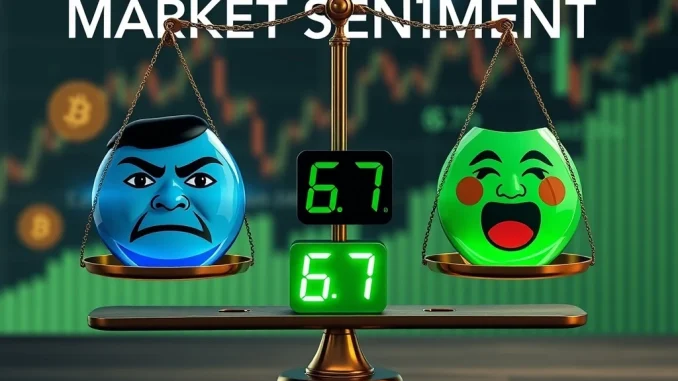
The **Crypto Fear & Greed Index** offers a captivating glimpse into prevailing **crypto market sentiment**. On August 9, this significant indicator registered a score of 67. This reading marked a seven-point decrease from the previous day. Despite this modest decline, the index firmly remained within the ‘Greed’ zone. This continued ‘Greed’ signal provides valuable insights for anyone interested in cryptocurrencies. It suggests a prevailing optimism among market participants. Furthermore, understanding this score helps decipher the collective mood driving digital asset prices.
Understanding the Crypto Fear & Greed Index as a Market Analysis Tool
The **Crypto Fear & Greed Index** functions as a crucial **market analysis tool**. It provides a comprehensive overview of the emotional state of the cryptocurrency market. This index ranges from 0 to 100. A score of 0 signifies ‘Extreme Fear’. Conversely, a score of 100 indicates ‘Extreme Greed’. The index aggregates various data points to generate its daily score. Consequently, it offers a quantitative measure of market emotions. This helps investors gauge when sentiment might be shifting. Many traders and analysts closely monitor this index. They use it to inform their decisions. Therefore, understanding its components is vital.
The Pillars of Sentiment: What Drives the Index?
The index’s calculation incorporates six distinct factors. Each factor contributes a specific weighting to the overall score. These components aim to capture different facets of **investor psychology** and market activity. By combining these diverse elements, the index provides a holistic view. Here is a breakdown of its key drivers:
Volatility (25%): This factor measures the current volatility and maximum drawdowns of Bitcoin. High volatility often suggests a fearful or uncertain market. Investors become anxious during rapid price swings. Conversely, lower volatility can indicate a calmer, more confident market. The index analyzes daily price changes to assess this.
Market Momentum/Volume (25%): This component evaluates the current volume and market momentum. It compares current trading volumes with historical averages. High trading volumes, especially during price increases, often signal strong buying interest. This indicates a ‘Greedy’ market. Conversely, low volume during price drops might suggest fear. This metric provides insight into market activity and conviction.
Social Media (15%): The index analyzes cryptocurrency-related hashtags on social media platforms. It looks for specific keywords and assesses their sentiment. A high volume of positive or overly optimistic mentions can point towards ‘Greed’. Conversely, negative or panic-driven discussions contribute to ‘Fear’. This reflects the collective mood expressed online.
Surveys (15%): This factor gauges public opinion through weekly surveys. Participants are asked about their perception of the market. While a significant component, the platform Alternative currently has surveys paused. When active, survey results provide direct insight into retail **investor psychology**. They reveal whether individuals feel optimistic or pessimistic.
Bitcoin Dominance (10%): This metric measures Bitcoin’s share of the total cryptocurrency market capitalization. An increasing **Bitcoin dominance** can sometimes indicate fear. During uncertain times, investors often move their funds into Bitcoin. They perceive Bitcoin as a safer asset compared to altcoins. Conversely, decreasing dominance might suggest a shift towards altcoins, often seen during ‘Greed’ phases. This shows a willingness to take on more risk.
Google Trends (10%): This component analyzes search query data for Bitcoin and other cryptocurrencies. Rising search interest for terms like ‘Bitcoin price manipulation’ often signals fear. People search for answers during market downturns. Conversely, increased searches for ‘Bitcoin buy’ or ‘how to buy crypto’ can suggest growing public interest and potential ‘Greed’. This reflects general public curiosity and engagement.
Decoding the ‘Greed’ Signal: What 67 Implies for Crypto Market Sentiment
A score of 67 places the index firmly in the ‘Greed’ zone. This indicates a predominantly optimistic and confident **crypto market sentiment**. Investors generally feel positive about future price movements. They might be more willing to take on risk. Historically, ‘Greed’ phases often precede market corrections. This is because excessive optimism can lead to overvaluation. Consequently, prices may become unsustainable. The current reading of 67, while lower than the previous day, still reflects strong bullish sentiment. It suggests that many market participants are actively buying. They expect further price increases. However, experienced investors often view high ‘Greed’ scores with caution. They remember the adage: ‘Be fearful when others are greedy, and greedy when others are fearful.’ Therefore, a high greed score can serve as a warning. It might suggest a good time to consider profit-taking. Alternatively, it might be a moment to reassess risk exposure.
Historical Context and Investor Behavior
The **Crypto Fear & Greed Index** provides valuable historical context. During periods of ‘Extreme Fear’ (scores below 20), prices are often at their lowest. This is when panic selling typically occurs. Conversely, ‘Extreme Greed’ (scores above 80) usually coincides with market peaks. This is when euphoria drives prices to unsustainable levels. For instance, during major bull runs, the index often stays in the ‘Greed’ or ‘Extreme Greed’ zones for extended periods. This reflects widespread optimism. However, sharp drops from ‘Greed’ to ‘Fear’ can signal a rapid shift in **investor psychology**. Such shifts often precede significant market downturns. By studying past patterns, investors gain a better understanding. They learn how collective emotions influence market cycles. This helps them anticipate potential shifts. It also aids in managing their own emotional responses.
Utilizing the Crypto Fear & Greed Index for Informed Decisions
While a powerful **market analysis tool**, the **Crypto Fear & Greed Index** should not be used in isolation. It offers a snapshot of current sentiment. However, it does not predict future price movements with certainty. Instead, investors should integrate it into a broader analytical framework. Combine it with fundamental analysis. Also, consider technical indicators. For example, a high ‘Greed’ score might prompt an investor to look for signs of market exhaustion. They might seek decreasing trading volume on price increases. Similarly, an ‘Extreme Fear’ reading could signal a potential buying opportunity. This is especially true if other indicators suggest a market bottom. Ultimately, the index serves as a guide. It helps individuals understand the prevailing emotional climate. It encourages a counter-cyclical approach to investing. This involves buying when others are fearful and selling when others are greedy. This strategy aligns with the core principle of value investing.
Beyond the Index: Other Factors Influencing Crypto Market Sentiment
While the **Crypto Fear & Greed Index** is a robust indicator, numerous other factors influence overall **crypto market sentiment**. Macroeconomic conditions play a significant role. Inflation rates, interest rate decisions, and global economic stability directly impact investor appetite for risk assets. Regulatory developments also heavily influence the market. News regarding new crypto regulations or enforcement actions can cause swift shifts in sentiment. Technological advancements within the blockchain space also matter. Breakthroughs in scalability or new decentralized applications can generate significant excitement. Conversely, security breaches or major hacks can trigger widespread fear. Geopolitical events, such as conflicts or political instability, can also drive market reactions. Therefore, a comprehensive understanding requires looking beyond just the index. It involves staying informed about a wide range of global and industry-specific news. This holistic view provides a more complete picture of the market’s direction.
Conclusion: Navigating the Market with the Crypto Fear & Greed Index
The **Crypto Fear & Greed Index** remains an invaluable **market analysis tool** for understanding **crypto market sentiment**. Its current reading of 67, indicating ‘Greed’, suggests prevailing optimism among investors. This index distills complex market dynamics into a simple, digestible score. It provides insight into the collective **investor psychology** that drives asset prices. By analyzing factors like volatility, market momentum, social media trends, and **Bitcoin dominance**, it offers a comprehensive view. While it serves as a powerful indicator, it is crucial to use it alongside other analytical methods. No single tool guarantees success in the volatile cryptocurrency market. However, by understanding and wisely applying the insights from the Fear & Greed Index, investors can make more informed decisions. This helps them navigate the exciting yet unpredictable world of digital assets with greater confidence.
Frequently Asked Questions (FAQs)
Q1: What is the Crypto Fear & Greed Index?
The Crypto Fear & Greed Index is a tool that measures the emotional state of the cryptocurrency market. It ranges from 0 (Extreme Fear) to 100 (Extreme Greed). It helps investors understand if the market is overly optimistic or pessimistic.
Q2: How is the Crypto Fear & Greed Index calculated?
The index is calculated using six weighted factors: volatility (25%), market momentum/volume (25%), social media sentiment (15%), surveys (15% – currently paused), Bitcoin dominance (10%), and Google Trends data (10%).
Q3: What does a ‘Greed’ score of 67 mean for the crypto market?
A score of 67 in the ‘Greed’ zone indicates that investors are generally optimistic and confident. They are more willing to buy assets. While positive, high ‘Greed’ scores can sometimes precede market corrections, suggesting a need for caution.
Q4: Can the Crypto Fear & Greed Index predict market movements?
The index is a sentiment indicator, not a direct predictor of future price movements. It provides insight into current **investor psychology**. Investors should use it as part of a broader analysis, combining it with fundamental and technical research, rather than as a standalone trading signal.
Q5: How does Bitcoin dominance influence the index?
Bitcoin dominance measures Bitcoin’s market share. An increasing dominance can sometimes indicate ‘Fear’, as investors might move to Bitcoin as a perceived safer asset during uncertainty. Conversely, decreasing dominance often signals ‘Greed’, as funds flow into altcoins for higher potential gains.