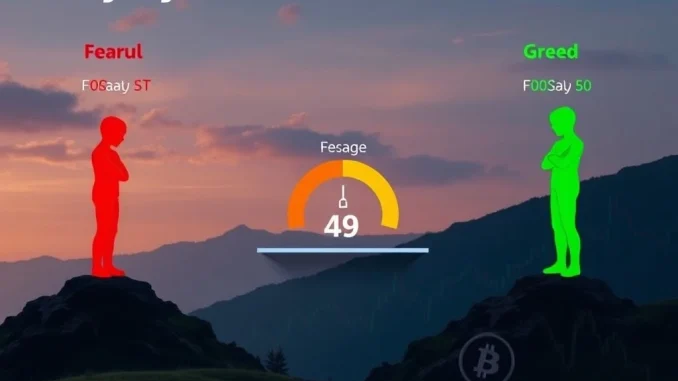
Understanding the pulse of the cryptocurrency market is vital for any investor. Currently, the Crypto Fear & Greed Index has edged up to 49, firmly planting itself in the neutral zone. This movement offers crucial insights into prevailing market sentiment, moving away from extreme fear or euphoria. For those navigating the often-turbulent waters of digital assets, this index provides a valuable compass.
Understanding the Crypto Fear & Greed Index
The Crypto Fear & Greed Index serves as a powerful barometer for investor emotion within the volatile cryptocurrency market. Created by Alternative.me, this index consolidates various market factors into a single, easy-to-understand score. A reading close to 0 signifies extreme fear, suggesting potential buying opportunities as investors might be overselling. Conversely, a score near 100 indicates extreme greed, often signaling an overheated market ripe for a correction. Therefore, tracking this index helps participants gauge the collective mood.
This index provides more than just a number; it offers a snapshot of the psychological state of the market. When fear dominates, many investors panic, selling off assets. Conversely, greed often leads to irrational exuberance and speculative buying. Observing these shifts helps investors make more informed decisions, potentially avoiding emotional pitfalls. Consequently, the index has become a go-to tool for many.
The Six Pillars: How the Index is Calculated
The index is not based on a single metric; instead, it aggregates data from six distinct sources, each weighted differently to provide a comprehensive view. These factors collectively paint a picture of overall market sentiment. Let’s explore each component:
- Volatility (25%): This factor measures the current volatility and maximum drawdowns of Bitcoin compared to its average values over the last 30 and 90 days. High volatility often signals a fearful market.
- Trading Volume (25%): Current trading volume and market momentum are compared with average values. High buying volumes in a rising market suggest greed, while low volumes in a falling market can indicate fear.
- Social Media Mentions (15%): The index analyzes keywords on platforms like Twitter to gauge public sentiment. A surge in mentions, especially with positive or negative sentiment, influences the score.
- Surveys (15%): Weekly polls are conducted among thousands of crypto investors to directly capture their perception of the market. This offers a direct insight into investor psychology.
- Bitcoin Dominance (10%): An increasing Bitcoin dominance often suggests a flight to safety, indicating fear in the altcoin market. Conversely, decreasing dominance can signal greed as investors move into riskier altcoins.
- Google Search Trends (10%): Data from Google Trends for cryptocurrency-related searches reveals public interest. Rising search queries for terms like ‘Bitcoin price manipulation’ might suggest fear, whereas ‘buy Bitcoin’ could indicate greed.
Navigating the Neutral Zone: What a Score of 49 Means
A score of 49 places the Crypto Fear & Greed Index squarely in the ‘neutral’ category. This means the market is not currently dominated by extreme fear or excessive greed. Instead, it suggests a period of relative balance and uncertainty. Investors are neither panic-selling nor FOMO-buying aggressively. Therefore, this neutral stance can be interpreted in several ways.
Historically, neutral zones often precede significant market movements. They can represent a consolidation phase before a breakout or breakdown. For instance, some analysts view a neutral reading as a healthy pause, allowing the market to digest previous price actions. Others might see it as a period of indecision, where both bulls and bears are vying for control. Understanding this balance is crucial for predicting future trends.
This particular score, 49, is very close to the exact midpoint of 50. Such proximity indicates a delicate equilibrium. It implies that slight shifts in any of the underlying factors could quickly push the index into either fear or greed territory. Consequently, vigilance remains paramount for market participants.
Cryptocurrency Volatility and Its Impact on Sentiment
Cryptocurrency volatility is a defining characteristic of the digital asset market. Rapid price swings are common, and these movements significantly influence the Fear & Greed Index. When prices drop sharply, fear typically surges. Conversely, sudden price pumps often ignite greed. The index’s volatility component directly measures these fluctuations, assigning a 25% weight to this critical factor.
High volatility can create both opportunities and risks. For day traders, volatility is their bread and butter, offering numerous entry and exit points. However, for long-term investors, extreme volatility can be unsettling, testing their conviction. The current neutral reading, despite the inherent volatility of crypto, suggests that recent price movements have not been severe enough to trigger widespread panic or irrational exuberance. Thus, it hints at a more measured market environment.
Moreover, the relationship between volatility and investor psychology is cyclical. Increased price swings can fuel emotional responses, which in turn can exacerbate volatility. The index helps to quantify this feedback loop, providing a quantitative measure of sentiment driven by price action. Therefore, monitoring both is essential.
The Role of Bitcoin Dominance in Market Sentiment
Bitcoin dominance, which represents Bitcoin’s market capitalization relative to the total cryptocurrency market capitalization, plays a unique role in the Crypto Fear & Greed Index. This metric often acts as an indicator of risk appetite. When Bitcoin dominance rises, it usually means investors are moving capital out of altcoins and into Bitcoin, which is perceived as a safer, more established asset in the crypto space. This ‘flight to safety’ typically occurs during periods of market uncertainty or fear.
Conversely, a declining Bitcoin dominance suggests that investors are becoming more comfortable taking on risk. They might be allocating funds to altcoins, which generally offer higher potential returns but also higher risk. This shift often coincides with periods of increasing greed or optimism in the broader market. Therefore, the index assigns a 10% weight to this crucial indicator, reflecting its importance in gauging collective confidence.
A neutral index reading, with a stable or slightly fluctuating Bitcoin dominance, indicates that investors are not making aggressive moves in either direction. They are not entirely abandoning altcoins for Bitcoin, nor are they rushing into speculative altcoin plays. This contributes to the overall sense of balance reflected in the 49 score, reinforcing the idea of a market pausing for breath.
Investor Psychology and Google Search Trends
The human element, or investor psychology, is undeniably a powerful force in financial markets. The Crypto Fear & Greed Index directly taps into this through its survey component and indirectly via social media and Google search trends. Surveys provide a direct snapshot of how people feel, while online activity reflects broader public interest and sentiment. When many people search for ‘how to short Bitcoin,’ it often signals fear, whereas ‘best crypto to buy now’ might indicate greed.
Google search trends, accounting for 10% of the index, offer a fascinating look into the collective consciousness of potential and existing investors. A sudden spike in searches for negative keywords related to crypto scams or market crashes can pull the index lower. Conversely, increased searches for positive investment opportunities or specific projects can push it higher. These trends are not just random; they often correlate with significant market movements.
The combination of direct surveys and indirect search data provides a robust measure of public mood. In a neutral market, search trends might show a mix of interest, without overwhelming focus on either extreme bullish or bearish terms. This balanced search activity further reinforces the current equilibrium reflected in the index’s score of 49. It suggests a period where the average investor is observing rather than reacting impulsively.
Conclusion: A Balanced Outlook for Crypto Markets
The Crypto Fear & Greed Index currently holding at 49 offers a fascinating insight into the prevailing mood of the digital asset market. This neutral stance suggests a period of equilibrium, where extreme fear or rampant greed are not dictating investor actions. It’s a time for observation rather than impulsive decisions, as the market digests recent events and perhaps prepares for its next significant move. Understanding the underlying factors—from cryptocurrency volatility to Bitcoin dominance and broader investor psychology—empowers market participants to navigate these waters with greater clarity. While the future remains uncertain, the current neutral reading signals a moment of cautious optimism or perhaps strategic patience for those involved in crypto.
Frequently Asked Questions (FAQs)
Q1: What does a ‘neutral’ score on the Crypto Fear & Greed Index signify?
A neutral score, like the current 49, indicates that the cryptocurrency market is not dominated by extreme fear or excessive greed. Investors are neither panic-selling nor aggressively buying. It often suggests a period of balance, indecision, or consolidation.
Q2: How often is the Crypto Fear & Greed Index updated?
The Crypto Fear & Greed Index is typically updated daily, providing a fresh snapshot of market sentiment based on the latest data from its various contributing factors.
Q3: Can the Crypto Fear & Greed Index predict future price movements?
While the index is not a direct predictor of future prices, it is a valuable tool for gauging market sentiment. Historically, extreme fear (low scores) has often preceded market bottoms, while extreme greed (high scores) has sometimes signaled market tops. Therefore, it can offer insights into potential reversals or continuations.
Q4: Why is Bitcoin’s market dominance a factor in the index?
Bitcoin’s market dominance is included because it acts as a proxy for risk appetite. A rising dominance often indicates investors are seeking safety in Bitcoin (fear), while a falling dominance suggests a move into riskier altcoins (greed). It helps to understand the flow of capital within the crypto ecosystem.
Q5: How reliable are social media mentions and Google search trends for measuring market sentiment?
Social media mentions and Google search trends offer valuable, real-time insights into public interest and sentiment. While they can be influenced by hype or FUD (Fear, Uncertainty, Doubt), when combined with other robust metrics like volatility and trading volume, they contribute to a comprehensive and more reliable overall index score. They reflect collective investor psychology.