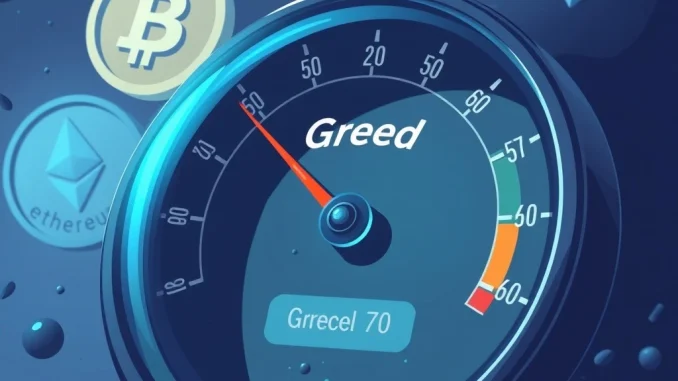
The world of cryptocurrency is a rollercoaster, isn’t it? One day you’re up, the next you’re down, and trying to gauge the collective mood can feel like guesswork. That’s where the Crypto Fear & Greed Index comes in. Recently, this crucial barometer dipped slightly to 70 as of July 16, a three-point drop from the previous day. Despite this minor slip, it remains firmly entrenched in the ‘Greed’ zone, prompting many to wonder: what does this truly signal for the dynamic crypto market sentiment?
What Exactly is the Crypto Fear & Greed Index?
Developed by Alternative, a software development platform, the Crypto Fear & Greed Index is designed to provide a snapshot of the emotional state of the cryptocurrency market. It’s a powerful tool for investors and enthusiasts alike, aiming to cut through the noise and give a clear indication of whether market participants are leaning towards fear or greed. The index operates on a scale from 0 to 100, where 0 represents ‘Extreme Fear’ and 100 signifies ‘Extreme Greed’. Think of it as a market thermometer, measuring the temperature of investor psychology.
Decoding the ‘Greed Zone’ at 70: What’s the Implication?
When the index stands at 70, as it currently does, it clearly places the market within the ‘Greed’ zone. But what does this level of Greed Zone really mean? Generally, a high index value suggests that investors are becoming overly optimistic, potentially leading to a market correction. Conversely, extreme fear often indicates a good buying opportunity. While a reading of 70 isn’t ‘Extreme Greed’ (which would be closer to 100), it certainly indicates a strong bullish sentiment prevailing. This sustained ‘Greed’ suggests that many market participants are actively buying, perhaps even FOMOing (Fear Of Missing Out) into positions, believing prices will continue to rise. This can sometimes precede periods of increased market volatility as corrections become more likely.
The Driving Forces: Factors Shaping Crypto Market Sentiment
The Crypto Fear & Greed Index isn’t just a random number; it’s a sophisticated aggregation of various market indicators. Alternative takes into account six distinct factors, each weighted differently, to arrive at its final score. Understanding these components is key to grasping the nuances of crypto market sentiment:
- Volatility (25%): This measures the current volatility and maximum drawdowns of Bitcoin compared to its average values over the last 30 and 90 days. High volatility can indicate a nervous market, but sustained high volatility during an uptrend can also reflect strong buying pressure.
- Market Momentum/Volume (25%): This factor analyzes the current volume and market momentum, comparing them with the average values over the last 30 and 90 days. High buying volumes in a rising market are often seen as a sign of strong bullish momentum.
- Social Media (15%): The index scans various social media platforms, primarily Twitter, for specific keywords related to Bitcoin and cryptocurrencies. It analyzes the number of posts, hashtags, and engagement to gauge public sentiment.
- Surveys (15%): While currently paused, this component traditionally involved weekly polls asking investors about their market outlook. These surveys directly captured individual sentiment.
- Bitcoin Dominance (10%): This measures Bitcoin’s share of the total cryptocurrency market capitalization. An increasing Bitcoin dominance often indicates that investors are moving funds from altcoins back into Bitcoin, seeing it as a safer haven or expecting it to lead the next bull run. Conversely, falling dominance can suggest a shift towards altcoins.
- Google Trends (10%): By analyzing Google search queries related to Bitcoin and cryptocurrencies, the index can gauge public interest and search volume. A sudden surge in searches for terms like “Bitcoin price manipulation” or “Bitcoin bubble” might signal fear, while searches for “how to buy Bitcoin” might indicate growing public interest and greed.
Navigating the Waves: Actionable Insights Amidst ‘Greed’
So, with the index signaling ‘Greed,’ what should an investor do? It’s crucial to remember that the index is a tool, not a crystal ball. However, it offers valuable insights into crypto market sentiment that can inform your strategy.
- For the Cautious Investor: A sustained period in the ‘Greed Zone’ might be a signal to exercise caution. Consider taking some profits off the table, rebalancing your portfolio, or setting stop-loss orders to protect gains. History shows that periods of extreme greed often precede pullbacks.
- For the Opportunistic Investor: While buying into greed can be risky, some might view minor dips within the ‘Greed Zone’ (like the fall from 73 to 70) as potential entry points, assuming the overall bullish trend will continue. However, this requires careful risk management and a clear exit strategy.
- Monitor Bitcoin Dominance: Keep an eye on Bitcoin dominance. If it’s rising alongside the ‘Greed’ index, it could suggest a flight to quality within crypto, with investors favoring Bitcoin over riskier altcoins. If dominance is falling, it might indicate an ‘altcoin season’ is brewing, but also potential increased market volatility across the board.
- Beware of FOMO: The ‘Greed Zone’ is fertile ground for FOMO. Don’t let the excitement of rising prices push you into impulsive decisions. Always do your own research (DYOR) and stick to your investment plan.
The Limitations: Is the Index Always Right About Market Volatility?
While incredibly useful, the Crypto Fear & Greed Index isn’t without its limitations. It’s a sentiment indicator, not a predictive model. It tells you what people feel, not necessarily what will happen. For instance, a high ‘Greed’ reading doesn’t guarantee an immediate crash, just as ‘Extreme Fear’ doesn’t guarantee an immediate bounce. The market can remain irrational longer than you can remain solvent, as the saying goes.
- Lagging Indicator: It often reflects current sentiment rather than predicting future movements.
- Bitcoin-Centric: While it considers other factors, Bitcoin’s performance heavily influences the index, meaning it might not fully capture the sentiment for the broader altcoin market.
- Surveys Paused: The absence of survey data (15% of the index) means a direct measure of individual investor opinion is currently missing, which could subtly impact its accuracy.
- External Factors: Geopolitical events, regulatory news, and macroeconomic data can rapidly shift crypto market sentiment in ways the index might only reflect after the fact.
Conclusion: Navigating the Currents of Crypto Market Sentiment
The Crypto Fear & Greed Index provides a fascinating and often insightful look into the collective psyche of the crypto market. Its current position at 70, firmly in the ‘Greed Zone,’ signals strong bullish sentiment, driven by factors like Bitcoin dominance and perceived lower market volatility in the short term. However, this isn’t a signal to throw caution to the wind. Instead, it’s an invitation to remain vigilant, to understand the underlying drivers of this sentiment, and to make informed decisions. Whether you’re a seasoned trader or a curious newcomer, keeping an eye on this index, alongside other fundamental and technical analysis, can help you navigate the thrilling, unpredictable currents of the cryptocurrency world with greater confidence.
Frequently Asked Questions (FAQs)
Q1: What does a high Crypto Fear & Greed Index score indicate?
A1: A high score, especially above 50 and into the ‘Greed Zone’, indicates that investors are becoming overly optimistic and potentially complacent. This can suggest that the market is overbought and might be due for a correction or pullback.
Q2: How often is the Crypto Fear & Greed Index updated?
A2: The Crypto Fear & Greed Index is typically updated daily, providing a fresh snapshot of market sentiment based on the latest data from its various contributing factors.
Q3: Does the Crypto Fear & Greed Index only track Bitcoin?
A3: While Bitcoin’s data (volatility, market momentum, dominance, Google Trends) heavily influences the index, it aims to reflect overall crypto market sentiment. However, due to Bitcoin’s leading role, its movements significantly impact the index.
Q4: Can I use the Crypto Fear & Greed Index for trading decisions?
A4: The index is a valuable sentiment indicator, but it should not be used as the sole basis for trading decisions. It’s best combined with fundamental analysis, technical analysis, and sound risk management strategies to make informed choices.
Q5: What is the significance of Bitcoin Dominance in the index?
A5: Bitcoin Dominance, one of the factors, measures Bitcoin’s market cap share. A rising dominance often indicates investors are favoring Bitcoin over altcoins, which can reflect a shift in market sentiment or a flight to perceived safety within the crypto space.
Q6: Why are surveys currently paused in the index calculation?
A6: The provided information states that surveys are currently paused. The reasons for this pause are not specified, but it means that the direct polling of investor sentiment is temporarily excluded from the index’s calculation.