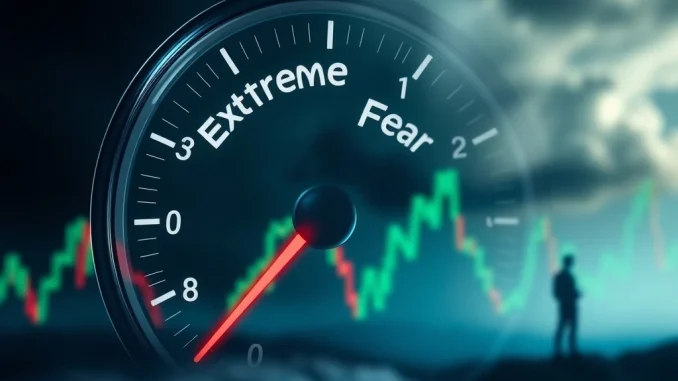
The cryptocurrency market often moves with significant emotional swings. Today, the **Crypto Fear & Greed Index** has captured this volatility, dropping to a notable 24. This shift moves overall **market sentiment** from ‘fear’ into the ‘extreme fear’ zone. Such a change often signals heightened investor anxiety and caution. Therefore, understanding this indicator is crucial for anyone involved in digital assets. This article will explore what this index signifies and its potential implications for the broader crypto landscape.
Understanding the Crypto Fear & Greed Index
The **Crypto Fear & Greed Index** serves as a vital barometer for investor emotions. Compiled by data provider Alternative, it offers a snapshot of current market sentiment. The index operates on a scale from 0 to 100. A score of 0 indicates ‘extreme fear,’ while 100 represents ‘extreme optimism’ or ‘extreme greed.’ This tool helps investors gauge whether the market is overly bullish or bearish. Furthermore, it provides insights beyond simple price movements. A lower score, like the current 24, suggests investors are feeling particularly anxious. Conversely, a higher score implies a more confident or even euphoric market.
The index calculation relies on several key factors, each weighted differently. These factors provide a comprehensive view of market conditions:
- Volatility (25%): This measures current market fluctuations and maximum drawdowns. Higher volatility often indicates more fear.
- Trading Volume (25%): Robust trading volume usually signals strong market interest. However, unusual volume spikes can also suggest panic selling or buying.
- Social Media Mentions (15%): Analysis of keywords and sentiment across various social media platforms. Negative sentiment increases fear.
- Surveys (15%): Although currently paused, these polls directly ask investors about their market outlook.
- Bitcoin’s Market Cap Dominance (10%): An increasing Bitcoin dominance often suggests a flight to safety. Investors move from altcoins to Bitcoin during uncertain times.
- Google Search Volume (10%): Tracking search queries related to cryptocurrencies. A surge in ‘Bitcoin price manipulation’ searches, for example, could indicate fear.
What Does Extreme Fear Crypto Signal?
A reading of 24 on the **Crypto Fear & Greed Index** clearly places the market in a state of **extreme fear crypto**. This means investors are highly risk-averse. They may be selling assets to avoid further losses. Historically, periods of extreme fear have often presented unique opportunities. Legendary investor Warren Buffett famously advised to ‘be fearful when others are greedy, and greedy when others are fearful.’ However, this strategy carries inherent risks. There is no guarantee that market bottoms occur immediately after an extreme fear reading. Therefore, careful analysis remains paramount. Market participants should avoid making impulsive decisions based solely on this index. Instead, they should consider it as one data point among many. This index reflects the collective emotional state, which can be a powerful force.
When the index enters extreme fear, several market behaviors typically emerge. For instance, selling pressure often intensifies. Many investors choose to exit positions, fearing further price declines. This can lead to rapid price drops. Furthermore, new money might hesitate to enter the market. Potential buyers often wait for signs of stabilization. This reduced demand can prolong bearish trends. Therefore, the current score of 24 highlights a cautious investment environment. Investors should proceed with diligence and a well-defined strategy. They must assess their risk tolerance carefully.
Analyzing Factors: Bitcoin Market Sentiment and Volatility
The decline to 24 directly reflects shifts in key contributing factors. **Bitcoin market sentiment**, a significant component, likely shows increased pessimism. As the largest cryptocurrency, Bitcoin’s performance often influences the entire market. When Bitcoin faces downward pressure, altcoins typically follow suit. Its dominance factor within the index highlights this relationship. A rising Bitcoin dominance during a market downturn suggests investors are consolidating their holdings. They move into what they perceive as the safest digital asset. This action can further reduce liquidity in the broader altcoin market.
**Cryptocurrency volatility** also plays a crucial role in the index’s movement. Higher volatility, particularly on the downside, pushes the index lower. Recent price swings have likely been significant. These movements increase investor uncertainty. Large, sudden price drops can trigger panic selling. Conversely, sustained periods of low volatility might indicate complacency. This current reading suggests that sharp price movements have contributed significantly to the prevailing fear. Traders and investors should monitor volatility closely. It can offer clues about potential future price action. Understanding these underlying drivers helps interpret the index’s current state. It moves beyond simply observing the number itself.
Historical Context and Investor Implications
Examining past instances of **extreme fear crypto** provides valuable perspective. Historically, periods of extreme fear have often preceded market reversals. For example, during major bear markets, the index has spent considerable time in the single digits or low twenties. Following these periods, significant rallies have sometimes occurred. However, correlation does not imply causation. Each market cycle has unique characteristics. Investors must consider the broader economic landscape. They should also look at specific crypto-related developments. Relying solely on historical patterns can be misleading. Therefore, while past data offers insights, it should not be the only basis for investment decisions.
For investors, this current state of extreme fear presents a dual challenge. On one hand, it could be a time to accumulate assets at potentially lower prices. Value investors often seek opportunities during downturns. They look for strong projects with solid fundamentals. On the other hand, falling prices can continue. Further downside risk always exists. New investors, especially, might find these conditions daunting. It is crucial to have a clear investment thesis. Diversification can also mitigate risks during volatile periods. Moreover, dollar-cost averaging can be an effective strategy. This involves investing a fixed amount regularly, regardless of price. This approach helps smooth out purchase prices over time.
Navigating the Current Market Sentiment
The current **market sentiment** requires a strategic approach. Emotional decision-making can be detrimental in volatile markets. Instead, investors should focus on fundamental analysis. They should research projects thoroughly. Understanding the technology, team, and use case of a cryptocurrency is essential. This helps in making informed decisions. Furthermore, setting clear entry and exit points is vital. This discipline prevents panic selling during dips. It also avoids FOMO (Fear Of Missing Out) during rallies. The **Crypto Fear & Greed Index** is a sentiment indicator. It is not a buy or sell signal on its own. It should complement a broader investment strategy. This strategy should include risk management and financial planning. Therefore, staying informed and rational is key to navigating periods of extreme fear.
Looking ahead, several factors could shift the index out of extreme fear. Positive regulatory news could boost confidence. Significant technological advancements in key projects might also help. A broader economic recovery could also improve investor appetite for risk. Conversely, negative macroeconomic news or further regulatory crackdowns could prolong the current sentiment. Investors should remain vigilant. They should adapt their strategies as market conditions evolve. The crypto market remains dynamic. Its sentiment can change rapidly. This makes continuous monitoring important for all participants.
Conclusion
The **Crypto Fear & Greed Index** dropping to 24 signals a period of pronounced anxiety. This ‘extreme fear’ reflects a confluence of high **cryptocurrency volatility** and cautious **Bitcoin market sentiment**. While such periods can be challenging, they also offer unique perspectives. Investors are encouraged to remain calm and analytical. They should leverage the index as a sentiment tool. However, it should not be their sole decision-making factor. A well-researched strategy, combined with disciplined risk management, remains the best approach. The crypto market’s inherent cycles mean that sentiment can, and often does, shift. Staying informed and prepared is paramount for navigating these emotional tides effectively.
Frequently Asked Questions (FAQs)
What is the Crypto Fear & Greed Index?
The Crypto Fear & Greed Index is a tool that measures the current sentiment of the cryptocurrency market. It ranges from 0 (extreme fear) to 100 (extreme greed), indicating whether investors are overly anxious or overly optimistic. It helps gauge the collective emotional state of the market.
How is the Crypto Fear & Greed Index calculated?
The index is calculated using several weighted factors. These include volatility (25%), trading volume (25%), social media mentions (15%), surveys (15%), Bitcoin’s market cap dominance (10%), and Google search volume (10%). These components provide a comprehensive view of market activity and sentiment.
What does an ‘extreme fear’ reading, like 24, mean for investors?
An ‘extreme fear’ reading suggests that investors are highly risk-averse and may be selling off assets due to panic or concern over further losses. While some view such periods as potential buying opportunities (as prices may be low), it also indicates significant market uncertainty and potential for further downside. Investors should exercise caution and conduct thorough research.
Does the Crypto Fear & Greed Index predict market bottoms or tops?
No, the Crypto Fear & Greed Index is a sentiment indicator, not a predictive tool. While historically, periods of extreme fear have sometimes preceded market recoveries, and extreme greed has preceded corrections, it does not guarantee future price movements. It should be used as one piece of information among many for investment decisions.
How can investors use the Crypto Fear & Greed Index in their strategy?
Investors can use the index to understand the prevailing market psychology. For example, during extreme fear, a disciplined investor might consider accumulating assets slowly, while during extreme greed, they might become more cautious or take profits. It encourages contrarian thinking but should always be combined with fundamental analysis and a robust risk management strategy.