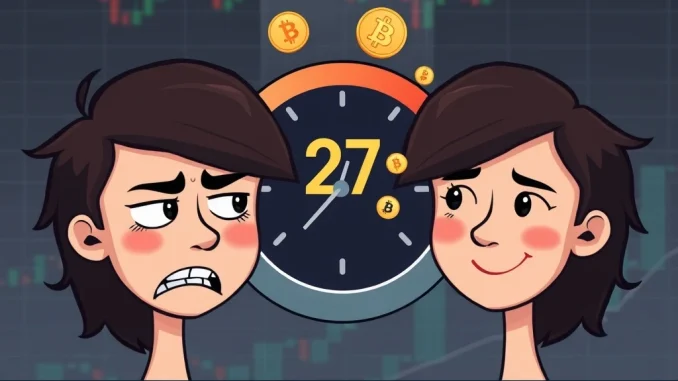
Understanding market sentiment is crucial for cryptocurrency investors. The **Crypto Fear & Greed Index** serves as a vital tool. This index recently climbed five points from yesterday, reaching 34. However, it still firmly resides in the ‘fear’ category. This shift offers a nuanced look at the current emotional state of the crypto market. Therefore, investors must understand what this movement signifies for their strategies.
Decoding the Crypto Fear & Greed Index: What Does 34 Mean?
The **Crypto Fear & Greed Index** provides a snapshot of current **market sentiment**. It operates on a scale from zero to 100. Zero represents ‘extreme fear,’ while 100 indicates ‘extreme greed.’ A score of 34, while an improvement, still points to a cautious or even pessimistic outlook among investors. This means many participants remain hesitant to enter the market. Consequently, they may be quick to sell assets.
Alternative.me compiles this index. It relies on a sophisticated methodology. This method combines various data points to form a comprehensive picture. Understanding these underlying factors is essential. They offer insights beyond a simple number. Furthermore, a ‘fear’ rating often suggests potential buying opportunities for long-term investors. Conversely, ‘extreme greed’ can signal an impending market correction. Thus, interpreting the index requires careful consideration of its components.
The Pillars of Market Sentiment: Volatility and Trading Volume
Two significant factors heavily influence the **Crypto Fear & Greed Index**: **volatility** and **trading volume**. Each contributes 25% to the overall score. Therefore, these elements play a dominant role in shaping **market sentiment**.
Crypto Volatility: A Double-Edged Sword
Market **volatility** measures how much Bitcoin’s price fluctuates. High volatility often signals an anxious market. This can indicate uncertainty among investors. When prices swing wildly, fear can increase. This happens because sudden drops cause panic selling. Conversely, rapid gains can lead to FOMO (Fear Of Missing Out). However, the index primarily considers current volatility. It compares this to average levels. Higher volatility, especially on the downside, pushes the index towards ‘fear.’ Thus, stability often corresponds with more neutral sentiment.
Understanding Trading Volume’s Impact
**Trading volume** reflects market activity. It quantifies the amount of cryptocurrency traded over a period. High trading volumes, particularly when accompanied by strong positive price movements, suggest growing interest. This can signal bullish sentiment. However, if high volume accompanies sharp price declines, it can indicate panic selling. The index assesses current trading volume. It compares this to historical averages. A healthy, sustained trading volume typically supports a more balanced or greedy sentiment. Low volumes, especially during price stagnation, might suggest investor apathy. This contributes to fear.
Social Buzz and Surveys: Gauging Public Crypto Sentiment
Beyond raw market data, human emotion significantly drives cryptocurrency markets. The **Crypto Fear & Greed Index** incorporates two important qualitative factors: social media mentions and surveys. Each contributes 15% to the index score. These elements provide a direct gauge of public perception and investor confidence.
Social Media Mentions: The Digital Echo Chamber
Social media platforms buzz with crypto discussions. These conversations often reflect prevailing sentiments. The index analyzes keywords and hashtags related to cryptocurrency. It tracks their frequency and sentiment. A surge in negative mentions, like discussions about market crashes or scams, pushes the index towards fear. Conversely, widespread optimistic chatter about price predictions or new projects can signal greed. However, this metric must be interpreted carefully. Social media can amplify both genuine enthusiasm and unfounded hype. Therefore, its influence is significant yet sometimes fleeting.
Surveys: Direct Investor Feedback
Surveys offer a direct line to investor psychology. They poll participants about their market outlook. These surveys ask about future price expectations and investment intentions. For example, participants might be asked if they believe Bitcoin will rise or fall. A majority expressing bearish views contributes to a higher fear score. Conversely, widespread bullish sentiment pushes the index towards greed. While surveys represent a smaller portion of the index, they provide valuable insights. They capture direct human sentiment, which other metrics might miss. This human element is crucial for a complete understanding of **market sentiment**.
Bitcoin Dominance and Search Trends: Key Market Indicators
The **Crypto Fear & Greed Index** also considers two other important factors: **Bitcoin dominance** and Google search volume. Each contributes 10% to the index. These components offer unique perspectives on market dynamics and public interest.
Bitcoin Dominance: A Barometer for Altcoin Health
**Bitcoin dominance** measures Bitcoin’s market capitalization relative to the total crypto market cap. A rising Bitcoin dominance often indicates a flight to safety. Investors may sell altcoins and consolidate into Bitcoin during uncertain times. This reflects fear in the broader altcoin market. Conversely, a declining Bitcoin dominance suggests increased investor confidence in altcoins. It points to a more speculative and potentially greedy market. Therefore, monitoring Bitcoin dominance helps assess the overall risk appetite within the crypto ecosystem. It provides a nuanced view of capital flow.
Google Search Volume: Public Interest and Hype Cycles
Google search volume tracks interest in cryptocurrency-related terms. High search volumes for phrases like ‘Bitcoin price’ or ‘buy crypto’ can signal growing public interest. This often correlates with rising prices and optimistic **market sentiment**. However, extremely high search volumes, especially during rapid price surges, can also indicate a speculative bubble. Conversely, declining search volumes might suggest waning public interest or a cooling market. This contributes to fear. The index analyzes these trends to gauge the level of retail participation and general hype. It acts as an indicator of broader public engagement with the crypto space.
Navigating the Fear Zone: Strategies for Crypto Volatility
The current index reading of 34 places the market firmly in the ‘fear’ zone. This condition presents both challenges and potential opportunities for investors. Understanding how to navigate periods of heightened **crypto volatility** is key to successful long-term investing. During these times, emotional reactions often dominate rational decisions. Therefore, a disciplined approach becomes even more critical.
Potential Opportunities in Fear
- Dollar-Cost Averaging (DCA): This strategy involves investing a fixed amount of money regularly. It helps mitigate the impact of volatility. When prices are low, DCA allows investors to buy more assets.
- Research and Accumulation: Periods of fear can be ideal for researching projects. Investors can identify undervalued assets. They can then accumulate these assets at lower prices.
- Risk Management: Rebalancing portfolios becomes important. Investors can reduce exposure to high-risk assets. They can increase holdings in more stable cryptocurrencies.
Cautionary Measures During Volatility
- Avoid Panic Selling: Emotional decisions often lead to losses. Selling assets during a downturn can lock in losses.
- Diversify Your Portfolio: Do not put all your capital into one asset. Diversification spreads risk across different cryptocurrencies.
- Stay Informed: Follow reliable news sources. Understand market trends. This helps in making informed decisions.
Ultimately, the **Crypto Fear & Greed Index** serves as a guide. It does not provide definitive buy or sell signals. Investors should combine its insights with their own research. They should also consider their individual risk tolerance. This holistic approach helps navigate the complex crypto landscape effectively.
Conclusion: Understanding Market Cycles with the Crypto Fear & Greed Index
The **Crypto Fear & Greed Index** offers invaluable insights into the emotional state of the cryptocurrency market. Its recent rise to 34, while still in ‘fear’ territory, suggests a slight easing of extreme pessimism. This index synthesizes complex data points. These include **volatility**, **trading volume**, social media sentiment, surveys, **Bitcoin dominance**, and Google search trends. Consequently, it provides a comprehensive view of **market sentiment**. Investors can leverage this tool. They can make more informed decisions. It helps them avoid emotional pitfalls. Ultimately, understanding these indicators allows participants to better anticipate market cycles. This fosters a more strategic and disciplined approach to cryptocurrency investing.
Frequently Asked Questions (FAQs)
What is the Crypto Fear & Greed Index?
The Crypto Fear & Greed Index measures the current sentiment of the cryptocurrency market. It ranges from 0 (extreme fear) to 100 (extreme greed). This helps investors gauge whether the market is overly optimistic or pessimistic.
How is the index calculated?
The index is calculated using six key factors: volatility (25%), trading volume (25%), social media mentions (15%), surveys (15%), Bitcoin’s market cap dominance (10%), and Google search volume (10%). Each factor contributes to the overall score.
What does a score of 34 on the index mean?
A score of 34 means the market is currently in a state of ‘fear.’ While not ‘extreme fear,’ it indicates that investors are cautious. They might be hesitant to buy, or they could be prone to selling due to uncertainty.
How can I use the Crypto Fear & Greed Index in my investment strategy?
The index acts as a sentiment indicator, not a direct buy/sell signal. It can help you understand the prevailing emotions. Many investors consider ‘extreme fear’ as a potential buying opportunity. Conversely, ‘extreme greed’ might signal a good time to take profits. Always combine this with your own research.
Why is Bitcoin dominance a factor in the index?
Bitcoin dominance reflects the overall risk appetite in the crypto market. When Bitcoin’s dominance rises, it often suggests investors are moving capital from altcoins into Bitcoin, which is seen as a safer asset during uncertain times, thus indicating fear in the broader market.
Does the index predict future price movements?
The index does not predict future price movements directly. Instead, it reflects current market sentiment. While sentiment often influences price, many other factors are at play. Therefore, it serves as one tool among many for market analysis.