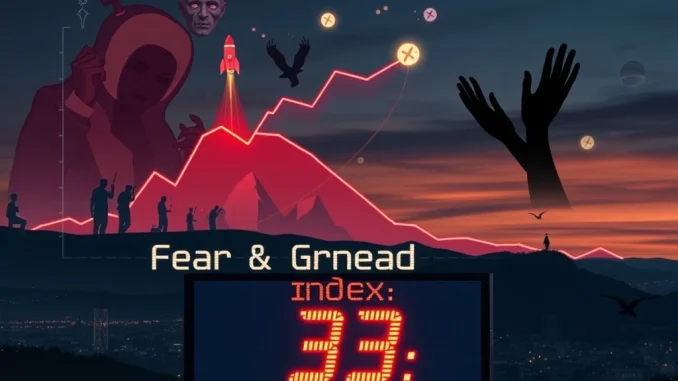
The **Crypto Fear & Greed Index** currently sits at 33. This score signals a persistent state of ‘fear’ within the broader **cryptocurrency market sentiment**. Understanding this index offers critical insights for every investor navigating the volatile world of digital assets. Indeed, this tool helps gauge collective emotions, which are often powerful drivers in market movements. Consequently, knowing its implications can help inform more rational decisions rather than purely emotional ones.
Decoding the Crypto Fear & Greed Index
The **Crypto Fear & Greed Index** serves as a crucial barometer for market participants. Developed by Alternative.me, it quantifies the prevailing emotional state of the cryptocurrency market. Essentially, it operates on a simple premise: extreme fear often indicates undervalued assets, while extreme greed can suggest an impending correction. Therefore, many traders and analysts monitor it closely.
The index uses a scale from 0 to 100. A score of 0 signifies ‘extreme fear,’ meaning investors are highly anxious and potentially overselling. Conversely, a score of 100 indicates ‘extreme greed,’ suggesting investors are overly optimistic and buying aggressively. A score of 33, as observed, firmly places the market in a state of ‘fear.’ This particular reading suggests caution dominates investor thinking.
How is the Fear and Greed Index Explained?
To provide a comprehensive view, the index synthesizes data from six distinct market factors. Each factor contributes a specific weight to the final score, ensuring a balanced assessment. Understanding these components is vital for anyone seeking a full explanation of the **Fear and Greed Index Explained**.
Here are the key factors:
- Volatility (25%): This measures the current volatility and maximum drawdowns of Bitcoin compared to its average over the last 30 and 90 days. High volatility often signals a fearful market.
- Market Momentum/Volume (25%): This factor analyzes current trading volume and market momentum. High buying volumes in a rising market suggest greed, while high selling volumes in a falling market point to fear.
- Social Media (15%): It aggregates posts and hashtags related to Bitcoin from various social media platforms. High interaction rates and sentiment analysis indicate market mood.
- Surveys (15%): Weekly polls are conducted among crypto investors to gather their sentiment directly. (Note: This factor is currently paused).
- Dominance (10%): Bitcoin’s market cap dominance is assessed. A rising dominance often suggests investors are moving from altcoins to Bitcoin, which can indicate fear in the altcoin market.
- Google Trends (10%): This analyzes Google search queries related to Bitcoin and other cryptocurrencies. Sudden spikes in search terms like ‘Bitcoin price manipulation’ or ‘Bitcoin crash’ indicate fear.
Each component offers a unique perspective on overall **cryptocurrency market sentiment**. Consequently, the combined data provides a robust indicator for investors.
Impact on Bitcoin Price Analysis
The index holds significant weight in **Bitcoin price analysis**. Historically, periods of extreme fear have often preceded market bottoms, presenting potential buying opportunities for long-term investors. Conversely, extreme greed frequently signals market tops, prompting cautious investors to consider profit-taking.
When the index registers ‘fear,’ as it does at 33, it typically means selling pressure might be elevated. Investors may be panicking or simply choosing to stay on the sidelines. This behavior can further depress prices, especially for Bitcoin, the market’s leading cryptocurrency. Therefore, understanding this dynamic is crucial for making informed decisions regarding **Bitcoin price analysis**.
However, it is important to remember that the index is a sentiment indicator, not a crystal ball. It does not predict exact price movements. Instead, it offers a snapshot of the collective psychological state. Savvy investors use this information as one piece of a larger analytical puzzle. They combine it with technical analysis, fundamental analysis, and broader economic indicators. For example, a low index score combined with strong on-chain metrics might suggest a resilient asset.
Understanding Investor Behavior Crypto
The current reading of 33 highlights a crucial aspect of **investor behavior crypto**: fear. Human emotions play a disproportionate role in financial markets. Fear can lead to irrational decisions, such as panic selling at a loss. Conversely, greed can drive speculative buying, leading to overvalued assets.
In a fearful market, many participants adopt a ‘wait and see’ approach. They might hesitate to invest new capital. Existing holders may feel compelled to sell their assets to avoid further losses. This collective sentiment creates a self-reinforcing cycle. Thus, fear can be contagious, spreading quickly across online communities and trading forums. Understanding these psychological triggers is paramount for effective **investor behavior crypto** strategies.
Psychological biases like herd mentality and loss aversion heavily influence market sentiment. When everyone else seems to be selling, individuals often feel pressure to follow suit, even against their better judgment. Furthermore, the pain of a loss typically feels stronger than the pleasure of an equivalent gain. This bias can cause investors to hold onto losing positions too long or sell winning positions too early.
Navigating Persistent Fear in the Cryptocurrency Market
A score of 33, indicating persistent fear, presents both challenges and potential opportunities within the **cryptocurrency market**. For short-term traders, this environment often brings increased volatility and heightened risk. Quick price swings can lead to significant gains or losses. Consequently, a disciplined approach and robust risk management are essential.
For long-term investors, periods of fear can be advantageous. Legendary investor Warren Buffett famously advised to ‘be fearful when others are greedy and greedy when others are fearful.’ A market steeped in fear often means assets are trading below their intrinsic value. This situation could represent an opportune moment for accumulating assets at lower prices. Therefore, patient investors often view such times as valuable for strategic positioning within the **cryptocurrency market**.
It is crucial to differentiate between healthy caution and irrational panic. A fearful market does not automatically mean a market crash is imminent. Instead, it suggests that sentiment is low, and potential negative news might be amplified. Investors should conduct thorough research and avoid making decisions based solely on emotion. Moreover, diversifying one’s portfolio can help mitigate risks during uncertain times.
Strategies for Informed Decision-Making
Given the current state of fear, how should investors approach the market? Here are some strategies:
- Dollar-Cost Averaging (DCA): Instead of investing a lump sum, commit to investing a fixed amount regularly. This strategy reduces the impact of volatility.
- Research and Due Diligence: Focus on projects with strong fundamentals, clear roadmaps, and active development. Do not simply follow the crowd.
- Risk Management: Only invest what you can afford to lose. Set stop-loss orders to limit potential downsides.
- Long-Term Perspective: Cryptocurrency markets are known for their cycles. Many successful investors focus on the long-term growth potential rather than short-term fluctuations.
- Avoid FOMO/FUD: Resist the fear of missing out (FOMO) during greedy periods and the fear, uncertainty, and doubt (FUD) during fearful periods.
By adopting these practices, investors can navigate the market with greater resilience. They can make decisions based on analysis rather than emotional impulses. Ultimately, informed choices lead to better outcomes.
Conclusion
The **Crypto Fear & Greed Index** at 33 clearly signals persistent fear in the market. This reading offers a valuable lens through which to view the current **cryptocurrency market sentiment**. While fear can feel unsettling, it also provides a unique opportunity for discerning investors to reassess their strategies. Understanding the index’s components and their influence on **Bitcoin price analysis** and **investor behavior crypto** empowers individuals. It allows them to move beyond reactive trading to make more strategic, long-term decisions. Always remember that emotional control and a well-researched approach remain key to navigating the volatile, yet promising, world of digital assets.
Frequently Asked Questions (FAQs)
Q1: What is the Crypto Fear & Greed Index?
The **Crypto Fear & Greed Index** is a tool that measures the prevailing emotional state of the cryptocurrency market. It ranges from 0 (extreme fear) to 100 (extreme greed), helping investors gauge overall sentiment.
Q2: How is the index calculated?
The index combines data from six weighted factors: volatility (25%), trading volume (25%), social media mentions (15%), surveys (15%), Bitcoin’s market cap dominance (10%), and Google search trends (10%). These components provide a holistic view of **cryptocurrency market sentiment**.
Q3: What does a score of 33 mean for the market?
A score of 33 indicates a state of ‘fear’ in the market. This suggests that investors are generally cautious or anxious, which can lead to increased selling pressure or a reluctance to buy new assets. It reflects current **investor behavior crypto**.
Q4: How can investors use the Crypto Fear & Greed Index?
Investors can use the index as a contrarian indicator. Extreme fear might signal a potential buying opportunity, while extreme greed could suggest a time for caution or profit-taking. It should be used in conjunction with other forms of **Bitcoin price analysis** and research.
Q5: Does the index only track Bitcoin sentiment?
While Bitcoin’s dominance and related searches are significant factors, the index aims to reflect overall **cryptocurrency market sentiment**. Bitcoin’s movements often influence the broader market, making it a key proxy for the entire asset class.
Q6: Is the Crypto Fear & Greed Index always accurate?
No, the index is a sentiment indicator, not a definitive prediction tool. It reflects current emotions but does not guarantee future price movements. Investors should use it as one data point among many for comprehensive **Fear and Greed Index Explained** analysis.