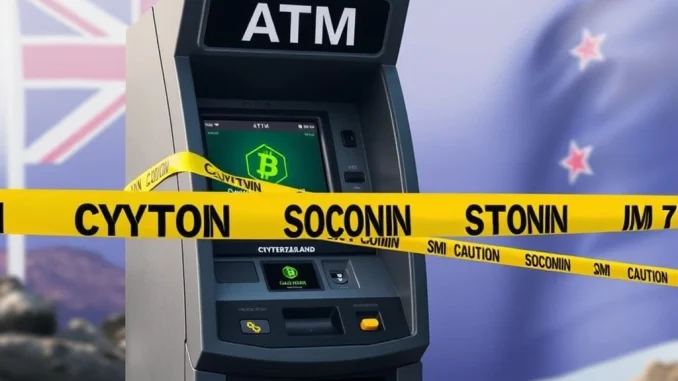
A significant development is underway regarding cryptocurrency access in New Zealand. The nation is implementing a comprehensive New Zealand crypto ban specifically targeting crypto automated teller machines (ATMs). This move is part of a broader governmental effort to strengthen defenses against financial crime, including money laundering and terrorism financing.
Why the Push to Ban Crypto ATMs?
The primary driver behind this decision is the inherent nature of crypto ATMs, which often allow for cash-to-crypto conversions with minimal identity verification compared to regulated exchanges. This perceived anonymity makes them a potential tool for individuals looking to obscure the origins of illicit funds or facilitate criminal activities across borders.
According to reports, officials believe that restricting this anonymous pathway is a crucial step in enhancing the country’s anti-money laundering (AML) and counter-terrorism financing (CTF) frameworks. The goal is to make it significantly harder for criminals to convert ‘dirty’ cash into digital assets that can be easily moved globally.
Key concerns cited include:
- Anonymity: Many ATM transactions historically required less stringent Know Your Customer (KYC) procedures than online exchanges.
- Cash Conversion: They provide a direct bridge from physical cash (often untraceable) to digital assets.
- Cross-Border Transfers: Crypto allows for rapid value transfer, which can be exploited for illicit financing.
How Does This Affect Crypto ATMs New Zealand Operators and Users?
The government’s directive means that operators of crypto ATMs New Zealand will be required to cease operations. For users who relied on these machines for convenient access to cryptocurrencies, this ban removes a direct and potentially less regulated on-ramp into the crypto market.
While the exact timeline and enforcement mechanisms will be critical details, the intent is clear: eliminate this specific channel for accessing crypto, which is deemed high-risk from a financial crime perspective. This impacts both the businesses operating the machines and the individuals who used them.
Is This Part of a Broader NZ Crypto Regulation Strategy?
This ban appears to be a targeted action within a larger trend of increased scrutiny and regulation of the cryptocurrency sector globally. While New Zealand has been exploring various approaches to digital assets, this specific measure highlights a focus on points of access that regulators perceive as vulnerabilities.
It signals that the New Zealand government is taking a proactive stance on managing the risks associated with cryptocurrencies, particularly concerning financial integrity. This aligns with international efforts by bodies like the Financial Action Task Force (FATF), which advocates for stricter AML/CTF measures on virtual asset service providers, including ATM operators.
Can This Truly Help Crypto Crime Prevention?
The effectiveness of banning crypto ATMs as a measure for crypto crime prevention is a subject of ongoing debate. Proponents argue it closes a known loophole used by criminals. By pushing users towards regulated exchanges that enforce strict KYC/AML policies, it theoretically increases traceability and makes it harder to use crypto anonymously for illicit purposes.
However, critics suggest that criminals are adaptable. Banning ATMs might simply push illicit activity to other, potentially harder-to-track methods, such as peer-to-peer (P2P) transactions or using platforms in jurisdictions with laxer regulations. They argue that a more comprehensive approach focusing on intelligence, international cooperation, and tracing tools might be more effective than banning specific technologies.
Arguments for and against effectiveness:
| Argument | Explanation |
|---|---|
| Pro: Closes a loophole | ATMs often had weaker KYC, making them attractive for cash conversion. |
| Pro: Directs users to regulated platforms | Encourages use of exchanges with mandatory identity checks. |
| Con: Criminals adapt | Illicit actors may simply shift to P2P or offshore platforms. |
| Con: Limited scope | Only targets ATMs, not other potential cash-to-crypto methods. |
What’s Next for Crypto in New Zealand?
For individuals in New Zealand wishing to buy or sell cryptocurrency legally, the ban on ATMs means relying on alternative methods. These primarily include:
- Regulated cryptocurrency exchanges operating in or accessible from New Zealand, which require identity verification.
- Peer-to-peer (P2P) platforms, although users must exercise caution and be aware of risks.
- Brokerage services that facilitate crypto purchases.
This development underscores the increasing global trend towards regulating the crypto space. While the focus here is on preventing financial crime, future NZ crypto regulation could potentially address other areas, such as consumer protection, taxation, or the classification of digital assets.
Conclusion
The decision to implement a New Zealand crypto ban on ATMs is a significant step in the country’s efforts to bolster its defenses against money laundering and terrorism financing. By targeting a channel perceived as high-risk due to potential anonymity, authorities aim to make it more difficult for criminals to exploit digital assets. While the effectiveness of this measure in achieving total crypto crime prevention remains to be seen, it clearly signals New Zealand’s commitment to bringing the crypto landscape under stricter financial oversight. Operators of crypto ATMs New Zealand must comply, and users will need to adapt to using regulated alternatives, marking a notable shift in how cryptocurrency can be accessed in the country.