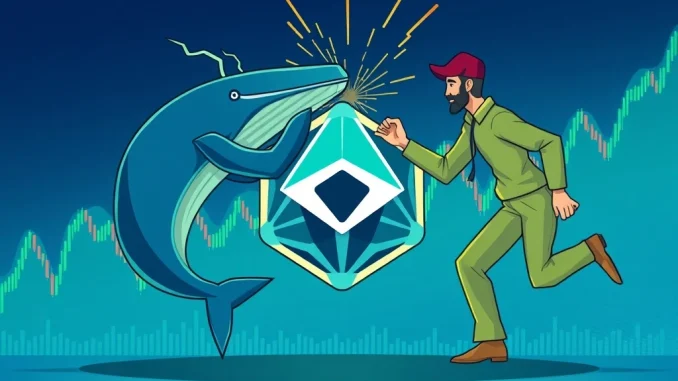
The world of cryptocurrency is no stranger to drama, but the latest developments within the Cardano (ADA) community have truly captured attention. A heated Cardano governance dispute is unfolding, casting a significant shadow over the project’s future trajectory and directly influencing ADA price movements. This internal conflict pits founder Charles Hoskinson against a prominent, long-time supporter, dubbed the ‘Cardano Whale,’ highlighting the inherent tensions between centralized development and decentralized aspirations.
Understanding the Core of the Cardano Governance Dispute
At the heart of the current turmoil lies a fundamental disagreement about Cardano’s development direction and the performance of Input Output Global (IOG), the entity spearheaded by Charles Hoskinson. The ‘Cardano Whale,’ a significant voice within the community, has leveled serious accusations, claiming that IOG has fallen short on its commitments. Specifically, the critic points to a perceived failure to adequately capitalize on burgeoning market trends such as decentralized finance (DeFi) and artificial intelligence (AI), areas where competitors have made substantial strides.
This discontent is not merely rhetorical. The Whale has declared an intention to vote ‘No’ on all future IOG proposals, a move that could significantly impact the project’s roadmap. A key piece of evidence cited is Cardano’s Total Value Locked (TVL), which stands at a modest $366 million. This figure is starkly contrasted by industry giants like Ethereum, boasting an $81 billion TVL, and even Solana, with $10 billion. Such disparities fuel concerns about Cardano’s ecosystem growth and its ability to attract and retain developers and users.
| Blockchain Network | Total Value Locked (TVL) |
|---|---|
| Ethereum | ~$81 Billion |
| Solana | ~$10 Billion |
| Cardano | ~$366 Million |
Charles Hoskinson has not remained silent, defending IOG’s efforts and expenditure. He argues that IOG’s spending is relatively modest when compared to the vast ecosystem development initiatives undertaken by rival networks. Hoskinson has characterized the Whale’s opposition as an ’emotional reaction’ rather than a ‘constructive critique,’ suggesting a deeper personal element to the Cardano dispute.
Impact on ADA Price and Market Sentiment
Unsurprisingly, this internal strife has directly translated into heightened crypto volatility for ADA. While the token experienced a commendable 15.2% surge over the past seven days, reflecting broader market optimism or specific positive catalysts, it simultaneously faced a 2.2% dip in the last 24 hours. This fluctuation underscores how quickly market sentiment can shift in response to internal project dynamics.
Despite the short-term dip, ADA has managed to maintain its position as the 9th largest cryptocurrency by market value, a testament to its strong community and underlying technology. However, analysts are closely watching key technical levels. A potential rebound to $1.18 is on the horizon if ADA successfully retests the $0.87 support level, a point that previously acted as resistance. Technical indicators hint at a possible pullback to the 9-day and 21-day exponential moving averages (EMAs) before a potential push towards the $1.00 mark.
The Broader Implications of the Cardano Dispute
Beyond immediate price movements, the ongoing governance conflict raises fundamental questions about Cardano’s decentralized future. It highlights the inherent challenge of balancing a vision for decentralized governance with the practicalities of centralized development efforts. Critics argue that IOG’s focus on ‘real-world’ applications, while noble, might have diverted attention from more scalable and immediate use cases that could drive rapid ecosystem growth.
Conversely, supporters of IOG maintain that prioritizing long-term, robust infrastructure is paramount for Cardano’s sustainability and ultimate success. They believe that a solid foundation, even if it means slower initial adoption in certain areas, will ultimately lead to a more resilient and impactful blockchain.
The resolution of this Cardano dispute is critical. It will likely influence ADA’s ability to attract new developers, a vital component for innovation and dApp creation, and institutional capital, which is often a significant driver for price recovery and market maturity. The outcome will serve as a significant precedent for other decentralized projects grappling with similar governance challenges.
What’s Next for Cardano and ADA Holders?
The path forward for Cardano will heavily depend on how this governance conflict is managed. A widening rift between Hoskinson and key stakeholders could erode investor confidence, potentially leading to prolonged price stagnation or decline. Conversely, a constructive resolution that addresses the community’s concerns and reaffirms a clear development path could reignite enthusiasm and propel ADA to new heights.
For ADA holders and prospective investors, staying informed about the evolving governance discussions is paramount. The strength of a decentralized network lies in its community, and how this community navigates internal disagreements will be a defining factor in Cardano’s journey towards its ambitious goals. The ADA price will continue to be a barometer of this ongoing internal dialogue.
Conclusion: Navigating the Tides of Crypto Volatility
The current Cardano governance dispute serves as a potent reminder of the complexities inherent in large-scale decentralized projects. While it has introduced an element of crypto volatility to ADA’s price, it also underscores the vibrant, often passionate, nature of blockchain communities. The ability of Cardano to reconcile differing visions and unite its stakeholders will be crucial for its long-term success and its ambition to be a leading force in the blockchain space. The coming months will be pivotal in determining whether this challenge strengthens Cardano’s resolve or becomes a significant hurdle on its path to widespread adoption.
Frequently Asked Questions (FAQs)
Q1: What is the core issue in the Cardano governance dispute?
The core issue revolves around criticisms from a prominent ‘Cardano Whale’ supporter against Input Output Global (IOG) and its founder, Charles Hoskinson. The critic alleges that IOG has underdelivered on promises, particularly in areas like DeFi and AI, and that Cardano’s ecosystem growth, as evidenced by its low Total Value Locked (TVL), is insufficient compared to competitors.
Q2: How has the Cardano governance dispute affected ADA’s price?
The dispute has caused increased ADA price volatility. While ADA saw a 15.2% gain over seven days, it experienced a 2.2% drop in the past 24 hours, reflecting market uncertainty. Technical analysis suggests potential retests of support levels before a push towards higher price targets, but investor confidence could be impacted if the conflict escalates.
Q3: Who is Charles Hoskinson, and what is his role in Cardano?
Charles Hoskinson is the co-founder of Ethereum and the founder of Cardano. He leads Input Output Global (IOG), the primary development entity behind the Cardano blockchain. In the current dispute, he is defending IOG’s development strategy and expenditures against the ‘Cardano Whale’s’ criticisms.
Q4: What is Total Value Locked (TVL), and why is it relevant to Cardano?
Total Value Locked (TVL) represents the total value of crypto assets locked within a decentralized finance (DeFi) protocol or blockchain ecosystem. It’s a key metric indicating the health and adoption of a network’s DeFi applications. Cardano’s relatively low TVL compared to Ethereum and Solana is a central point of criticism in the current governance dispute, suggesting slower DeFi growth.
Q5: What are the potential long-term implications of this dispute for Cardano?
The outcome of this dispute could significantly influence Cardano’s ability to attract developers and institutional capital, both crucial for its long-term price recovery and ecosystem growth. It highlights the systemic challenge of balancing decentralized governance with centralized development priorities and could set a precedent for future governance models in the crypto space.