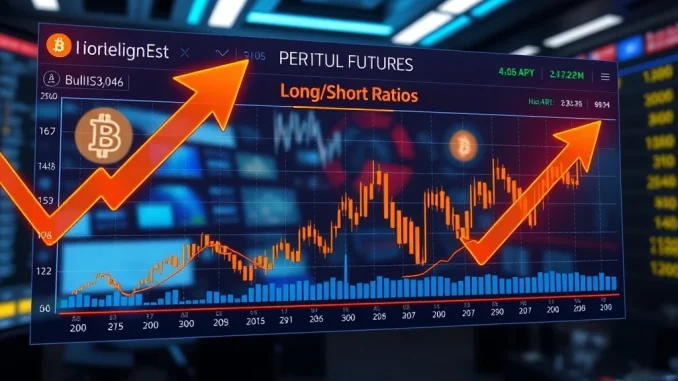
Understanding the pulse of the cryptocurrency market is crucial for traders and investors. The **BTC perpetual futures** long/short ratio offers a vital glimpse into prevailing market sentiment. This metric reveals how many traders are betting on Bitcoin’s price increase versus those anticipating a decline. It provides invaluable insights into the collective expectations of participants on major exchanges. Observing these ratios helps market participants gauge potential price movements and assess overall market health.
Deciphering the BTC Perpetual Futures Landscape
Perpetual futures contracts are a popular financial instrument in the crypto world. Unlike traditional futures, they lack an expiry date. This feature allows traders to hold positions indefinitely. These contracts track the underlying asset’s price, in this case, Bitcoin. The **long/short ratio** specifically measures the proportion of bullish (long) positions against bearish (short) positions. A higher long ratio suggests optimism, while a higher short ratio indicates caution or pessimism.
Monitoring these ratios on leading platforms is essential. These exchanges process vast volumes of trades daily. Therefore, their aggregated data reflects a significant portion of the global **Bitcoin futures** market. Today’s data presents an interesting picture across the top three exchanges by open interest.
Current Market Snapshot: Long/Short Ratios
The latest 24-hour long/short position ratios for **BTC perpetual futures** on the world’s top three cryptocurrency futures exchanges by open interest are as follows. This data offers a clear look at current trader positioning. It highlights a specific lean in the market.
| Exchange/Overall | Long Positions | Short Positions |
|---|---|---|
| Overall | 41.19% | 50.81% |
| Binance | 47.8% | 52.2% |
| Bybit | 49.63% | 50.37% |
| Gate.io | 50.12% | 49.88% |
As the table illustrates, the overall market currently shows a higher proportion of short positions. Specifically, 50.81% of traders are short, compared to 41.19% who are long. This suggests a cautious or bearish outlook among a majority of participants. Each exchange contributes to this aggregated view. Binance, Bybit, and Gate.io collectively represent substantial market activity. Their individual ratios also reveal distinct nuances.
Understanding Crypto Trading Sentiment Across Exchanges
The individual exchange data provides further detail. On Binance, the largest exchange, shorts significantly outweigh longs. This indicates a strong bearish conviction among its user base. Bybit shows a slightly less pronounced short bias. However, shorts still lead longs. Gate.io stands out with a marginally higher long percentage. Still, its ratio remains very close to balanced. These variations highlight diverse trader behaviors across platforms.
A higher proportion of short positions typically signals bearish sentiment. Traders expect Bitcoin’s price to fall. They position themselves to profit from such a decline. This collective positioning can influence market dynamics. It can also act as a contrarian indicator in some scenarios. However, traders must interpret this data carefully. It is one piece of a larger puzzle. Comprehensive **market analysis** requires examining multiple indicators.
Implications of Predominantly Short Positions
When short positions dominate, it can suggest several things. Firstly, traders might anticipate a price correction. They could be reacting to macroeconomic news. Alternatively, technical analysis might indicate downward pressure. Secondly, it could signal a lack of strong conviction for an immediate price rally. This can lead to decreased buying pressure. Consequently, price stagnation or decline may occur. Thirdly, a high short ratio can sometimes precede a short squeeze. If the price unexpectedly rises, short sellers might close their positions. This action involves buying back Bitcoin, which can further fuel the price increase. Therefore, understanding this **crypto trading sentiment** is vital.
Strategies for Navigating Bitcoin Futures Markets
Traders employ various strategies when analyzing **Bitcoin futures** data. Some use the long/short ratio as a direct indicator. They might follow the majority sentiment. Others view it as a contrarian signal. They believe that extreme sentiment often precedes a reversal. For example, an overwhelming short ratio might suggest a potential bounce. This happens when the market becomes too oversold. Experienced traders combine this ratio with other metrics. They look at funding rates, open interest, and technical chart patterns. This comprehensive approach helps validate trading decisions. Furthermore, risk management remains paramount. Never trade based on a single indicator alone.
The current data suggests caution. Traders are predominantly betting against a price increase. This sentiment might persist for some time. However, market conditions can change rapidly. Staying informed about new developments is crucial. Economic reports, regulatory news, and technological advancements all impact Bitcoin’s price. Regularly checking updated long/short ratios provides continuous market insights. It helps traders adapt their strategies effectively.
The Role of Open Interest in Market Analysis
Open interest is another key metric alongside the long/short ratio. It represents the total number of outstanding futures contracts. A rising open interest with a high short ratio can amplify market movements. It suggests more money is entering the market with a bearish bias. Conversely, decreasing open interest might indicate traders are closing positions. This could signal a potential shift in sentiment. Combining open interest with the **BTC perpetual futures** long/short ratio offers a more complete picture. This combined view aids in deeper **market analysis**. It helps predict potential volatility or stability.
Mitigating Risks in Crypto Trading Sentiment Analysis
While valuable, relying solely on **crypto trading sentiment** indicators carries risks. These ratios are snapshots in time. They can change quickly. Flash crashes or unexpected news events can invalidate prior sentiment. Always consider the broader market context. Global economic indicators, interest rate decisions, and geopolitical events influence crypto prices. Furthermore, liquidity on individual exchanges varies. This can impact the reliability of their specific ratios. Diversifying your analytical tools is essential. Use fundamental analysis alongside technical indicators. This layered approach provides a more robust framework for decision-making. Protect your capital with strict stop-loss orders. Manage your position sizes carefully. These practices are critical in volatile markets.
The current lean towards short positions in **BTC perpetual futures** indicates a cautious market. However, this does not guarantee future price action. Traders must remain vigilant. They should continuously monitor these ratios and other relevant data points. Informed decisions stem from a holistic understanding of market dynamics. This includes both sentiment and underlying fundamentals. Successful trading requires discipline and ongoing education.
Frequently Asked Questions (FAQs)
Q1: What is the BTC perpetual futures long/short ratio?
A1: It measures the proportion of traders betting on a Bitcoin price increase (longs) versus those betting on a price decrease (shorts) for perpetual futures contracts.
Q2: Why is the long/short ratio important for Bitcoin futures trading?
A2: It provides insight into overall market sentiment. A higher short ratio, for example, suggests a bearish outlook among traders, which can influence price movements.
Q3: How do top exchanges like Binance, Bybit, and Gate.io contribute to this analysis?
A3: These exchanges have high open interest. Their combined data offers a significant representation of global **crypto trading sentiment** for **BTC perpetual futures**.
Q4: Does a high short ratio always mean Bitcoin’s price will fall?
A4: Not necessarily. While it indicates bearish sentiment, it can also sometimes precede a short squeeze if the price unexpectedly rises, forcing shorts to cover their positions.
Q5: What other metrics should I consider alongside the long/short ratio for market analysis?
A5: Traders should also consider funding rates, open interest, technical analysis indicators (like moving averages and RSI), and broader macroeconomic factors for comprehensive **market analysis**.
Q6: Can the BTC perpetual futures long/short ratio be used as a contrarian indicator?
A6: Yes, in some cases. Extreme long or short ratios can sometimes indicate an overextended market sentiment, potentially signaling a reversal in the opposite direction.