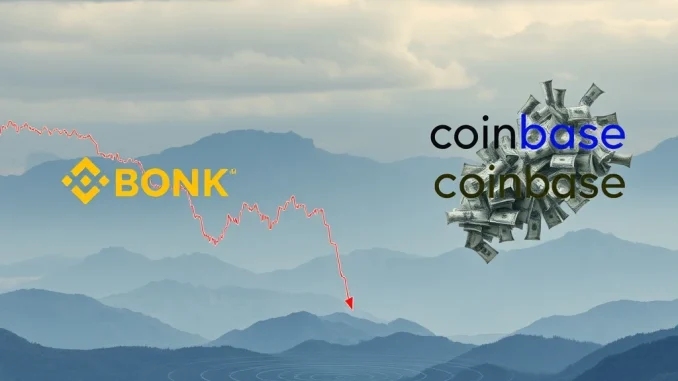
The world of cryptocurrencies is no stranger to dramatic swings, but a recent event involving the popular Solana-based BONK token has sent a significant ripple through the market. Just hours after a substantial token burn aimed at reducing supply, a massive $18.75 million transfer of 510 billion BONK tokens, reportedly linked to Galaxy Digital, moved to major exchanges Binance and Coinbase. This perplexing dual action has ignited discussions and concerns among investors, highlighting the inherent volatility of the cryptocurrency market.
The BONK Token’s Rollercoaster Ride: Burn vs. Transfer
Imagine a scenario where a company publicly announces it’s destroying a significant portion of its shares to increase their value, only for a major shareholder to immediately dump an equivalent amount onto the market. That’s essentially what unfolded with BONK. The project executed a deflationary move, burning 500 billion tokens, which was intended to enhance scarcity and potentially drive up the token’s price. However, this bullish signal was almost immediately overshadowed by a colossal whale transfer of 510 billion BONK tokens to two of the world’s largest crypto exchanges.
This duality has created significant tension:
- Deflationary Burn: Aimed at reducing circulating supply, making existing tokens theoretically more valuable.
- Massive Transfer: Moving tokens to exchanges often precedes selling pressure, as holders prepare to liquidate or rebalance their portfolios.
The immediate consequence? BONK’s value dropped by 6.34% in the 24 hours following the transfer, trading at $0.00003237. This stark contrast between the project’s stated intentions and the actions of a major holder underscores the complex dynamics at play in the crypto space.
Galaxy Digital’s Alleged Involvement and Market Impact
The reported link to Galaxy Digital adds another layer of intrigue to this event. While unconfirmed, the involvement of a major institutional player like Galaxy Digital in such a large transaction lends a degree of credibility, yet also amplifies the market’s reaction. Institutional activity in the meme coin space is a double-edged sword: it can signal growing legitimacy and adoption, but it also means that large movements can disproportionately impact volatility.
If verified, the transfer could signify several things:
- Profit-Taking: A major stakeholder cashing out gains from their investment.
- Portfolio Rebalancing: Adjusting asset allocations based on market conditions or investment strategies.
- Liquidity Provisioning: Moving funds to exchanges to facilitate trading or provide liquidity, though the sheer volume suggests more than just routine operations.
Regardless of the exact motive, the sheer volume moved—nearly 99% of the tokens burned—highlights the fragility of BONK’s perceived scarcity and the power of large holders to influence market sentiment. This event serves as a stark reminder that even well-intentioned tokenomics can be challenged by significant on-chain actions.
Understanding the Whale Transfer Phenomenon in Meme Coins
A whale transfer refers to the movement of a large amount of cryptocurrency by a single entity or a small group of entities. In the context of meme coin markets, these movements are particularly impactful. Unlike traditional assets, meme coins often lack fundamental utility and derive much of their value from community-driven narratives, social media trends, and speculative interest. This makes them highly susceptible to large on-chain actions.
Here’s why whale transfers are critical for meme coins:
| Factor | Impact on Meme Coins |
|---|---|
| Liquidity Depth | Meme coins often have thinner order books, meaning large sell orders can cause dramatic price drops due to insufficient buying pressure. |
| Sentiment-Driven | Community sentiment is paramount. A large transfer to an exchange can be interpreted as a lack of confidence by a major holder, triggering panic selling among retail investors. |
| Perceived Scarcity | While token burns aim for scarcity, a subsequent large transfer can dilute this perception, as it signals a large supply is still available for sale. |
| Volatility Amplification | The combination of low liquidity and high speculation means whale moves can create exaggerated price swings. |
The interplay between institutional participation and retail-driven dynamics further complicates the trajectory of assets like BONK. While the burn signals a commitment to tokenomics, the simultaneous exchange transfer can dilute confidence, particularly among risk-averse investors.
Navigating the Volatile Cryptocurrency Market: What Investors Should Do
Events like the BONK token transfer underscore the inherent risks and opportunities within the broader cryptocurrency market. For investors, vigilance and a robust risk management strategy are paramount.
Actionable Insights for Investors:
- Monitor On-Chain Activity: Tools that track large wallet movements can provide early warnings of potential selling pressure. Platforms like Whale Alert or blockchain explorers allow users to follow significant transfers.
- Contextualize Price Movements: Always consider the broader crypto market context. Bitcoin’s performance often sets the tone for altcoins. Sector-wide trends and macroeconomic factors also play a crucial role.
- Understand Meme Coin Economics: Be aware that meme coins are highly sensitive to news, social media trends, and whale activity. Their value is often more speculative than utility-driven.
-
Implement Risk Management:
- Stop-Loss Orders: Automatically sell your holdings if the price drops to a certain level, limiting potential losses.
- Diversified Portfolios: Avoid putting all your capital into a single, highly volatile asset. Spread your investments across different cryptocurrencies and asset classes.
- Invest What You Can Afford to Lose: This golden rule is especially critical for speculative assets like meme coins.
- Verify Information: In a fast-moving market, rumors spread quickly. Always verify information from multiple reputable sources before making investment decisions. The disclaimer in the original source regarding AI-generated content highlights the need for independent verification.
The incident serves as a compelling case study in the delicate balance between supply-side interventions (like token burns) and market psychology. While token burns aim to create deflationary scarcity, their efficacy hinges on the absence of counteracting forces like large-scale distributions. For BONK, the next phase will likely depend on whether institutional participation stabilizes the asset or exacerbates its volatility. Investors should remain cautious and informed as this saga unfolds.
Frequently Asked Questions (FAQs)
Q1: What is the significance of a ‘whale transfer’ in cryptocurrency?
A whale transfer refers to the movement of a very large amount of cryptocurrency by a single holder (a ‘whale’). These transfers are significant because they can indicate potential selling pressure if moved to an exchange, or a shift in long-term holding strategy. For smaller, less liquid assets like meme coins, a whale transfer can cause substantial price volatility due to its disproportionate impact on market supply and demand.
Q2: How does a token burn differ from a token transfer to an exchange?
A token burn permanently removes tokens from circulation, reducing the total supply and aiming to increase the scarcity and value of the remaining tokens. A token transfer to an exchange, however, moves tokens from a private wallet to an exchange’s wallet, often with the intention of selling them, thereby increasing the circulating supply available for trade and potentially increasing selling pressure.
Q3: Why did BONK’s price drop despite a massive token burn?
BONK’s price dropped primarily because the positive impact of the token burn (reducing supply) was immediately counteracted by a massive transfer of a comparable volume of tokens to exchanges. This transfer, allegedly linked to Galaxy Digital, signaled potential selling pressure from a major holder, overriding the scarcity narrative created by the burn and leading to a decline in market confidence and price.
Q4: What role does Galaxy Digital play in this event?
Galaxy Digital is a prominent institutional player in the cryptocurrency space. While their direct involvement in this specific BONK transfer is reported but unconfirmed, any association of a large transfer with such an entity adds a layer of institutional activity to the event. This can influence market sentiment, as institutional moves are often seen as more calculated and can signal significant shifts in market dynamics or investment strategies.
Q5: What are the unique challenges of investing in meme coins?
Meme coins like BONK are highly volatile and largely sentiment-driven, often lacking fundamental utility. Their value is heavily influenced by social media trends, community narratives, and the actions of large holders (whales). This makes them highly susceptible to sudden price swings, pump-and-dump schemes, and rapid changes in investor confidence, making them a high-risk investment.