The competitive landscape of Layer 1 blockchains is constantly evolving. Recently, **BNB Chain fees** have achieved a significant milestone, impressively surpassing Solana (SOL) in daily network fee revenue. This development marks a notable shift in the ongoing race for blockchain dominance.
BNB Chain Fees Soar Past Solana’s Performance
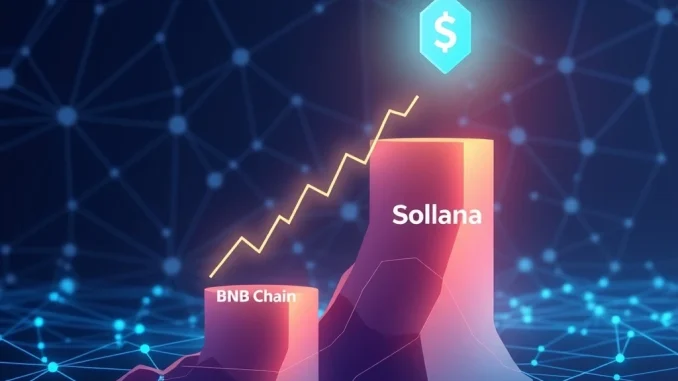
For three consecutive days, **BNB Chain** maintained its lead over Solana in daily network fees. Data from CryptoRank, as reported by CryptoPotato, confirms this impressive surge. Specifically, from September 20-22, BNB Chain’s daily fees consistently ranged between $1.1 million and $1.4 million. In contrast, Solana’s daily fees during the same period slowed, settling into a range of $850,000 to $950,000. This sustained lead highlights a period of increased activity and transaction volume on the BNB Chain network.
Network fees represent the cost users pay to process transactions on a blockchain. Therefore, higher fees often indicate greater network utilization and demand. This recent performance suggests a robust engagement within the BNB Chain ecosystem.
Understanding Daily Network Revenue
Daily **network revenue** is a crucial metric for evaluating a blockchain’s health and utility. It reflects the total value generated from transaction fees. Several factors contribute to a blockchain’s network revenue:
- Transaction Volume: More transactions naturally lead to higher fee collection.
- Gas Prices: The cost of executing operations on the network directly impacts fees.
- Network Activity: Increased usage of dApps, DeFi protocols, and NFT marketplaces drives fee generation.
Observing **BNB Chain fees** outperform Solana’s indicates a potential shift in user preference or increased developer activity on BNB Chain. Solana, known for its high throughput and low transaction costs, has historically attracted significant user bases. However, recent trends show BNB Chain gaining considerable traction in this key metric.
Analyzing BNB Chain’s Recent Surge in Performance
The consistent outperformance of **BNB Chain performance** in daily fees prompts an examination of potential underlying causes. Several factors could contribute to this recent surge:
- Increased DApp Usage: A rise in the number of active decentralized applications or a spike in transactions for existing popular dApps on BNB Chain.
- Strategic Partnerships: New collaborations or integrations could bring more users and transactions to the network.
- Ecosystem Development: Ongoing enhancements or new project launches within the BNB Chain ecosystem may attract more participants.
- Market Dynamics: Broader market trends or specific events might favor BNB Chain activity over Solana during this period.
These elements collectively influence user engagement and the overall demand for block space. As a result, they directly impact the network’s fee generation capabilities. Understanding these drivers is essential for comprehending the competitive dynamics between major Layer 1 blockchains.
The Significance of Blockchain Fees
The total amount of **blockchain fees** collected is not merely a number; it represents the economic activity occurring on the network. These fees serve multiple critical functions within a blockchain ecosystem:
- Network Security: Fees often incentivize validators or miners, securing the network against malicious attacks.
- Sustainability: They contribute to the long-term operational costs and development funding of the blockchain.
- Tokenomics: In some cases, fees are burned, reducing the supply of the native token and potentially increasing its value.
Therefore, a higher fee revenue indicates a more robust and self-sustaining network. It signals strong demand for the network’s services. This metric provides valuable insight for investors, developers, and users assessing the long-term viability and growth potential of a blockchain.
What This Means for the Crypto Landscape
The sustained lead in **BNB Chain fees** over Solana highlights the intense competition among Layer 1 blockchains. While Solana boasts impressive speed and low costs, BNB Chain demonstrates strong user adoption and economic activity. This shift underscores the dynamic nature of the cryptocurrency market. Projects and networks must constantly innovate and adapt to maintain relevance.
This development does not necessarily signify a permanent shift in dominance. However, it does emphasize BNB Chain’s current strength and its ability to attract significant transaction volume. Both networks continue to evolve, introducing new features and attracting diverse user bases. Investors and users should monitor these metrics closely. They offer crucial insights into the health and competitive standing of leading blockchain platforms.
The recent data from CryptoRank, as reported by CryptoPotato, provides a clear snapshot of current market dynamics. It showcases BNB Chain’s effective strategy in fostering a vibrant and economically active ecosystem. Consequently, this allows it to generate substantial daily network fee revenue.
Frequently Asked Questions (FAQs)
Q1: What are daily network fees on a blockchain?
Daily network fees represent the total amount of cryptocurrency users pay to execute transactions and smart contract operations on a blockchain within a 24-hour period. These fees compensate validators or miners for processing and securing the network.
Q2: Why is BNB Chain’s fee revenue surpassing Solana significant?
BNB Chain’s fee revenue surpassing Solana is significant because it indicates higher demand and activity on the BNB Chain network during that period. Higher fees often correlate with increased transaction volume, dApp usage, and overall network utilization, signaling a robust ecosystem.
Q3: What factors contribute to a blockchain’s network fee revenue?
Several factors influence a blockchain’s network fee revenue, including the total number of transactions processed, the complexity of those transactions (which affects gas costs), the overall demand for block space, and the specific pricing mechanisms implemented by the network.
Q4: Does higher network fee revenue mean a blockchain is ‘better’?
Not necessarily. While higher fee revenue can indicate strong network usage and economic activity, it doesn’t solely define a ‘better’ blockchain. Other factors like transaction speed, scalability, decentralization, security, and developer ecosystem are equally important. It’s one metric among many.
Q5: How do BNB Chain and Solana compare in terms of network architecture?
BNB Chain (specifically BNB Smart Chain) is EVM-compatible and uses a Proof of Staked Authority (PoSA) consensus mechanism, offering fast transactions and lower fees than Ethereum. Solana, on the other hand, utilizes a unique combination of Proof of History (PoH) and Proof of Stake (PoS) to achieve exceptionally high throughput and very low transaction costs, aiming for scalability.
Q6: Where can I track daily network fee data for blockchains?
You can track daily network fee data for various blockchains on reputable crypto analytics platforms such as CryptoRank, Token Terminal, The Block Crypto, and other similar data aggregators that provide on-chain metrics and market insights.