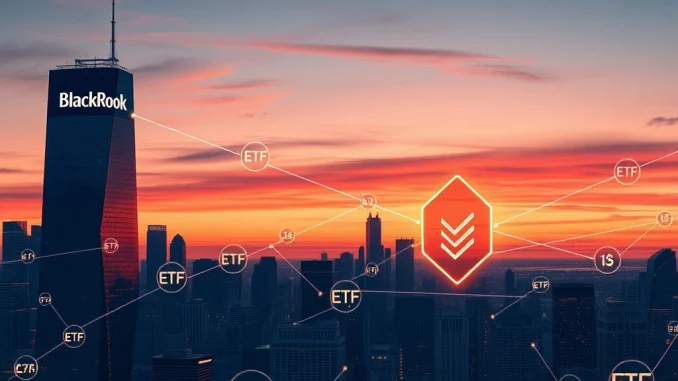
The financial world buzzes with a groundbreaking announcement. BlackRock, a global investment giant, is reportedly planning to launch tokenized ETFs. This strategic move follows the impressive performance of its spot Bitcoin ETF, signaling a significant embrace of blockchain technology within traditional finance. Investors are watching closely as this development could redefine how we perceive and trade digital assets.
The Strategic Shift Towards BlackRock Tokenized ETFs
BlackRock, the world’s largest asset manager, is reportedly preparing to introduce tokenized ETFs. This initiative marks a pivotal moment for the financial industry. Essentially, tokenization involves converting real-world assets into digital tokens on a blockchain. This process, for example, offers numerous advantages. It can notably enhance liquidity and reduce transaction costs. Furthermore, it allows for fractional ownership, thus opening investment opportunities to a broader audience. BlackRock’s foray into tokenized ETFs could set a new industry standard. They are actively exploring how to leverage this technology. Ultimately, this will streamline the management and trading of their vast portfolio of exchange-traded funds.
Leveraging Blockchain Technology for Enhanced Efficiency
At the core of BlackRock’s plan lies blockchain technology. This distributed ledger system provides an immutable and transparent record of transactions. Consequently, it can significantly improve the efficiency and security of financial markets. Blockchain, moreover, eliminates the need for many intermediaries. This action reduces both costs and settlement times. Imagine an ETF share represented as a digital token. This token could then be traded almost instantly, 24/7. In addition, the inherent security features of blockchain, like cryptography, make fraudulent activities extremely difficult. This level of transparency and efficiency is highly appealing to institutional investors. It offers a clear path to modernize existing financial infrastructures.
The Precedent: Success of the Spot Bitcoin ETF
BlackRock’s confidence in tokenization stems directly from the remarkable success of its spot Bitcoin ETF, IBIT. Since its launch, IBIT has attracted billions in inflows. This demonstrated a robust institutional and retail demand for digital asset exposure. The positive reception of IBIT, therefore, provided crucial validation. It showed that traditional investors are ready for innovative financial products built on digital rails. The spot Bitcoin ETF proved that a regulated product bridging traditional finance with cryptocurrencies can thrive. This success has evidently emboldened BlackRock. They now see the broader potential of asset tokenization beyond just cryptocurrencies. It is, indeed, a clear indicator of market readiness.
The Future of Asset Tokenization in Traditional Finance
The potential for asset tokenization extends far beyond ETFs. Real estate, private equity, fine art, and even commodities could all be tokenized. This process unlocks liquidity for illiquid assets. Furthermore, it creates new investment avenues. For example, a fractional share of a commercial building could be owned and traded as a digital token. This democratizes access to high-value assets. Moreover, it streamlines complex legal and administrative processes. BlackRock’s move could, therefore, accelerate this trend. It might encourage other major financial institutions to explore similar initiatives. The long-term implications for global finance are truly profound. We are, without doubt, at the cusp of a financial revolution.
BlackRock’s Vision for Digital Assets
BlackRock’s strategic embrace of digital assets underscores its long-term vision. CEO Larry Fink has frequently spoken about the transformative power of tokenization. He believes it can bring greater efficiency and transparency to capital markets. This vision aligns with the evolving landscape of finance. Institutions are increasingly looking for ways to integrate digital innovations. BlackRock aims to stay at the forefront of this evolution. Their exploration of BlackRock tokenized ETFs is not merely an experiment. Instead, it represents a calculated step towards a future where traditional and digital finance converge. This proactive approach solidifies BlackRock’s position. It is a leader in adopting cutting-edge financial technologies. They are, consequently, paving the way for broader institutional adoption of blockchain solutions.
Conclusion
In conclusion, BlackRock’s reported plans to tokenize its ETFs signify a major leap forward for digital assets and blockchain technology in mainstream finance. Building on the strong performance of its spot Bitcoin ETF, the firm is poised to revolutionize investment products. This move promises enhanced efficiency, liquidity, and accessibility for investors worldwide. As asset tokenization gains momentum, BlackRock’s initiative could very well catalyze a new era of financial innovation, shaping the future of global markets.
Frequently Asked Questions (FAQs)
Q1: What does it mean for BlackRock to “tokenize its ETFs”?
A1: Tokenizing ETFs means converting traditional ETF shares into digital tokens on a blockchain. This process allows for fractional ownership, enhanced liquidity, and potentially lower transaction costs, making them more accessible and efficient to trade.
Q2: How does blockchain technology play a role in tokenized ETFs?
A2: Blockchain technology provides the underlying infrastructure for tokenized ETFs. It offers a secure, transparent, and immutable ledger for recording ownership and transactions. This reduces the need for intermediaries and can speed up settlement times.
Q3: Why is BlackRock pursuing tokenized ETFs now?
A3: BlackRock’s decision is significantly influenced by the success of its spot Bitcoin ETF (IBIT). The strong demand and positive performance of IBIT demonstrated investor readiness for digital asset-based products, validating the potential for broader asset tokenization.
Q4: What are the potential benefits of tokenized ETFs for investors?
A4: Investors could benefit from increased accessibility due to fractional ownership, greater liquidity as tokens can be traded 24/7, and potentially lower fees through streamlined processes. It also offers enhanced transparency through blockchain’s public ledger.
Q5: Will tokenized ETFs replace traditional ETFs?
A5: While tokenized ETFs offer significant advantages, it is unlikely they will immediately replace traditional ETFs. Instead, they are more likely to coexist, offering investors more choices and evolving the financial landscape. This innovation represents an expansion of investment opportunities.
Q6: What other assets could be subject to asset tokenization?
A6: Beyond ETFs, a wide range of assets can be tokenized. This includes real estate, private equity, fine art, commodities, and even intellectual property. Asset tokenization can unlock liquidity and democratize access to these typically illiquid assets.