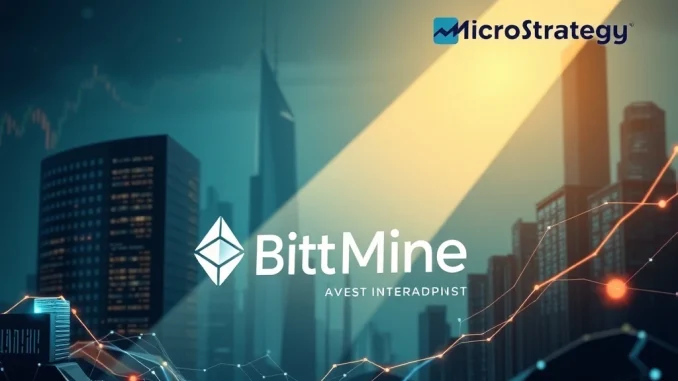
Are you ready for a seismic shift in institutional crypto adoption? While MicroStrategy (MSTR) has long dominated headlines as the quintessential “Bitcoin stock,” a new contender is emerging that could redefine corporate treasuries for the Ethereum era: BitMine Immersion Technologies (BMNR). For retail investors crypto, this isn’t just another fleeting trend; it could be a high-conviction opportunity to get ahead of the curve in a rapidly evolving financial landscape.
BitMine: Pioneering the Ethereum Treasury Model
In the summer of 2025, the financial world is witnessing a fascinating evolution. BitMine Immersion Technologies (BMNR) is boldly positioning itself as the Ethereum analog to MicroStrategy’s Bitcoin strategy. But what makes BitMine so compelling? It’s their audacious bet on Ethereum’s future, backed by significant institutional confidence.
Consider this:
- Strategic Stake: Billionaire Peter Thiel, through his venture capital firm Founders Fund, holds a substantial 9.1% stake in BMNR. This isn’t just a vote of confidence; it’s a strategic alignment with one of the most influential figures in tech and finance.
- Ambitious Goal: BitMine’s strategy is clear and ambitious: acquire 5% of the total ETH supply. This positions them as a major player in the Ethereum ecosystem, leveraging its growth and utility.
- Current Holdings: As of July 17, 2025, BitMine holds an impressive 300,657 ETH, valued at over $1 billion. This represents a staggering 300% increase from its $250 million private placement in June, showcasing rapid appreciation.
- Dual-Income Model: Unlike pure speculation, BitMine generates recurring returns through a sophisticated dual-income model: Ethereum staking (offering a 4–5% annual yield) and DeFi liquidity provision. This means their holdings are not only appreciating but also actively producing income.
The MicroStrategy Ethereum Playbook: A Deeper Dive
MicroStrategy’s success story is well-known. Their thesis was simple yet revolutionary: transform corporate treasuries into Bitcoin reserves. By accumulating a massive 607,770 BTC at an average cost of $71,756, the company effectively turned its balance sheet into a leveraged Bitcoin investment vehicle. The result? A staggering 650% surge in its stock price in 2025, turning MSTR into a proxy for Bitcoin exposure.
Now, imagine that playbook applied to Ethereum. That’s precisely what BitMine is doing. Ethereum is no longer just a cryptocurrency; it’s the foundational layer for a sprawling digital economy, including the rapidly expanding $251 billion stablecoin ecosystem. BitMine isn’t just buying ETH; it’s embedding itself within the network’s core functions, aiming to capture value from its growth and utility.
Peter Thiel’s Strategic Bet and Macroeconomic Tailwinds
Why is Peter Thiel investment in BitMine so significant? It’s more than just an endorsement; it’s a strategic move aligning with his broader vision for the future of finance. Founders Fund’s stake in BMNR complements Thiel’s other ventures, such as Bullish (a crypto exchange going public as BLSH) and his early investments in Ethereum dating back to 2023. This demonstrates a consistent, high-conviction belief in the long-term value of the Ethereum network.
The macroeconomic context further amplifies Ethereum’s appeal. With global government debt-to-GDP ratios projected to reach nearly 95% by year-end 2025, investors are actively seeking non-sovereign assets to hedge against systemic risk and inflation. Ethereum’s inherent structural scarcity, bolstered by post-Shanghai staking mechanisms and continuous transaction fee burns, positions it as a compelling store of value, arguably even superior to Bitcoin in certain aspects due to its productive yield and deflationary pressures.
Furthermore, legislative developments like the U.S. Senate’s GENIUS Act, aimed at regulating stablecoins, could accelerate Ethereum’s adoption. As stablecoins gain regulatory clarity, their reliance on robust, decentralized, and scalable blockchains like Ethereum will only grow, cementing ETH’s role as the backbone of this critical financial infrastructure.
Why BitMine’s Ethereum Treasury Model Stands Out
While MicroStrategy’s Bitcoin strategy is largely a bet on pure price appreciation, BitMine’s Ethereum treasury model offers a distinct advantage: recurring yield generation. Let’s break down the key differences:
| Feature | MicroStrategy (Bitcoin) | BitMine (Ethereum) |
|---|---|---|
| Primary Value Driver | Bitcoin price appreciation | Ethereum price appreciation + Yield generation |
| Income Stream | Minimal (pure holding) | Staking (4-5% annual yield) + DeFi liquidity |
| Balance Sheet Role | Leveraged Bitcoin investment vehicle | Self-sustaining, yield-generating crypto treasury |
| Network Engagement | Holding only | Active participation (staking, DeFi) |
With 36 million ETH currently staked (representing 30% of the circulating supply), BitMine’s holdings are not only poised for capital gains but are also producing a consistent income stream. This dual benefit creates a powerful, self-sustaining flywheel that sets it apart from MicroStrategy’s more speculative model.
Moreover, concerns about dilution risks for BitMine are largely offset by Ethereum’s robust growth trajectory. Despite a 13-fold share increase post-PIPE (Private Investment in Public Equity), the company’s “Ethereum-per-share” metric continues to rise, mirroring MicroStrategy’s successful “Bitcoin per share” strategy. For example, BitMine’s 60,000 ETH in in-the-money options, backed by $200 million in unencumbered cash, significantly enhances its capital efficiency and provides a valuable layer of downside protection.
Opportunities for Retail Investors Crypto: Act Now?
Every high-conviction opportunity comes with its share of risks, and BitMine is no exception. Its current financials show volatility: a negative P/E ratio of -23.56, a price-to-sales ratio of 46.59, and a current ratio of 0.41, which could signal liquidity challenges. However, for investors with a strong belief in the underlying asset, these metrics are often secondary to the overarching Ethereum thesis.
If Ethereum continues its impressive 7% daily rally, potentially reaching $3,461.89 in July 2025 as projected, BitMine’s treasury could realistically double in value by year-end. This potential for rapid appreciation is precisely why the article suggests that retail investors crypto should consider acting now, before broader institutional inflows might drive up the stock’s valuation to new heights.
The company’s NYSE options trading launch on July 23, 2025, is another significant development. This will further amplify liquidity, making it easier for investors to hedge their positions or leverage their exposure to BitMine and, by extension, Ethereum’s growth.
Conclusion: A High-Conviction Play on Ethereum’s Future
BitMine’s pioneering Ethereum treasury strategy represents a fundamental reinvention of corporate treasuries in the burgeoning crypto era. With the strategic backing of Peter Thiel, a clear and compelling yield-generating model, and significant macroeconomic tailwinds favoring decentralized assets, BitMine is firmly positioning itself as the MicroStrategy of Ethereum. For investors comfortable with the inherent volatility of the crypto market, this presents a rare chance to own a piece of a company that could very well redefine institutional crypto adoption and unlock substantial value. The window for early entry may be closing, so understanding this opportunity now is paramount.
Frequently Asked Questions (FAQs)
Q1: What is BitMine Immersion Technologies (BMNR)?
A1: BitMine Immersion Technologies (BMNR) is a company that is building a significant treasury of Ethereum (ETH), aiming to become the “MicroStrategy of Ethereum.” It leverages ETH holdings through staking and DeFi to generate yield, alongside benefiting from Ethereum’s price appreciation.
Q2: How does BitMine’s strategy compare to MicroStrategy’s Bitcoin strategy?
A2: While both companies accumulate significant crypto assets on their balance sheets, BitMine’s Ethereum strategy differs by generating recurring yield through ETH staking and DeFi liquidity provision. MicroStrategy’s Bitcoin strategy primarily relies on the appreciation of Bitcoin’s price alone.
Q3: What is Peter Thiel’s involvement with BitMine?
A3: Peter Thiel, through his venture capital firm Founders Fund, holds a 9.1% stake in BitMine. This investment signifies a strong vote of confidence and aligns with Thiel’s broader portfolio and long-term bullish view on the crypto space, particularly Ethereum.
Q4: What are the main risks associated with investing in BitMine?
A4: BitMine faces risks typical of growth-stage companies in volatile sectors, including a negative P/E ratio, high price-to-sales ratio, and a low current ratio, which indicate financial volatility and potential liquidity challenges. Its performance is also highly dependent on Ethereum’s price movements.
Q5: Why is the article suggesting retail investors should “act now”?
A5: The article suggests acting now to potentially capitalize on BitMine’s valuation before significant institutional inflows might drive up the stock price. The impending NYSE options trading launch is also cited as a factor that will increase liquidity and market attention.
Q6: How does Ethereum’s macroeconomic context benefit BitMine?
A6: Ethereum benefits from a macroeconomic environment characterized by high global government debt, pushing investors to seek non-sovereign assets. Ethereum’s structural scarcity (via staking and fee burns) and its role as the backbone for stablecoins (potentially bolstered by legislation like the GENIUS Act) position it as a strong hedge against systemic risk, directly benefiting BitMine’s ETH treasury.