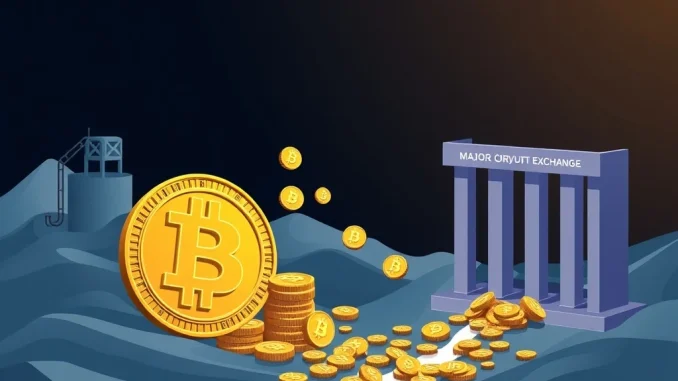
A significant development recently captured the attention of the cryptocurrency market. Specifically, a substantial Bitcoin transfer involving 1,848 BTC occurred, moving from Antpool, one of the largest Bitcoin mining pools, to Binance, a leading global cryptocurrency exchange. This single transaction, valued at approximately $224 million at the time of the transfer, immediately sparked discussions among analysts and investors. Such a large BTC movement often indicates strategic shifts by major holders, commonly known as ‘whales,’ and can carry implications for market dynamics.
Unpacking the Latest Bitcoin Transfer
On-chain data provided by Whale Alert, a prominent cryptocurrency tracking service, confirmed the considerable Bitcoin transfer. The alert detailed the movement of 1,848 BTC from a wallet associated with Antpool directly to a wallet on the Binance exchange. This substantial amount represents a significant portion of capital, drawing immediate scrutiny from market participants. Consequently, observers are now analyzing the potential reasons behind such a large-scale transfer and its broader impact on the crypto ecosystem.
Furthermore, the sheer size of this particular transaction highlights the ongoing activity within the digital asset space. Valued at hundreds of millions of dollars, it underscores the substantial capital flows that characterize the Bitcoin market. These movements are continuously monitored by various platforms and analysts to gain insights into market sentiment and potential future price action. Therefore, understanding the entities involved in such transfers becomes crucial for market interpretation.
Understanding Antpool: A Key Player in Mining
Antpool stands as one of the most prominent Bitcoin mining pools globally. Mining pools combine the computational power of many individual miners to increase their chances of solving blocks and earning block rewards. Subsequently, these rewards are then distributed among the pool participants based on their contributed hash power. Antpool has consistently maintained a significant share of the total Bitcoin network hash rate, making it a crucial entity in the blockchain’s security and operation.
For instance, large amounts of BTC accumulate in mining pool wallets as a result of successful block discoveries. Transfers from these wallets, like the one to Binance, can represent various operational activities. These might include distributing payouts to miners, rebalancing internal funds, or preparing for over-the-counter (OTC) sales. Knowing that a large Bitcoin transfer originated from a mining pool provides context for its potential purpose. Mining pools are vital for the decentralized nature of Bitcoin, and their movements are closely watched.
Binance: A Global Hub for Cryptocurrency Trading
Binance is currently the world’s largest cryptocurrency exchange by trading volume. It offers a vast array of digital assets for trading, along with various financial services like staking, lending, and derivatives. As a central liquidity hub, Binance facilitates billions of dollars in transactions daily. Consequently, any large influx of Bitcoin into its wallets often raises questions about potential selling pressure or increased market liquidity.
Moreover, exchanges like Binance serve as critical gateways between the fiat and cryptocurrency worlds. They enable users to buy, sell, and trade digital assets efficiently. When a large BTC movement arrives on such an exchange, it could signal an intent to sell on the open market, or perhaps to utilize other services offered by the platform. The destination of a whale transaction, particularly a major exchange, is therefore a key piece of information for market analysts.
The Significance of a Whale Transaction
A whale transaction refers to the movement of a large amount of cryptocurrency by a single entity or a group of associated entities. These movements are significant because they can influence market sentiment and potentially impact price. When a substantial amount of Bitcoin moves to an exchange, it generally suggests an increased supply available for sale, which could, in theory, lead to downward price pressure if the BTC is indeed sold. Conversely, a large withdrawal from an exchange might signal an intention to hold or move assets into cold storage.
Therefore, tracking these large movements provides valuable insights. Market participants often interpret such transfers as indicators of a ‘whale’s’ immediate intentions. For example, the transfer of 1,848 BTC to Binance is a classic example of a significant whale transaction that warrants attention. Analysts consider factors like the origin, destination, and timing of these transfers to deduce their likely impact on market dynamics.
Potential Market Implications of a Large BTC Movement
The transfer of 1,848 BTC to Binance carries several potential market implications. Firstly, it could signal an impending sale. If Antpool or its associated entities intend to sell a portion of these Bitcoin holdings, it would increase the available supply on the exchange. This increased supply, if met with insufficient demand, could potentially lead to a price correction. Secondly, the transfer might be for operational purposes, such as converting BTC into other cryptocurrencies or fiat to cover operational costs or distribute profits. This is common for mining operations.
Furthermore, such a substantial large BTC movement can influence market sentiment. Traders and investors closely watch these transfers for clues about institutional or large-holder activity. A sudden influx of Bitcoin onto an exchange can sometimes trigger a speculative sell-off as others anticipate downward pressure. However, it is also important to note that not all transfers to exchanges result in immediate sales. Some might be for liquidity provision, derivative trading, or even security rebalancing.
Analyzing Whale Activity and Market Sentiment
Whale activity, encompassing large Bitcoin transfer events, is a critical component of on-chain analysis. These movements often precede significant price swings or indicate shifts in market sentiment. Analysts utilize various tools and metrics to track these large transactions, aiming to anticipate market trends. Understanding the patterns of whale behavior can provide a distinct advantage in navigating the volatile cryptocurrency markets.
Moreover, the transparency of blockchain technology allows for this level of scrutiny. Every transaction is recorded on a public ledger, enabling services like Whale Alert to track and report these movements. Consequently, this transparency empowers market participants with more information, albeit with the caveat that the true intent behind a large BTC movement is not always immediately clear. Nevertheless, the mere presence of such activity shapes market psychology.
Historical Context of Bitcoin Transfers
Large Bitcoin transfers are not new phenomena in the cryptocurrency space. Historically, similar substantial movements have occurred, sometimes preceding significant market events. For instance, large transfers from mining pools or early adopters to exchanges have often been a precursor to periods of increased volatility. However, not all large transfers lead to dramatic price changes. The market has matured significantly, and its capacity to absorb large orders has increased.
Therefore, while a whale transaction of this magnitude is noteworthy, it must be viewed within the broader context of market liquidity and overall demand. The market’s reaction to a Bitcoin transfer of this size depends heavily on prevailing sentiment, macroeconomic factors, and the overall health of the crypto ecosystem. Each large movement adds to the ongoing narrative of Bitcoin’s price discovery and adoption.
Monitoring On-Chain Data for Insights
The ability to monitor on-chain data provides unparalleled transparency in the cryptocurrency market. Services like Whale Alert provide real-time updates on significant transactions, including this recent large BTC movement. This data allows investors to make more informed decisions, moving beyond mere price charts to understand the underlying flow of assets. On-chain metrics track everything from transaction volume to active addresses, offering a holistic view of network health and activity.
Ultimately, while a single Bitcoin transfer may not dictate the entire market, it serves as a valuable data point. It contributes to the mosaic of information that analysts use to forecast potential market shifts. Investors and traders often integrate this on-chain intelligence into their broader strategies, looking for confluence with technical analysis and fundamental factors.
The recent transfer of 1,848 BTC from Antpool to Binance represents a significant event in the cryptocurrency landscape. Such a substantial Bitcoin transfer naturally draws attention, given its potential implications for market liquidity and sentiment. While the precise intent behind this whale transaction remains speculative, its occurrence underscores the dynamic nature of the digital asset market. As the crypto ecosystem continues to evolve, monitoring these large BTC movements from key entities like Antpool to major exchanges like Binance will remain crucial for understanding market dynamics and potential future trends. These on-chain signals provide valuable, albeit often complex, insights into the behavior of major market participants.
Frequently Asked Questions (FAQs)
Q1: What is the significance of a Bitcoin transfer from Antpool to Binance?
A Bitcoin transfer from a major mining pool like Antpool to a large exchange like Binance is significant because it often indicates a potential increase in sell-side liquidity. Mining pools accumulate large amounts of BTC, and moving them to an exchange could mean they are preparing to sell, distribute profits, or rebalance funds. It is considered a whale transaction due to its large size.
Q2: What is Antpool, and why does it hold so much Bitcoin?
Antpool is one of the world’s largest Bitcoin mining pools. It combines the computing power of many individual miners to collectively mine Bitcoin blocks. When Antpool successfully mines a block, it receives the block reward (newly minted BTC plus transaction fees), which then accumulates in its wallets before being distributed to participants or used for operational purposes. This is why it holds large amounts of Bitcoin.
Q3: How does a large BTC movement affect the market?
A large BTC movement, especially to an exchange, can influence market sentiment. It might signal an increased supply available for sale, potentially leading to downward price pressure if demand does not match. However, it could also be for operational reasons, such as converting BTC to other assets or using exchange services, without immediate intent to sell on the open market. Analysts closely monitor these movements for clues about market direction.
Q4: What is a ‘whale transaction’ in cryptocurrency?
A ‘whale transaction‘ refers to the movement of a very large amount of cryptocurrency by a single individual or entity, known as a ‘whale.’ These transactions are significant because they have the potential to impact market prices due to their sheer volume. The recent transfer of 1,848 BTC is a prime example of such a transaction.
Q5: Is every large Bitcoin transfer to an exchange a sign of selling?
Not necessarily. While a large Bitcoin transfer to an exchange often raises speculation about selling, it can also be for various other reasons. These include moving funds for trading derivatives, providing liquidity, converting to other cryptocurrencies, using staking or lending services, or even rebalancing security holdings. Therefore, it is important to consider multiple factors before concluding the intent behind a large BTC movement.