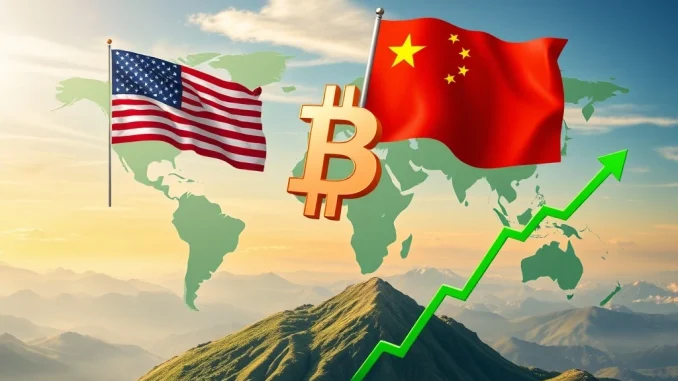
In the dynamic world of cryptocurrency, sudden shifts are common, but few capture attention like a massive rally fueled by global economic news. Recently, Bitcoin delivered a powerful performance, surging past a significant milestone. This dramatic rise wasn’t just a random fluctuation; it was intricately linked to a crucial development on the international stage: an extended US-China trade tariff truce.
The Pivotal US-China Trade Truce: A Market Catalyst
The global financial landscape is highly sensitive to geopolitical tensions, and few relationships are as impactful as that between the United States and China. News of a 90-day extension to their trade tariff truce in early July 2025 sent ripples of relief across markets, directly influencing the recent Bitcoin surge. This temporary ceasefire, while confirmed through informal channels rather than official government statements, temporarily quelled fears of escalating trade wars that have long loomed over global commerce.
- De-escalation Signal: The truce signaled a tactical pause in a months-long standoff, fostering a ‘risk-on’ sentiment among investors.
- High-Level Discussions: Negotiations reportedly took place in Stockholm, Sweden, involving key figures like U.S. Treasury Secretary Scott Bessent and Chinese Vice Premier He Lifeng.
- Tariff Considerations: Reports suggested potential tariff reductions, including China’s consideration to suspend a 125% tariff on certain U.S. imports, further easing tensions.
Understanding the Bitcoin Surge: Why $123,205?
Following the trade truce news, Bitcoin’s price soared past $123,205, marking a remarkable 7.13% increase and a significant rebound from its dip below $115,000 just days prior. This impressive rally underscores Bitcoin’s growing sensitivity to macro-economic and geopolitical developments. While traditional markets like equities also saw gains, the cryptocurrency’s performance highlighted its evolving role.
Analysts largely attributed this rally to speculative positioning by investors anticipating positive market reactions to the extended truce. Despite an absence of direct comments from major crypto figures, the broader crypto market interpreted the news as a clear positive for digital assets, leading to simultaneous gains for both Bitcoin and Ethereum. However, initial surges were tempered by profit-taking, as some capital flowed back into traditional assets, indicating a cautious optimism rather than an unbridled bull run.
Bitcoin’s Role in Geopolitical Stability
The recent price action reinforces Bitcoin’s burgeoning reputation as a hedge against geopolitical instability. In an era of unpredictable trade policies and global economic uncertainty, assets perceived as stores of value often gain traction. Michael Saylor, CEO of MicroStrategy, a prominent Bitcoin holder, reiterated his firm’s accumulation strategy, emphasizing Bitcoin’s resilience amidst fluctuating trade relations.
This event highlights how global supply chains and international trade directly impact the valuation of decentralized assets. For instance, China’s rare-earth magnet exports reportedly surged by 158% in the wake of the truce, demonstrating the immediate economic benefits that can translate into positive sentiment for risk assets like Bitcoin, which thrive on perceived stability and economic growth.
Navigating the Crypto Market: Lingering Uncertainties
While the 90-day truce provided much-needed short-term relief, experts caution against viewing it as a definitive resolution. As one analyst noted, “This is a tactical pause, not a structural shift.” Unresolved disputes over tech trade controls and intellectual property rights continue to cast a shadow, suggesting that volatility may return once the 90-day period concludes if a permanent resolution isn’t reached.
Moreover, the broader economic environment remains complex. Factors such as former President Trump’s proposed 50% tariffs on EU imports and ongoing U.S. discussions with Brazil and Japan add layers of global trade complexity. Domestically, the U.S. Federal Reserve’s upcoming policy decisions on inflation and interest rates will also play a crucial role in shaping Bitcoin’s trajectory and the overall crypto market sentiment.
The Future of Digital Assets Amid Global Tensions
Bitcoin’s performance during this period underscores the interconnectedness of trade negotiations and the valuation of digital assets. As the 90-day truce progresses, stakeholders across financial markets will be closely monitoring for signs of renewed tensions or progress towards a lasting agreement. A failure to formalize a permanent resolution could quickly reignite volatility across trade-related assets and the broader financial landscape.
For now, Bitcoin’s impressive rally serves as a powerful barometer for global economic sentiment, reaffirming its evolving and increasingly significant role in a world grappling with geopolitical complexities. Its ability to react sharply to international news solidifies its position as an asset that savvy investors watch not just for technological innovation, but also for its sensitivity to the global pulse.
Frequently Asked Questions (FAQs)
Q1: What caused the recent Bitcoin surge to $123,205?
The primary catalyst for the recent Bitcoin surge was the reported 90-day extension of the US-China trade tariff truce. This news alleviated fears of escalating global trade tensions, spurring a ‘risk-on’ sentiment across financial markets, including cryptocurrencies.
Q2: How does the US-China trade truce impact the crypto market?
The trade truce reduces geopolitical uncertainty, which often encourages investors to take on more risk. For the crypto market, this translates into increased investment and positive price action for assets like Bitcoin and Ethereum, as they are sometimes viewed as hedges against traditional market instability or beneficiaries of improved global economic outlooks.
Q3: Is Bitcoin truly a hedge against geopolitical instability?
Many analysts and prominent figures, like MicroStrategy CEO Michael Saylor, view Bitcoin as a store of value that can act as a hedge against unpredictable trade policies and geopolitical instability. Its decentralized nature and limited supply contribute to this perception, making it an attractive asset during times of global uncertainty.
Q4: What are the lingering uncertainties despite the trade truce?
Despite the 90-day truce, analysts caution that it is a tactical pause, not a structural resolution. Unresolved issues like tech trade controls and intellectual property disputes remain. Additionally, other global trade tensions (e.g., US-EU tariffs) and upcoming Federal Reserve policy decisions on inflation and interest rates could still influence Bitcoin’s trajectory.
Q5: How significant is Bitcoin’s role as a barometer for global economic sentiment?
Bitcoin’s rapid response to the US-China trade truce highlights its growing significance as a barometer for global economic sentiment. Its price movements are increasingly reflecting broader geopolitical and macroeconomic developments, making it an important indicator for investors monitoring the health and direction of the global economy.