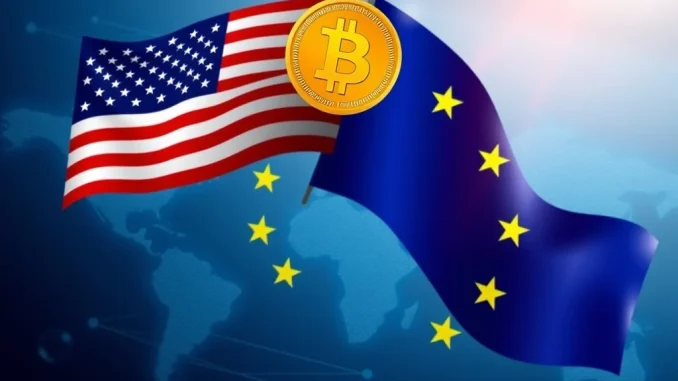
The financial world is abuzz with news of the monumental $1.35 trillion US-EU trade deal, announced on July 27, 2025. This isn’t just another trade agreement; it’s a pivotal moment poised to reshape global markets, reduce macroeconomic risks, and, perhaps surprisingly, provide a significant boost to the Bitcoin outlook. For anyone invested in the future of digital assets, understanding the nuances of this agreement is crucial.
Unpacking the US-EU Trade Deal: A New Era for Global Commerce
Imagine a world with fewer trade skirmishes and more predictable economic pathways. That’s the promise of the recent US-EU trade deal. By standardizing tariffs at a uniform 15% for traded goods, this agreement aims to simplify cross-border commerce and foster greater market stability between two of the world’s largest economic blocs. But the deal goes beyond just tariffs:
- Significant Investments: The EU has committed to $750 billion in US energy purchases.
- Economic Stimulus: An additional $600 billion in American economic investments is on the table, including military equipment acquisitions.
These measures are designed to curb geopolitical uncertainties and foster a more stable trading environment. This strategic realignment could significantly reduce trade tensions and macroeconomic volatility, setting the stage for broader market confidence.
How the Deal Cuts Risks and Boosts Bitcoin Outlook
When global markets become more stable, what happens to assets typically considered ‘risky’? Experts suggest they benefit. Thomas Lee of Fundstrat Global Advisors highlighted that removing ‘tail risks’ (unforeseen, high-impact events) typically benefits equities and Bitcoin alike. Bitcoin, increasingly viewed as a hybrid asset bridging traditional risk and hedging characteristics, stands to gain as institutional capital seeks less volatile avenues for growth.
The deal’s uniform tariff structure replaces fragmented rates, fostering market predictability. This shift is expected to bolster investor confidence, particularly as institutional investors increasingly allocate capital to Bitcoin in response to improved risk sentiment. A more predictable global economy reduces the need for extreme risk-off positioning, making assets like Bitcoin more attractive for long-term allocation.
The Ripple Effect: Broader Global Tariffs and Crypto Market Impact
While the US-EU deal brings stability, it also triggers simultaneous tariff adjustments in other regions, creating a complex, evolving landscape:
- Increased Tariffs: Canada (35%), Mexico (30%), and Brazil (50%) will face higher tariffs effective August 1.
- Temporary Pause: The US and China have agreed to a 90-day tariff pause, offering a brief reprieve in their trade relations.
These changes may redirect capital flows. Higher tariffs in key regions could heighten market uncertainty for traditional businesses operating there, potentially driving investors toward risk-on assets like cryptocurrencies. The evolving tariff landscape underscores Bitcoin’s role as a hedge against unpredictable global trade dynamics, especially as institutional adoption continues to grow. This intricate web of global tariffs has a direct crypto market impact, influencing where capital flows and how investors perceive value.
Why Institutional Bitcoin Adoption is Key
Bitcoin’s price performance, reported at $119,060 with a modest 0.78% 24-hour increase post-announcement, reflects improved market sentiment. While the direct correlation remains speculative, the cryptocurrency’s integration into institutional portfolios amplifies its sensitivity to macroeconomic catalysts. This makes Bitcoin a potential beneficiary of the US-EU agreement’s risk-reduction framework.
The consistent tariffs and large-scale investments fostered by the deal create a more predictable trading environment, which is critical for institutional Bitcoin adoption. Bitcoin thrives in low-risk climates where large-scale institutional participation can accelerate. As capital reallocations unfold, particularly in response to tariff hikes in Canada, Mexico, and Brazil, Bitcoin’s appeal as a store of value and medium of exchange may strengthen. Institutions, seeking diversification and alternative stores of value in a world with shifting trade dynamics, may increasingly look to Bitcoin.
Navigating the Future: What This Means for Bitcoin and Beyond
The US-EU trade deal marks a significant step toward easing trade tensions and fostering global economic stability. For Bitcoin, this means a potentially more favorable environment for growth and wider acceptance. The agreement’s success in redirecting capital flows and reinforcing Bitcoin’s hybrid asset status remains a key focus for observers monitoring cryptocurrency adoption and macroeconomic trends.
While the immediate gains for Bitcoin have been modest, the long-term implications are profound. A more stable global economy reduces the perceived volatility of digital assets, making them more attractive for long-term holding and integration into diverse portfolios. As institutions adapt to the new tariff regime and continue to explore the digital asset space, Bitcoin’s journey toward mainstream financial integration appears to be on a more solid footing.
Frequently Asked Questions (FAQs)
Q1: How does the US-EU trade deal directly benefit Bitcoin?
While not a direct benefit, the deal indirectly supports Bitcoin by reducing overall macroeconomic risks and fostering greater global market stability. This predictability makes risk assets, including Bitcoin, more attractive to institutional investors seeking less volatile environments for capital allocation.
Q2: What are the key financial components of the US-EU trade deal?
The deal standardizes tariffs at 15% for traded goods. It also includes commitments for $750 billion in US energy purchases by the EU and $600 billion in American economic investments, including military equipment.
Q3: How do the new tariffs on Canada, Mexico, and Brazil affect Bitcoin?
Increased tariffs in these regions (35% for Canada, 30% for Mexico, 50% for Brazil) could introduce uncertainty in those markets. This uncertainty might prompt investors to redirect capital towards alternative assets, including cryptocurrencies like Bitcoin, which are increasingly seen as hedges against traditional market volatility.
Q4: Why is institutional adoption important for Bitcoin’s growth in this new environment?
Institutional adoption is crucial because it brings significant capital and legitimacy to the cryptocurrency market. A more stable global trade environment, as created by the US-EU deal, reduces the perceived risk of Bitcoin, making it more appealing for large institutional investors to include in their portfolios, thus driving its price and mainstream acceptance.
Q5: Is Bitcoin now considered a ‘safe-haven’ asset due to this deal?
The deal reinforces Bitcoin’s evolving role as a ‘hybrid asset’ – one that combines characteristics of both traditional risk assets and potential hedges. While it’s not a traditional safe-haven like gold, reduced global uncertainty can make it a more appealing store of value for investors looking beyond conventional markets.