The cryptocurrency world just witnessed a significant shake-up! Following the unexpected extension of **US-China tariff talks**, Bitcoin soared, leaving investors buzzing. But while the leading digital asset enjoyed a substantial rally, what does this prolonged geopolitical drama mean for the broader **crypto market reaction**, especially for assets like **XRP**? Let’s dive into the details of this pivotal development and its ripple effects across the digital asset landscape.
Bitcoin’s Remarkable Price Surge: A Sign of Relief?
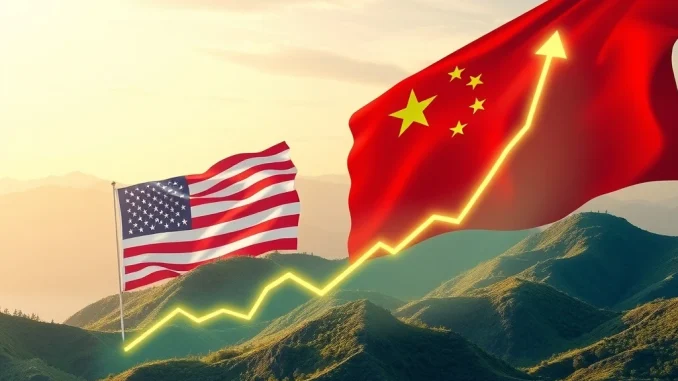
In a move that sent immediate waves through financial markets, the United States and China have extended their crucial tariff negotiations by three months, pushing the new deadline to November 12, 2025. This decision, announced after weeks of intense speculation about potential tariff hikes, triggered an immediate and significant **Bitcoin Price Surge**. The flagship cryptocurrency rocketed to a daily high of $118,571, reflecting a robust 6% gain. This jump signals investor relief over the temporary avoidance of steep tariffs that could have severely impacted global trade and economic stability.
Many analysts view Bitcoin’s swift response as further evidence of its evolving role as a macroeconomic hedge. In times of global economic uncertainty or geopolitical tension, investors often seek safe-haven assets. While traditional safe havens like gold have their place, Bitcoin’s decentralized nature and limited supply make it an increasingly attractive alternative. The temporary resolution of the tariff standoff allowed markets to recalibrate risk assessments, leading to this notable **Bitcoin Price Surge**.
Unpacking the Extended US-China Tariff Talks
The extension of the **US-China tariff talks** suggests that both economic superpowers prioritize continued dialogue over abrupt trade policy shifts, despite deep-seated structural disagreements that remain unresolved. Initially, the U.S. had threatened tariffs as high as 145% on Chinese imports and 125% on U.S. goods if an agreement wasn’t reached. The postponement of these measures reduces short-term uncertainty, providing a much-needed breathing room for global supply chains and businesses.
This strategic move aligns with past approaches by U.S. President Donald Trump, who has often used tariffs as leverage in negotiations while seeking compromises. For example, Trump previously scaled back planned 30% tariffs on EU imports to 15% after intense discussions. However, concrete progress with China remains elusive, raising concerns about broader trade disruptions as other August 1 deadlines for various trade measures approach. The ongoing **US-China tariff talks** represent a complex dance of economic and political maneuvering.
Diverse Crypto Market Reaction: Beyond Bitcoin’s Rally
While Bitcoin’s impressive 6% gain dominated headlines, the broader **crypto market reaction** was more nuanced. Ethereum (ETH) and BNB Coin (BNB) stabilized near key price levels, indicating a cautious optimism rather than an outright euphoria. This suggests that while the market appreciated the temporary relief, a sense of underlying fragility persists. Analysts caution that the rally might be short-lived, emphasizing that unresolved U.S.-China tensions could trigger renewed volatility at any moment.
One expert observed that the market is currently pricing in temporary relief, but underscored the lingering long-term uncertainty that continues to hang over global trade. Meanwhile, the response from XRP and other altcoins has been notably muted. This underscores a divergent investor sentiment, where certain assets like Bitcoin are seen as more direct beneficiaries or hedges against macroeconomic shifts, while others may be more influenced by their own ecosystem developments or specific regulatory clarity. The overall **crypto market reaction** highlights the sector’s increasing sensitivity to global economic and political developments.
What’s the Outlook for XRP Price Amidst Trade Tensions?
The muted reaction of XRP to the extended tariff talks raises questions about the immediate **XRP Price Outlook** in the face of such macroeconomic news. Unlike Bitcoin, which often reacts as a macro asset, XRP’s price movements are frequently influenced by different factors, including:
- Regulatory Clarity: Ongoing legal developments, particularly the SEC lawsuit in the U.S., remain a significant determinant for XRP’s trajectory.
- Utility and Adoption: Progress in Ripple’s enterprise solutions, partnerships, and cross-border payment initiatives play a crucial role.
- Broader Altcoin Sentiment: XRP often moves in tandem with the overall altcoin market, which can lag behind Bitcoin’s surges.
While the tariff extension offers temporary relief to the global economy, its direct impact on the **XRP Price Outlook** appears limited for now. Investors interested in XRP might need to look beyond immediate macroeconomic headlines and focus on the asset’s specific fundamentals and regulatory environment. Diversification and careful risk assessment remain paramount, especially given the varying sensitivities of different cryptocurrencies to external factors.
Navigating Global Trade Uncertainty: Broader Implications
The prolonged **Global Trade Uncertainty** stemming from these negotiations has broader economic implications that could indirectly affect crypto markets. Research suggests that baseline 15% tariffs, combined with targeted measures, could push U.S. consumer prices up by 2% over two years. Such inflationary pressures might influence central bank policies, potentially leading to interest rate hikes or tighter liquidity, which could in turn affect crypto valuations.
Geopolitical dynamics further complicate the outlook. While the U.S. aims to bolster domestic industries through trade agreements—such as Japan’s $550 billion investment to lower tariffs—China’s focus on decoupling from Western supply chains persists. Workarounds, like increased U.S. LNG purchases by China to avoid tariffs, may mitigate immediate impacts but fail to address the core disputes. This stalemate reflects a strategic tug-of-war where political posturing often overshadows practical compromises, contributing to ongoing **Global Trade Uncertainty**.
For investors, the extended timeline offers a window to monitor developments but also introduces new layers of uncertainty. Crypto markets, historically sensitive to macroeconomic shifts, may face renewed volatility if negotiations stall or if new trade barriers emerge. However, the sector’s performance will ultimately depend on a confluence of broader factors, including central bank policies, global risk appetite, and technological advancements, rather than tariffs alone. Analysts advise diversification and caution, given the fragile status quo and the complex interplay of forces shaping both traditional and digital economies.
Frequently Asked Questions (FAQs)
Q1: Why did Bitcoin jump after the US-China tariff extension?
Bitcoin jumped because the extension of tariff negotiations reduced immediate economic uncertainty. Investors perceived this as a temporary relief, leading to a surge in Bitcoin’s price as it often acts as a hedge against macroeconomic instability.
Q2: How did XRP and other altcoins react to the news?
While Bitcoin saw a significant surge, XRP and many other altcoins showed a muted or stabilized reaction. This indicates divergent investor sentiment, where Bitcoin is seen as more sensitive to broad macroeconomic news, while altcoins may be influenced more by their specific use cases or regulatory developments.
Q3: What is the new deadline for the US-China tariff negotiations?
The U.S. and China have extended their tariff negotiations by three months, setting a new deadline of November 12, 2025.
Q4: How might prolonged tariff talks affect the broader crypto market?
Prolonged tariff talks can create ongoing global trade uncertainty, potentially leading to inflationary pressures or shifts in central bank policies. These macroeconomic factors can indirectly influence crypto markets by affecting liquidity, investor sentiment, and overall risk appetite, leading to increased volatility.
Q5: Is Bitcoin a reliable hedge against global economic uncertainty?
Bitcoin has increasingly demonstrated its role as a macroeconomic hedge, with its price often reacting to global economic and geopolitical events. Its decentralized nature and limited supply make it an attractive asset for some investors seeking an alternative to traditional safe havens during times of uncertainty.
Q6: What are the broader economic implications of these tariff talks?
The broader economic implications include potential increases in consumer prices due to tariffs, shifts in global supply chains as countries seek to decouple, and ongoing geopolitical tensions that prioritize strategic positioning over immediate trade compromises. These factors can create a complex environment for global markets.